

The Wealth Gap: Why Some Have So Much More

- Published By: Tech Team
- April 16, 2026 / 11:22 AM IST


A look at how wealth is distributed across American households — and what those numbers really mean for all of us:
Not everyone in America has the same amount of money saved up. In fact, the difference between the richest and the rest is so large it is almost hard to imagine. This gap — called wealth inequality — is one of the biggest economic issues in the country today. Understanding it helps us make sense of the world around us.
What Is Wealth?
Wealth is not the same as income. Income is the money we earn each month from a job. Wealth is everything we own minus everything we owe. It includes savings, a home, investments, and retirement accounts, minus any debts like loans or credit cards. Wealth is what gives families a financial safety net — the ability to handle an emergency, pay for college, or retire comfortably.
What Does the Data Show?
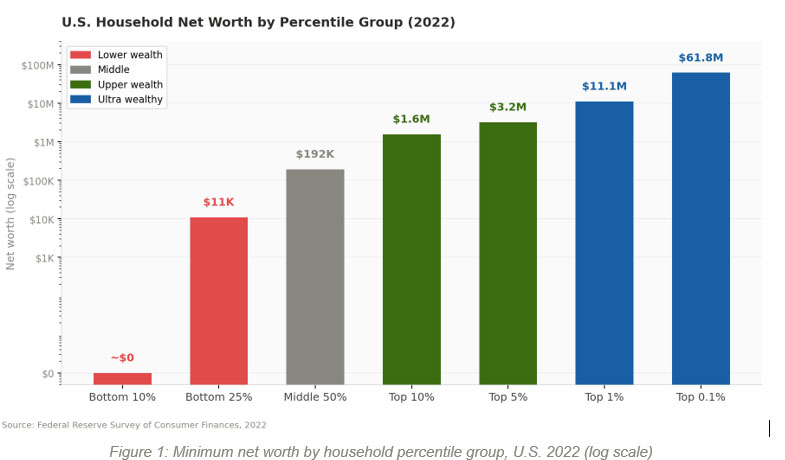
The chart below uses data from the Federal Reserve’s 2022 Survey of Consumer Finances, the most detailed snapshot of American household wealth available. It shows the minimum net worth needed to belong to each group — from the bottom 10% all the way up to the top 0.1%.
Why Does the Gap Exist?
Wealth tends to grow on its own. When someone owns stocks, real estate, or a business, those assets increase in value over time. The more wealth a person already has, the faster it grows. Meanwhile, someone with no savings has no assets to grow. This is sometimes called the wealth snowball effect — it keeps rolling and getting bigger for those already at the top.
Why Does This Matter to Us?
Wealth inequality affects real opportunities in life. It shapes whether a family can afford college without debt, recover from a medical emergency, or buy a home in a safe neighborhood. When wealth is highly concentrated at the top, it can also affect political power, since wealthy individuals and corporations have more resources to influence policy.
Source: Federal Reserve Survey of Consumer Finances, 2022 | Statista / Oxfam, 2026 | statista.com/chart/35953
By Shiva Duvvuru, CPA. email: [email protected]
Related News

ServiceNow Enterprise AI Maturity Index 2026: India’s Enterprise AI Investment Surges 119%

Amazon Launches ‘Creator Connections’ in India to Empower Creators with Performance-Led Commerce Opportunities

Ed-a-Mamma Launches Autumn-Winter 2026 Collection ‘The World Is Ours’ Inspired by Nature, Play, and Imagination

Spotify’s Loud & Clear Report 2026 Telugu Royalties Surge Over 120% as Indian Artist Earnings Grow 29%

ASUS India Partners with MSME Expert Rajiv Talreja to Strengthen the Expert Series Portfolio