

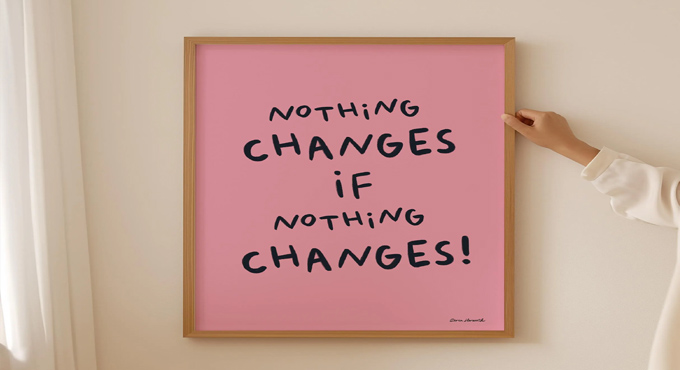
Nothing Changes if Nothing Changes
- Published By: shivaduvvuru
- July 22, 2026 / 08:20 PM IST


It is one of the most comforting delusions of human nature: the belief that if we just wait long enough, our lives will somehow fix themselves. We treat stagnation like a temporary rest stop, convincing ourselves that inspiration, better timing, or a stroke of good fortune will eventually arrive to push us forward.
But time does not pause for permission. In a world that shifts by the second, standing still isn’t holding our ground—it’s actively falling behind. If we want a different output, we have to alter the input. Because the brutal truth of reality remains absolute: nothing changes if nothing changes.
THE WRONG QUESTION VS. THE RIGHT QUESTION
Most of us are frequently paralyzed by a single, catastrophic question whenever we stand on the precipice of a new venture or a difficult change:
“What happens if I try and fail?”
This question is a clever trap designed by our psychological survival mechanisms to keep us safe and comfortable. It forces us to hyper-focus on immediate, hypothetical risks—rejection, financial exposure, loss of face, or temporary embarrassment. We allow this phantom risk to dictate our boundaries.
To break this paralysis, we have to weaponize a much harsher, far more realistic question against our own inertia:
“What happens to my life in three years—exactly 1,000 days—if absolutely nothing changes?”
When we project our current daily habits, lingering frustrations, and unmade decisions three years into the future, the illusion of a stable status quo completely evaporates. We do not get to stay where we are.
If we neglect our physical well-being today, we aren’t just stagnant in 1,000 days—our health will have actively deteriorated, leaving us more fatigued, less capable, and facing a much steeper climb just to recover our baseline. If we remain stuck in an unfulfilling professional loop, our skills erode and our adaptive capacity actively shrinks.
Stagnation is a downward slope masked as a flat surface. Suddenly, the risk of trying and failing looks incredibly small compared to the guaranteed, compounding decay of refusing to move.
MAPPING OUR TRAJECTORIES
To make this realization truly stick, we must pull it out of abstract thought and map it visually. We have to visualize our path as a single point today that diverges into two completely different realities over the next 1,000 days:
FIGURE 1.1: THE 1,000-DAY DIVERGENCE MODEL
The Growth Path
Calculated risks, consistent discomfort, compounding progress.
TODAY ➤
The Stagnation & Decay Path
Identical routines, eroding capability, health degradation, compounding regret.
Every minor choice we make today seems completely insignificant in isolation. Skipping a single hard task or putting off an uncomfortable conversation by just one day rarely triggers an immediate crisis.
However, when we multiply that single choice across a thousand days, the gap between who we could be and who we are currently becoming grows into a vast canyon. The visual map forces us to acknowledge exactly which path our daily actions are voting for.
THE ONE-LEVER RULE: OUR 21-DAY MICRO-COMMITMENT
The primary reason we fail when attempting to alter our lives is overwhelming ourselves. We attempt to rewrite our professional paths, financial tracking, personal wellness, and daily routines all in the same breath. This triggers an internal panic response, burns through finite willpower, and forces us to snap straight back to our old behavioral baseline.
The solution requires radical, exclusive focus: we must pick only one lever at a time.
We must look at our lives and identify the single variable that, if altered, would exert the highest positive leverage on everything else. Once that lever is identified, our sole objective is to protect it for the next 21 days —the psychological threshold required for a new behavior to begin transitioning into an automatic pattern.
To execute this effectively, we can follow three distinct ground rules:
Isolate the Variable: If our chosen focus is operational execution, we should not attempt a massive lifestyle overhaul at the exact same moment. We focus entirely on making that single operational target nonnegotiable.
Lower the Friction: We must make the opening step so micro-scale that it demands almost no initial willpower to begin. We build the core identity of consistency first, before worrying about the ultimate scale of the achievement.
Protect the Streak: For three consecutive weeks, our metrics track consistency rather than flawless perfection. A flawed, brief attempt is always infinitely superior to abandonment, because it actively reinforces the pattern of doing things differently.
Once those 21 days conclude and the behavior shifts from an exhausting uphill struggle to a natural, regular routine, our baseline has permanently evolved. Only then do we allow ourselves to reach for the next lever. By methodically shifting one variable at a time, 1,000 days from now we will look back and find we have completely reshaped our world.