
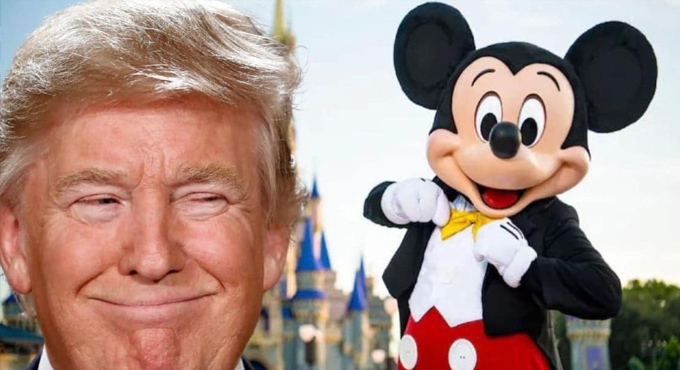
Trump vs Disney: The Strange Battle Over ABC That Could Change American Media
- Published By: Tech Team
- August 22, 2026 / 10:23 AM IST


— Surya Prakash Josyula
When we hear the name Disney, we usually think of cartoons, movies and Disneyland. But now, one of the world’s biggest entertainment companies is fighting a legal battle with U.S. President Donald Trump. The reason is not a movie, a business deal or money. It is about media freedom.
For some time, the Trump administration and the Federal Communications Commission (FCC) have been taking action against Disney-owned ABC. Trump and FCC Chairman Brendan Carr have repeatedly criticized ABC’s political coverage. Now the dispute has reached the courts, with Disney, ABC and eight ABC-affiliated stations filing a federal lawsuit against the FCC.
Disney’s argument is straightforward: the government should not be able to use broadcast licenses to pressure a media company simply because it does not like its news coverage. That is what has turned this into a much bigger fight between Trump and Disney.
Why is Trump angry with ABC?
Some of ABC’s political programs, particularly The View, have frequently criticized Trump. Jimmy Kimmel Live! has also featured comments that have angered the president. Trump has repeatedly attacked ABC’s political coverage, while FCC Chairman Brendan Carr has also publicly criticized the network.
The issue becomes more serious because ABC’s broadcast stations need FCC licenses to operate. The FCC has the power to renew and regulate those licenses. Disney is therefore worried that this regulatory power could be used to put pressure on ABC because of its political coverage.
In simple terms, Disney is asking: If the government does not like what a news organization says, can it use the organization’s license to put pressure on it?
Why did the FCC ask ABC stations to renew early?
This became one of the biggest points of conflict. ABC has eight regional stations whose licenses are still valid for several more years. But in April, the FCC asked those stations to apply for license renewals earlier than required.
The FCC gave its own reasons for the decision. Disney, however, believes the move is connected to the pressure being placed on ABC over its political coverage. The public response was also significant, with more than 150,000 comments reportedly sent to the FCC in support of ABC.
At that point, Disney had a clear choice. It could simply accept the pressure or challenge the government in court. Disney chose the second option.
The Jimmy Kimmel controversy
The current fight did not begin with this lawsuit. The earlier controversy involving Jimmy Kimmel Live! also became an important moment in the relationship between Disney and the Trump administration.
After a controversial comment by Kimmel, some ABC-affiliated stations stopped airing his show. FCC Chairman Brendan Carr also criticized the program, while Disney temporarily suspended it. But the decision triggered a strong public backlash, with viewers threatening to boycott Disney’s streaming services and theme parks. Kimmel was eventually brought back.
That episode showed Disney how quickly a decision involving political pressure could turn into a major public controversy. It also showed that audiences were willing to push back when they felt a media company was being pressured over political speech.
Why is Disney fighting back now?
Disney’s approach now appears much tougher. ABC did submit applications for the early license renewals, but it made clear that it was doing so “under protest.” In other words, Disney was saying that it would follow the order for the moment, but did not accept the order as legal.
The new lawsuit takes that argument further. Disney directly accuses the Trump administration of taking retaliatory action against ABC because of its coverage. The company argues that the government is using its regulatory powers and control over broadcast licenses to pressure a media organization whose political coverage it dislikes.
That is why this is no longer just a disagreement between a president and a television network. It has become a legal fight over how far the government can go when dealing with a critical media organization.
Is this only Disney’s problem?
This is perhaps the most important part of the story. Disney is a huge company with enormous financial and legal resources. If the government takes action against it, Disney has the ability to fight back in court.
But a smaller news organization may not have the same resources. If a small television station believes that criticizing the government could create problems with its license or future renewal, it may start avoiding sensitive stories altogether.
The government would not even have to directly say, “Do not report this.” If journalists and media companies simply become afraid of the consequences, they may begin censoring themselves. That is the larger concern behind Disney’s lawsuit.
Who will win?
The courts will ultimately decide whether the FCC’s actions were lawful and whether the Trump administration improperly targeted ABC because of its political coverage. The Trump administration and the FCC can argue that their actions have legitimate regulatory reasons, while Disney says the actions are politically motivated.
So the Trump vs. Disney fight is about much more than one company and one president. At its heart is a simple question: Can a media organization freely criticize the government without fearing punishment from the government?
That is why the outcome of this case could matter far beyond Disney and ABC. If the court sides with Disney, it could send a strong message about the limits of government power over broadcasters. If the government wins, other media organizations may be watching very closely.
Because in the end, this is not really about Mickey Mouse. It is about whether the media can speak freely when those in power do not like what they hear.
Related News
Did You Apply for a Ghost Job? Be Careful.. That Job May Not Even Exist!

“I’m Human”: The New Digital ID That Wants to Separate People From AI Bots

Gandhi’s 688 Pages Sold for ₹16.20 Crore! What Was Written in Them?
The Country Is Ours… But You Need a Permit to Enter These States! The Surprising History of ILP

Before Buying a House, Check This One Number… Or Your Crores Could Get Stuck!