

The Father of Genetics: The Forgotten Genius Who Unlocked the Secret of Heredity
- Published By: techteam
- July 22, 2026 / 11:07 AM IST


By Surya Prakash Josyula
January 6, 1884.
Brno, then part of the Austrian Empire.
Church bells echoed through the cold winter morning as a funeral procession slowly made its way to the cemetery. A wooden coffin was gently lowered into the ground. To the people gathered there, it was the funeral of an ordinary monk.
History, however, tells a very different story.
The man inside that coffin would one day become part of every genetics laboratory, every DNA test, and every modern hospital. Although the world did not recognize him during his lifetime, his discoveries would eventually transform biology, medicine, and our understanding of life itself.
His name was Gregor Johann Mendel.
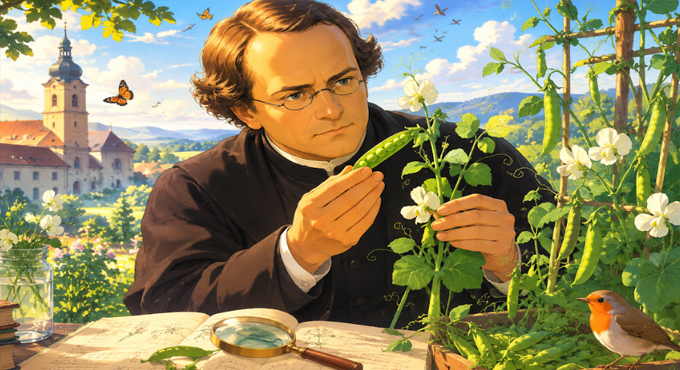
His remarkable journey began not in a famous university or a high-tech laboratory, but in a quiet monastery garden filled with nearly 28,000 pea plants.
Seven Years of Silent Observation
For seven years, Mendel followed the same routine. Every day he returned to the same garden, surrounded by the same plants, the same flowers, the same seeds, and the same notebook. Whether it rained or the sun was blazing, his work never changed. He observed, recorded, observed again, and recorded again.
He carefully noted how each plant grew, which flowers bloomed white or purple, which seeds were round or wrinkled, which plants grew tall and which remained short. Every small difference was documented with remarkable patience.
In all, he focused on seven contrasting traits, including seed shape, seed color, flower color, pod shape, pod color, flower position, and plant height. To those around him, it looked like nothing more than an unusual hobby. Few people saw him as a scientist, and almost no one believed his work would change biology.
What they did not realize was that Mendel was not simply observing pea plants. He was trying to read the hidden language of nature.
An Ordinary Monk with an Extraordinary Question
Mendel was not a famous professor or a researcher working in a prestigious laboratory. He was born into a poor farming family in a small village and struggled financially throughout his early life.
He failed the teaching certification examination twice. Eventually, with few options available, he joined the Augustinian monastery in Brno as a monk. It was there that he found the opportunity to continue learning and conducting experiments.
The world would later remember Gregor Johann Mendel by a title he never heard during his lifetime—The Father of Genetics.
The Question That Changed Biology
At that time, scientists had spent generations trying to answer one fundamental question. How are traits passed from parents to their children? Why do children resemble their parents? Why does one child inherit a father’s height while another inherits a mother’s eye color? Why do some diseases continue to appear generation after generation within the same family?
Most scientists searched for the answer in books and laboratories. Mendel chose a different path.
Inside a quiet monastery garden, surrounded by thousands of pea plants, he asked the same question every day. He believed that nature itself already knew the answer, and that careful observation would reveal it.
Related News

Is Christopher Nolan’s Next Movie ‘The Prisoner’? A 17-Year-Old Thriller Rumor Returns

One Rule for Hero Vijay… Another Rule for CM Vijay!

The AI Behind the Attack? What a New Study Reveals About Terror Groups

The Trojan Horse Strategy: How Scientists Used Sugar to Trick the Brain and Attack Cancer

‘The Small Films That Stood Tall Against The Odyssey! Here Is Hollywood’s New Formula’