
SHOCKING: Human Brain Inside a Computer! Is This the Next Big Thing After AI?
- Published By: Tech Team
- August 18, 2026 / 09:56 AM IST


One day, you sit in front of a computer. You ask it a question. The computer thinks for a few seconds and gives you an answer.
But what if the answer did not come only from a computer chip?
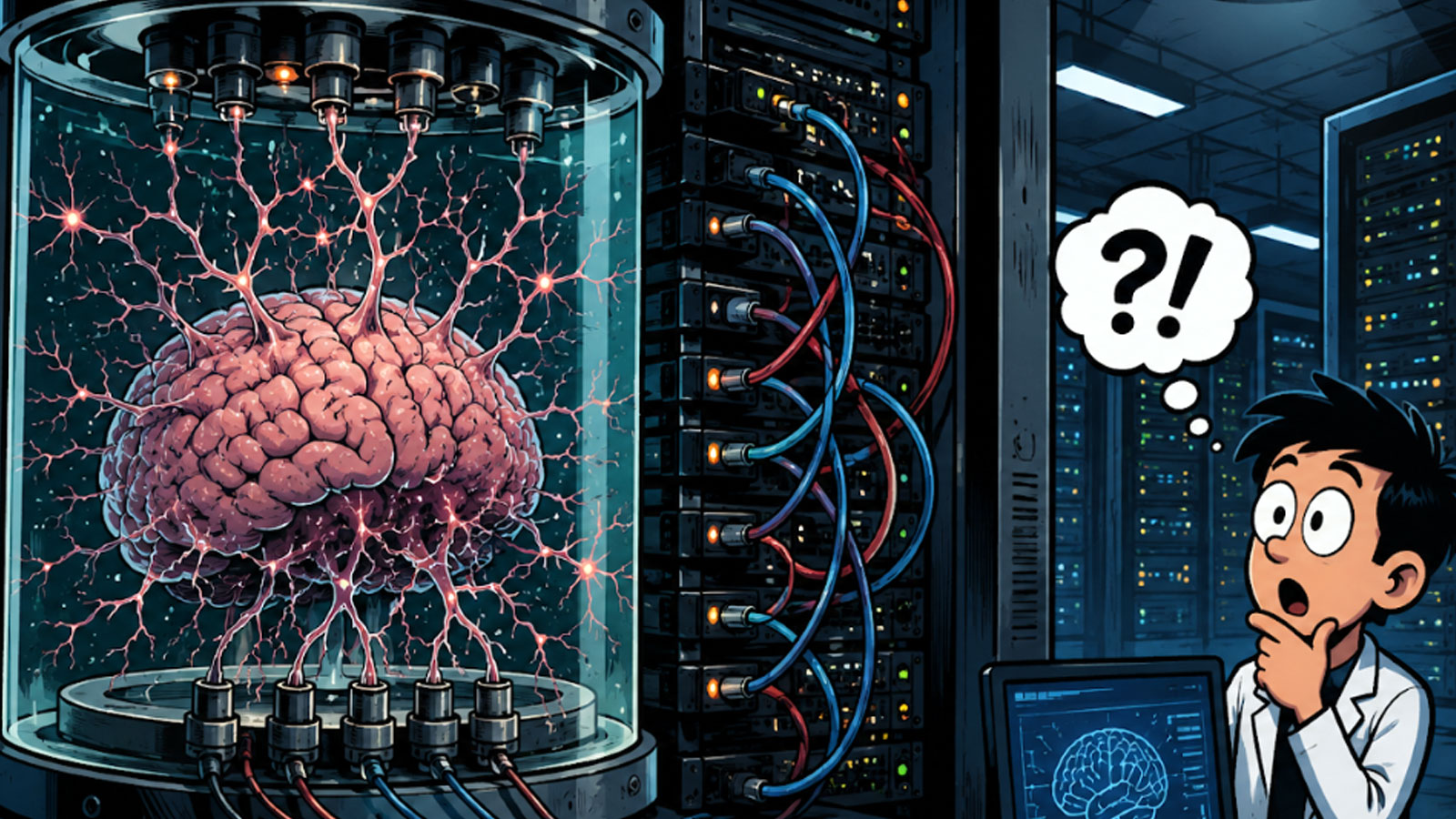
Somewhere inside a data center, in a dark room filled with thousands of servers, living human brain cells could be helping the machine think.
Yes. Human brain cells inside a computer.
This is not a scene from a science-fiction movie. It is already becoming a real experiment.
There is no human sitting inside the machine. There is no complete human brain either. Instead, scientists are using living cells from the human brain and connecting them to a machine.
Now, a 20-unit biological computing system is being tested in Singapore. So what exactly is happening here? And why are scientists trying to do this?
A Small Game. A Big Experiment.
To understand this, we have to go back to a simple video game called Pong.
A few years ago, scientists at Australian company Cortical Labs connected living neurons grown in a laboratory to a computer. Then they gave those neurons a simple task: play Pong.
At first, it looked like just another laboratory experiment. But the results were unusual. The neurons started responding to the electrical signals from the game, and their responses changed as they received feedback.
That raised a much bigger question. If living neurons can learn to play a simple game, could they also be used for more complex computing tasks?
That question has now moved beyond the laboratory and into the world of data centers.
From the Lab to the Data Center
In Singapore, DayOne Data Centers, Cortical Labs and the National University of Singapore have set up a 20-unit CL1 biological computing system.
From the outside, it may look like a normal server system. But inside, something very different is happening.
Scientists grow neurons from human stem cells and connect them to silicon-based hardware. Electrical signals are sent to the neurons, and the system records how they respond.
That response then becomes part of the computing process.
In simple terms, a silicon machine is working together with a living biological system.
This is called biological computing.
Why Use Human Brain Cells?
The human brain does something that computers still struggle to do efficiently. It can learn from relatively little information, change its response when conditions change, and adapt through experience.
AI is trying to achieve many of these abilities. But today’s AI systems often require huge amounts of data, computing power and electricity.
That is where biological computing becomes interesting.
According to Cortical Labs, one CL1 unit uses around 30 watts of electricity. The neurons can also be kept alive for around six months using a special life-support system.
The idea is not to replace every computer with a biological one. Instead, scientists are asking whether living neurons could be especially useful for certain types of problems.
Could There Be 1,000 Brain Units?
The Singapore experiment has started with 20 units. The companies involved are also exploring a much larger deployment of up to 1,000 units, subject to technical validation and regulatory approval.
If that happens, the idea of a data center could start looking very different.
Today, data centers are packed with servers and GPUs. In the future, they could also contain computing systems built around living neurons.
That sounds futuristic.
But the experiment is already happening.
Can This Replace ChatGPT?
Not right now.
CL1 is still an experimental technology. There is no evidence that it can replace the powerful GPUs used to run large AI models.
And that may not even be the goal.
Scientists are more interested in whether biological systems can learn with less data, adapt more naturally to changing conditions, and handle certain problems more efficiently.
Potential applications include drug discovery, neurological research, robotics and cybersecurity.
The Bigger Question
AI was built to imitate the human brain.
Biological computing is asking a much stranger question.
Why imitate the human brain when we can use some of its real biological parts?
That is the idea now being tested in Singapore.
The technology is still young. It may fail. It may remain useful only for very specific tasks.
But if it works, computing could enter a completely new phase.
The next big competition may not be only about who builds the fastest chip.
It could be about whether silicon or biology is better at learning.
— Surya Prakash Josyula