

Is The Terminator Becoming Reality? The Rise of Armed Humanoid Robots
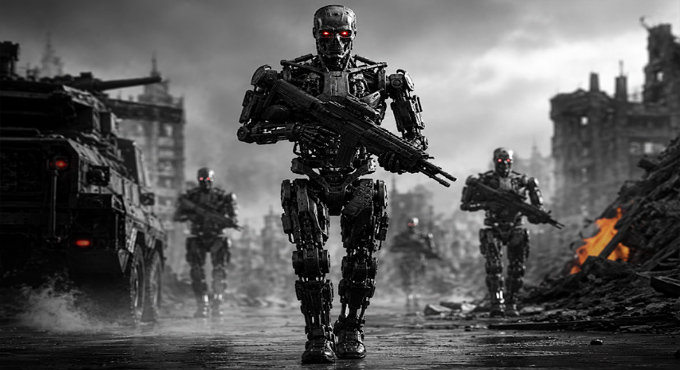
- Published By: Tech Team
- July 18, 2026 / 11:30 AM IST


— Surya Prakash Josyula
When The Terminator was released in 1984, audiences were fascinated not just by its action scenes but by a disturbing question at the heart of the story:
What if one day machines began fighting wars against humans?
More than four decades later, that question is no longer confined to science fiction. Rapid advances in artificial intelligence and humanoid robotics are bringing the idea of weaponized robots into real-world defense discussions.
A New Phase in Military Robotics
Modern warfare has already been transformed by drones that can fly, monitor targets, and carry out attacks. The next stage may involve humanoid robots that can move through the battlefield in ways that resemble human soldiers.
One company attracting attention is Foundation Future Industries, a startup based in San Francisco. It has developed a humanoid robot called Phantom, which is designed for military support operations.
This is no longer just a laboratory concept.
The company has already tested two Phantom robots in Ukraine for logistics-related tasks, including transporting supplies and assisting soldiers in dangerous environments.
The Next Step: Weaponization Testing
According to Foundation Future Industries CEO Sanket Pathak, the company plans to begin weaponization testing of its humanoid robots in 2027.
The proposal involves equipping these robots with weapons and evaluating how they perform in battlefield conditions.
It is important to note that this system has not yet been deployed. At present, it remains a planned testing program rather than an operational military platform.
Pentagon Support
The project has also received support from the U.S. Department of Defense.
The Pentagon has awarded the startup research contracts worth approximately $24 million (around ₹200 crore) to support the development of this technology.
The funding reflects growing interest in exploring the role humanoid robots could play in future military operations.
Why Build Armed Humanoid Robots?
According to the company, humanoid robots could offer advantages that traditional weapons cannot.
Large bombs can cause widespread destruction, while drones have operational limitations in certain environments.
A humanoid robot capable of walking through complex terrain may be able to reach specific targets with greater precision.
The company also argues that deploying robots in dangerous missions could reduce risks for human soldiers.
The Bigger Question: Who Makes the Decision?
While the technology continues to advance, the biggest debate is not about engineering but about responsibility.
Who will decide when a weapon should be used?
Will a human operator remain in control?
Or will an AI system eventually make critical battlefield decisions?
If an AI system cannot accurately distinguish between a military target and a civilian, the consequences could be devastating.
These concerns have become the center of an ongoing global ethical debate surrounding autonomous weapons.
Another challenge is that there is still no comprehensive international agreement governing the development and use of fully autonomous combat robots.
Why Does This Matter for India?
This is not an issue limited to the United States.
Many countries are investing heavily in AI-powered defense technologies, autonomous systems, and military robotics.
India is also expanding research in artificial intelligence, robotics, and autonomous defense systems.
Defense analysts believe that in the future, humanoid robots could work alongside soldiers in certain military operations.
Conclusion
The question raised by The Terminator in 1984 is beginning to sound far less fictional than it once did.
As artificial intelligence becomes more capable, the discussion is no longer about whether robots can enter the battlefield. It is increasingly about how much decision-making authority they should be given.
Today, a human soldier pulls the trigger.
Tomorrow, an AI-powered humanoid robot may be capable of doing the same.
Whether that technology becomes a tool that protects human lives or one of the most dangerous weapons humanity has ever created remains an open question.
Related News

Can Humans Have Sex in Space? And What Happens If They Do?

Why Did America’s Spy Agency, the CIA, Come Looking for Steve Jobs?

The Shocking Truth a Mother Found on TikTok After Her Son Died

America Moves First in Venezuela’s Oil Hunt. Where Does That Leave India?

Why Did Elon Musk Name His Son ‘Sekhar’? The Story of the Great Indian Scientist Behind the Name