

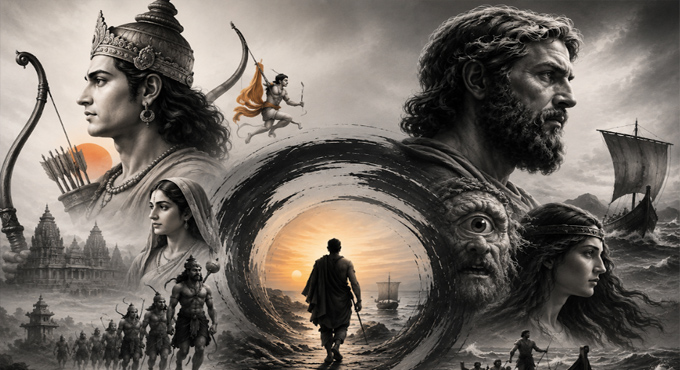
From the Ramayana to The Odyssey: The Timeless Story That Never Grows Old
- Published By: Tech Team
- July 18, 2026 / 10:15 AM IST


— Surya Prakash Josyula
Stories such as the Ramayana and the Mahabharata have been told for centuries, yet every generation continues to read them, watch them, and reinterpret them in new ways. The same is true of The Odyssey, the Greek epic written by Homer nearly 3,000 years ago. Christopher Nolan’s latest adaptation has once again demonstrated that some stories never lose their relevance, no matter how many times they are retold.
This raises an interesting question. Why do audiences continue to return to stories whose endings they already know? What makes epics like the Ramayana, the Mahabharata, and The Odyssey remain emotionally powerful across generations and cultures?
More Than a Story About War
At its core, The Odyssey is not a story about winning the Trojan War. Instead, it is about King Odysseus’ long and difficult journey home after the war has ended.
On his way back to Ithaca, he faces storms, mythical creatures, temptations, betrayal, and the anger of the gods. It takes him nearly twenty years to reunite with his family. The lasting appeal of the story lies not in its battles but in its emotional theme—the determination to return home despite overwhelming obstacles.
That emotional idea feels surprisingly familiar to audiences around the world.
A Journey Shared Across Cultures
Odysseus longs for Ithaca. Rama longs for Ayodhya. The Pandavas fight to reclaim Hastinapura.
Although these stories come from different civilizations, they are built around remarkably similar emotional experiences. Separation, loss, temptation, sacrifice, hope, and the desire to return home are universal human emotions. These themes explain why audiences from different countries continue to connect with these epics thousands of years after they were first written.
Joseph Campbell and the Hero’s Journey
American mythologist Joseph Campbell spent years studying myths and epics from different parts of the world. His conclusion was that many of the world’s greatest stories share a common narrative structure, which he described as the Hero’s Journey.
According to Campbell, the hero leaves the familiar world, faces a series of challenges, undergoes personal transformation, and finally returns changed by the experience.
This structure is clearly visible in the Ramayana, the Mahabharata, and The Odyssey. Although the settings, characters, and cultures are different, the emotional architecture remains remarkably similar.
Why Every Generation Retells The Odyssey
The reason The Odyssey has survived for nearly three millennia is not because the story never changes. It survives because every generation finds a new way to tell it.
The 1997 television miniseries focused on bringing Homer’s mythical world to the screen. O Brother, Where Art Thou? (2000) reimagined Odysseus as an escaped prisoner in Depression-era America. Cold Mountain (2003) adapted the emotional journey into the story of a soldier returning home after the American Civil War. Troy (2004) emphasized the scale and spectacle of the Trojan War, while The Return (2024) explored the psychological struggles of a hero after coming home.
Christopher Nolan’s The Odyssey continues that tradition by interpreting the ancient epic through his own cinematic style. Rather than simply recreating the original text, Nolan presents the story in a way that connects with contemporary audiences.
Why Hollywood Keeps Returning to Ancient Epics
Hollywood’s continued interest in The Odyssey reflects the enduring power of its narrative structure. Audiences may experience different worlds, characters, and visual styles, but they continue to respond to stories about transformation, resilience, and the search for belonging.
This is also why the Hero’s Journey appears in films such as Star Wars, The Lord of the Rings, Harry Potter, and The Lion King. While each story is unique, they all follow a similar emotional progression that audiences instinctively recognize.
The Ramayana’s Influence Across Asia
Just as The Odyssey has shaped Western storytelling, the Ramayana has influenced cultures across Asia.
It evolved into Kakawin Ramayana in Indonesia, Ramakien in Thailand, Reamker in Cambodia, Hikayat Seri Rama in Malaysia, and Maharadia Lawana in the Philippines.
Although the names, settings, and cultural details changed, the central emotional journey remained intact. This ability to adapt while preserving its core meaning is one of the defining characteristics of every great epic.
Why Nolan Chose The Odyssey
Christopher Nolan’s decision to revisit The Odyssey is not simply about adapting another classic.
He chose a story that already possesses a universal emotional structure capable of connecting with audiences across cultures and generations. Rather than searching for a completely new story, Nolan offers a new cinematic interpretation of one that has already stood the test of time.
A Story That Never Ends
Whether it is Odysseus returning to Ithaca, Rama returning to Ayodhya, or the Pandavas reclaiming Hastinapura, the destination is ultimately less important than the journey itself.
That is why great epics never disappear. Every generation revisits them, reshapes them, and discovers new meaning within them.
The stories remain the same.
What changes is the generation reading them—and the way each generation chooses to tell them.
Related News

Raja Kumari debuts as music director with IMPURE, and OMG is the Sangeet song for wedding season

‘Narayanamma’ Song from ONG FROM ‘– AK47’ Released

Vijay Deverakonda’s Ranabaali: Never Forget The Truth Documentary Series Announced

Star Producer A.M. Rathnam Graces Shree Nandu’s Kaasu Glimpse Launch Event

Director Pradeep Madugula’s Wife Deepti Reddy Sets an Example Through Organ Donation