
Have You Heard of ‘Project Udvasana’? Hyderabad Has Found a Dignified Way to Say Goodbye to Old Idols
- Published By: techteam
- August 11, 2026 / 09:00 AM IST


— Surya Prakash Josyula
What do you do when an old picture of a god in your home becomes damaged, or a worshipped idol breaks after years of use?
For many families, there is no easy answer. Throwing it into the garbage feels disrespectful. Leaving it under a tree or near a temple does not feel right either. Some people eventually immerse old idols, pictures and other religious items in lakes, rivers or ponds. What starts as an act of faith can end up becoming a waste and pollution problem.
Hyderabad is now trying to solve this unusual but very real problem with a thoughtful initiative called Project Udvasana.
The idea is simple. Religious items that have been worshipped for years should not simply be treated as ordinary waste. They deserve a respectful farewell, while the materials they are made from should be handled in an environmentally responsible way.
So, what exactly is Project Udvasana?
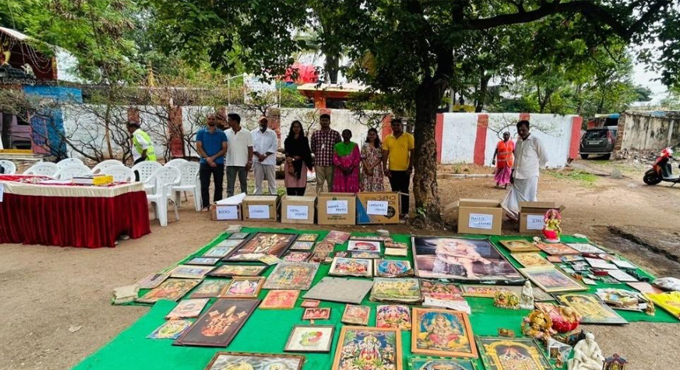
Launched by the Greater Hyderabad Municipal Corporation (GHMC), Project Udvasana creates a system for collecting old and damaged religious items from homes. This includes pictures of deities, idols, calendars and other puja materials that people no longer know how to dispose of.
Instead of sending these items directly to the garbage system, the project gives them a proper farewell through traditional religious rituals. After that, the materials are carefully separated and sent for recycling or reuse.
In other words, the project tries to bring together two things that are often treated as separate — respect for religious beliefs and responsibility towards the environment.
What happens after the collection?
The process begins with a traditional farewell ceremony. The collected religious items are taken to a temple, where priests perform the Udvasana puja according to customary practices. The idea is to formally conclude the relationship between the worshipper and the religious object before it enters the waste-management process.
Once the ritual is completed, volunteers begin sorting the materials. A single religious frame or idol can contain several different materials, including glass, paper, wood, metal, plastic, cloth and Plaster of Paris. These materials are separated so that they can be handled properly instead of being dumped together.
There is also an interesting reuse component. Photographic frames that are still in good condition are not necessarily thrown away. They can be cleaned and given free of cost to people who may need them. Other recyclable materials are handed over to authorised recycling agencies.
The response has been encouraging
What began as a pilot initiative at a temple on June 6 has gradually expanded across the city. According to the figures shared for the project, around 4,372 kilograms of religious material has been collected so far.
That includes more than 4,000 photo frames and deity images, along with over 600 idols.
The numbers may look like waste statistics, but there is another way to look at them. Every frame and every idol represents something that once had a place inside someone’s home or prayer space. The challenge was to find a way to handle those objects after their useful or devotional life had come to an end.
Project Udvasana is attempting to create that missing final step.
The idea is now moving beyond Hyderabad
The model has also caught the attention of the neighbouring Cyberabad Municipal Corporation (CMC), which has adopted a similar initiative called “Divine Waste – Devotional Collection Drive.”
During its first collection drive on July 18, CMC reportedly collected around 783 kilograms of religious material. The civic body is also planning a larger collection drive across 16 circles on August 22, with online registration being used to organise the collections.
That is perhaps the most interesting part of the story. A problem that was once handled privately by individual families is slowly becoming part of organised urban waste management.
A small idea with a bigger message
Cities usually talk about waste in terms of plastic, food, construction material or electronic waste. Religious waste is different because it carries an emotional and cultural value that ordinary waste does not.
For someone who has prayed before an idol for 20 years, simply putting it into a garbage bin may never feel acceptable. At the same time, leaving it in public places or immersing it in water can create another problem for the city and the environment.
Project Udvasana tries to solve both sides of that dilemma.
It gives people a way to say goodbye with dignity, while making sure the materials do not simply become another source of pollution.
What started in Hyderabad as a small civic experiment could therefore become a useful model for other Indian cities as well.
Because sometimes, good waste management is not just about deciding what to throw away.
It is also about understanding what something means to the person who is letting it go.
Related News

Ranganatha Ramayanam: 6 Unique Regional Retellings That Redefined the Telugu Epic
Is Your Doctor Really Qualified? When a Fake Certificate Becomes a Doctor: Inside India’s FMGE Scam
The Shocking Origin Story Behind Wall Street’s Bull and Bear Markets
Are Loan Recovery Agents Threatening You at Home? What RBI’s New Rules Say
Shocking: Do You Know How AI Is Teaching Robots About the Real World?