
Ranganatha Ramayanam: 6 Unique Regional Retellings That Redefined the Telugu Epic
- Published By: Tech Team
- August 11, 2026 / 09:45 AM IST


— Surya Prakash Josyula
We all know the story of the Ramayana.
Rama going into exile, Ravana abducting Sita, Hanuman traveling to Lanka, the construction of Rama Setu, and the war with Ravana—these are incidents we have heard since childhood.
However, when a Telugu poet retold the same epic 800 years ago in his own language, he made several intriguing additions and variations to the narrative. These versions became deeply embedded in popular culture. Who was this poet, and what were those additions?
Authored by Gona Buddha Reddy in the 13th century, Ranganatha Ramayanam was based on Valmiki’s Ramayana, yet it introduced fresh details to certain events, gave new backstories to specific characters, and blended the narrative with folk beliefs prevailing among the people.
That is why, within the story we know so well, we find these lesser-known subplots. Here are six such fascinating episodes:
1. Did Rama have a childhood conflict with Manthara?
The moment we hear the name Manthara, we remember Kaikeyi’s maid who was responsible for Rama’s exile. But why did she harbour such resentment toward Rama? Ranganatha Ramayanam provides an interesting backstory to this.
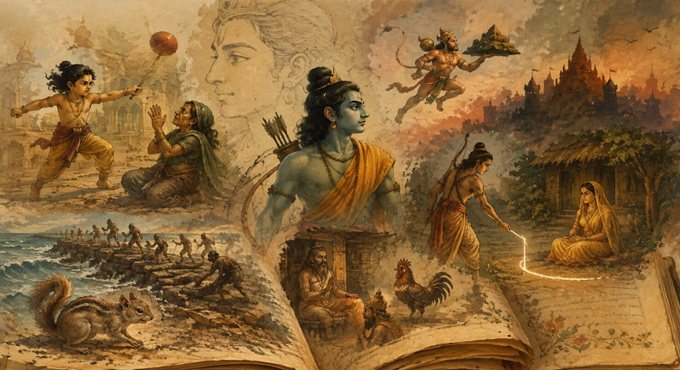
The story goes back to Rama’s childhood. While playing with a ball and stick, Manthara throws his ball far away. Enraged, young Rama strikes her knee with his stick, leaving her injured. The matter does not end there. That incident leaves a lingering bitterness in Manthara’s heart. We all know how she acts later at a crucial turning point in Rama’s life.
This means there is a small childhood flashback behind the main cause of Rama’s exile. The real interest in this story lies in how a minor childhood incident snowballs years later to alter the fate of an entire kingdom. This episode is absent in Valmiki’s Ramayana.
2. The Vanara army built Rama Setu, but what did the squirrel do?
When we think of building Rama Setu, we picture the giant Vanara army carrying massive rocks and boulders. However, Ranganatha Ramayanam mentions that a tiny creature also contributed its share to this massive effort—a squirrel.
The squirrel dips itself in the ocean, rolls in the sand, and shakes off the sand particles sticking to its body into the gaps between the rocks. It repeats this process over and over. Though its contribution seems tiny, Rama notices the effort. Touched by its devotion, Rama blesses the squirrel and gently strokes its back, leaving three stripes. This story is often cited as the origin of the three white lines on a squirrel’s back.
This episode carries a message bigger than the bridge itself: It is not about whether the work is big or small; what matters is whether we did the best we could.
3. Did Indra turn into a rooster in Ahalya’s story?
We are familiar with the story of Ahalya. However, in the Ranganatha Ramayanam tradition, we see another interesting detail. Indra takes the form of a rooster to enter Sage Gautama’s hermitage.
Why a rooster? Indra uses the rooster’s crow to manipulate Gautama’s daily routine, creating the illusion that morning has arrived early. While it may seem like a small detail, such elements add dramatic tension to the narrative. Instead of simply stating what happened in a major mythological event, the story explores how Indra executed his plan.
4. Who was Jambumali, who confronted Hanuman in Lanka?
After Hanuman sets foot in Lanka, the situation turns upside down. Having found Sita, Hanuman creates chaos in Lanka to test the enemy’s strength, leading to a clash with the demon army. During this confrontation, the episode of a demon named Jambumali occurs.
This is not just another fight scene. It showcases how Hanuman single-handedly shook an entire stronghold after demonstrating how formidable Lanka and its protective demon forces were. Hanuman did not just go there as a searcher; he became a warning to Lanka, making them realize that stopping Rama’s messenger was no easy task.
5. Why did Kalanemi try to obstruct Hanuman on his way to fetch the Sanjeevani?
Lakshmana’s life is in danger, and Hanuman sets off to fetch the Sanjeevani herb. Time is short, and the journey is long. To stop him in his tracks, Kalanemi enters the scene. Knowing that defeating Hanuman through brute force is impossible, Kalanemi resort to illusion and trickery to deceive Hanuman and delay his trip. However, Hanuman recognizes the trap.
There is a great plot twist here: Hanuman’s strength lies not just in his physical power, but also in his alertness. No matter how urgent the crisis, he possesses the intellect to spot an enemy’s trap. Thus, the Kalanemi episode highlights Hanuman’s sharp vigilance alongside his heroism.
6. Where did the “Lakshmana Rekha” drawn to protect Sita actually originate?
The term “Lakshmana Rekha” has transcended the Ramayana to become a common idiom in our language today. Whenever we want to caution someone about not crossing a boundary, we say, “Do not cross the Lakshmana Rekha.”
Interestingly, this specific “Lakshmana Rekha” episode does not appear in the classical text of Valmiki’s Ramayana. It grew popular through later regional Ramayana traditions. This concept gained a prominent place in the Telugu Ramayana tradition as well, popularizing the narrative where Lakshmana draws a protective boundary line around Sita when Ravana arrives disguised as an ascetic.
Over time, that single line evolved into a powerful symbol—representing boundaries of safety, and raising timeless questions about when a boundary should or should not be crossed.
Why is Ranganatha Ramayanam so special?
Here lies the essence of it all.
Ranganatha Ramayanam did not reject Valmiki’s Ramayana; it used it as its foundation. However, when retelling a story in another language, the imagination, folk beliefs, and storytelling traditions of the local people naturally blend in. That is why Manthara got a backstory, the squirrel received honor, Ahalya’s story got a new dramatic angle, Hanuman faced fresh obstacles, and the concept of Lakshmana Rekha took deep root in popular imagination.
This is the true journey of the Ramayana. Valmiki wrote one Ramayana, and subsequent centuries retold it in their own regional languages. The Telugu land did the same. Reading Ranganatha Ramayanam does not reveal a completely alien Ramayana—it presents the familiar epic, thoughtfully retold with a Telugu sensibility.
That is its true uniqueness.