
Are Loan Recovery Agents Threatening You at Home? What RBI’s New Rules Say
- Published By: Tech Team
- August 10, 2026 / 07:30 PM IST


— Surya Prakash Josyula
You miss one EMI. Your phone starts ringing. Not once, but ten times. Calls come in the morning, afternoon and even late at night. Then come WhatsApp messages. Finally, a recovery agent may show up at your home and try to embarrass you in front of your family. For many borrowers, such recovery harassment is not new. But banks, NBFCs and their recovery agents may no longer have the freedom to pressure borrowers in any way they want simply because an EMI is pending.
The Reserve Bank of India (RBI) has introduced new rules to make the loan recovery process more organised and fair. These changes are set to come into effect from January 1, 2027. The important point is that RBI is not only saying that loans must be recovered. It is also clearly setting rules on how lenders should recover the money.
No More Late-Night Recovery Calls
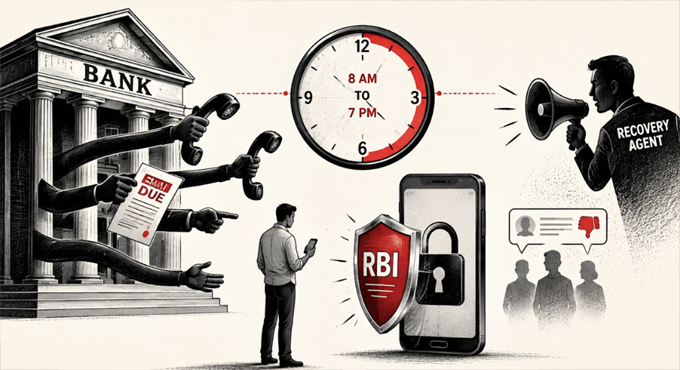
One of the biggest changes borrowers will notice is related to recovery calls. Recovery agents cannot contact borrowers before 8 AM or after 7 PM. So, repeatedly calling someone at 10 PM or 11 PM and pressuring them to pay an EMI would go against the rules.
The rules are not limited to phone calls. Recovery agents cannot threaten borrowers, use abusive language, repeatedly call or message them to create mental pressure, or embarrass them in front of family members or other people.
Using social media to shame borrowers by posting their photographs or details of their unpaid loans is also not allowed as part of the recovery process.
If an Agent Comes Home, You Must Be Informed First
Recovery agents cannot simply turn up at a borrower’s home without warning. Under the new framework, borrowers or guarantors must be informed before a recovery agent visits them personally for the first time. If digital contact details are available, the borrower should be informed through SMS or email at least one day in advance.
There is another important point here. A bank cannot escape responsibility simply because it has outsourced recovery work to an outside agency.
The lender is still responsible for monitoring how its recovery agents behave and whether they follow RBI rules. In other words, a bank cannot simply say, “He is not our employee. He works for an outside agency,” and walk away from the issue.
Recovery Calls Must Be Recorded
Until now, it could sometimes be difficult for a borrower to prove what a recovery agent said or when a call was made.
The new system gives greater importance to recording and maintaining details of recovery communications. Lenders will have to keep records such as call details, timing and other relevant information for the required period.
The idea is simple. If a borrower files a complaint, the lender cannot simply say, “Nothing like that happened.” There should be records that can help establish what actually happened.
Your Phone Cannot Be Blocked Immediately After Missing an EMI
The most interesting part of the new rules involves mobile phones, tablets and laptops bought through loans or EMIs.
Just because a borrower misses an EMI does not mean the lender can immediately block the device completely.
If a lender wants to use technology to restrict a financed device, it has to follow a gradual process. The borrower must first be given an opportunity to correct the default. Essential functions of the device should also continue to work.
Important services such as incoming calls, internet access, emergency SOS and public-safety notifications must be protected.
In simple terms, the system cannot work like this: “You missed one EMI, so your phone stops working.”
The borrower must be given proper notice and time to make the payment before restrictions are imposed in eligible cases.
What If You Pay the EMI but Your Phone Remains Locked?
This is where the ₹250 figure becomes important.
Once the borrower clears the required dues, the lender must remove the restrictions on the device within a maximum of one hour.
If the restriction continues even after payment, or if the lender delays removing it in circumstances covered by the rules, the lender may have to pay compensation of ₹250 for every hour of delay.
But there is an important point to understand.
This does not mean that a bank will pay you ₹250 simply because you paid your EMI late. The compensation applies to situations where a device restriction remains unfairly or is not removed within the required time after payment.
So, Is It Really “Jail” for Recovery Agents?
This is where viral headlines and the actual RBI rules can be very different.
The RBI has not introduced a rule saying that every recovery agent will automatically go to jail for violating the new recovery framework.
Instead, the RBI is increasing the responsibility of regulated lenders in areas such as recovery-agent conduct, monitoring, record keeping and complaint handling.
However, if a recovery agent threatens someone, uses violence, forces a borrower to pay or commits another criminal offence, separate criminal laws can also apply.
So, saying “Under the new RBI rules, recovery agents will directly go to jail” would not be an accurate way to describe the rules.
The bigger message behind RBI’s new recovery framework is simple.
A person who takes a loan has a responsibility to repay it. But recovering that money does not give a lender the right to threaten, publicly shame or invade the privacy of the borrower or their family.
A loan may be overdue. But a borrower’s rights are not.
That is the real message behind RBI’s new recovery framework.