
Google’s AI Talent Exodus: Is Salary Really the Problem?
- Published By: Tech Team
- August 10, 2026 / 01:30 PM IST


—Surya Prakash Josyula
Google has no shortage of money. It has some of the world’s most expensive AI infrastructure, its own AI chips, and a massive AI project like Gemini. And yet, some of its top AI scientists are leaving the company one after another.
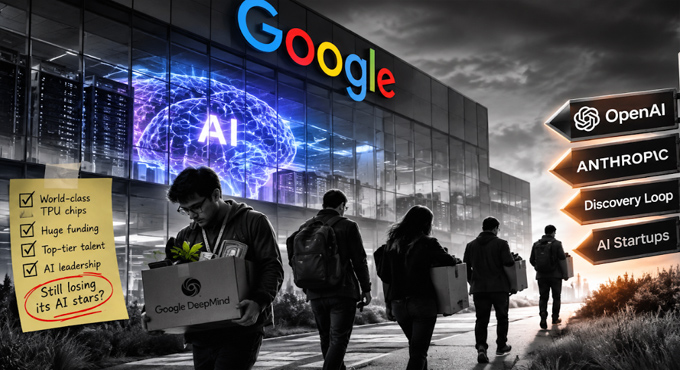
Recently, key names such as Jeff Dean, Sanjay Ghemawat, Oriol Vinyals and Quoc Le left Google DeepMind. Earlier, prominent researchers linked to Gemini, including Noam Shazeer and John Jumper, also moved to rivals such as OpenAI and Anthropic. So, why is this happening?
Are Google’s salaries and benefits no longer enough? Not really.
For a normal employee, salary may be one of the biggest reasons to switch jobs. But things are different for some of the world’s top AI researchers. Many of them already receive huge compensation packages, while Google offers top talent stock and equity worth millions of dollars.
So the real question is not simply, “Who is paying more?” It is, “Where can my ideas have a bigger impact?” That is becoming the real game in the AI industry.
Salary Is Not the Only Attraction
For top AI researchers, money is only one part of the deal. Companies such as OpenAI and Anthropic are growing rapidly, and their future value could become much bigger. That makes stock and equity in these companies highly attractive to researchers.
In simple terms, staying at Google as an employee is one option. Joining another AI company and getting a stake in its future is another. And there is an even bigger option: starting your own company.
That is what Jeff Dean, Sanjay Ghemawat, Oriol Vinyals and Quoc Le are now doing with their new company, Discovery Loop. Their goal is not to build another chatbot. They want to use AI to speed up the process of scientific research itself.
There is also an interesting twist. Google may have lost these people as employees, but it is becoming a founding investor and cloud partner of Discovery Loop. So Google has not completely lost access to their talent. But it has lost something important: control over that talent.
The Other Big Problem: Compute
This may sound technical, but the idea is simple. AI models need enormous computing power to train and improve. Google has some of the world’s most powerful AI chips, known as TPUs. But the demand for computing power is also enormous.
Google Cloud customers need it. Gemini needs it. AI research teams need it. According to the Los Angeles Times, some Google researchers have faced difficulties getting enough computing power for their research. In some cases, the shortage has affected which research projects get priority and which experiments can be run first.
That matters a lot in AI. Having a great idea is one thing; having enough computing power to test that idea is another. And in the AI race, even a delay of a few months can make a big difference.
What Does Google Lose When These People Leave?
If an ordinary employee leaves, a company can usually hire someone else. But replacing someone at the level of Jeff Dean or Oriol Vinyals is not that simple.
They bring years of research experience with them. They know which problems are worth solving, which research directions could lead to a breakthrough, which experiments are unlikely to work, and which people can build the right team.
So when a top researcher leaves, it is not just one employee walking out of the door. A large amount of knowledge, experience and institutional memory can leave with them.
One Person Leaves. Could Others Follow?
This could be an even bigger problem for Google. Imagine a senior scientist leaves. Another researcher who worked closely with that person gets a good offer from a rival company and leaves too.
Then others start asking themselves: “What does my future here look like?”
That is how a few departures can turn into a talent exodus. The growing number of senior AI researchers leaving Google has already raised concerns about the company’s ability to compete in the AI race, especially when some of those researchers are moving to direct competitors.
Is Google Losing the AI Race?
Not at all. Google still has enormous advantages. It has DeepMind, Google Research, Gemini, its own AI chips and huge computing infrastructure. It also has Google Cloud, Search, YouTube and billions of users.
So Google still has the resources to compete at the highest level of AI. But now it needs something else: talent retention.
Because the future of AI cannot be bought with money alone. Google may have the most expensive chips, billions of dollars to spend and massive infrastructure. But what happens if the people who come up with the next big AI idea are no longer working there?
That is the bigger question.
What is happening at Google is therefore not simply a story about a few employees changing jobs. It is a sign of a new battle in the AI industry.
The competition is no longer just about who has the most money. It is increasingly about who can keep the world’s best AI minds for the longest time.
And that may be Google’s biggest challenge now. It is not just about making Gemini smarter.
It is about keeping the people who can make Gemini smarter.