

A New Era of Cheating in Exams..! Is This the Biggest Scandal Exposed by AI?
- Published By: techteam
- July 10, 2026 / 10:50 AM IST


By Surya Prakash Josyula
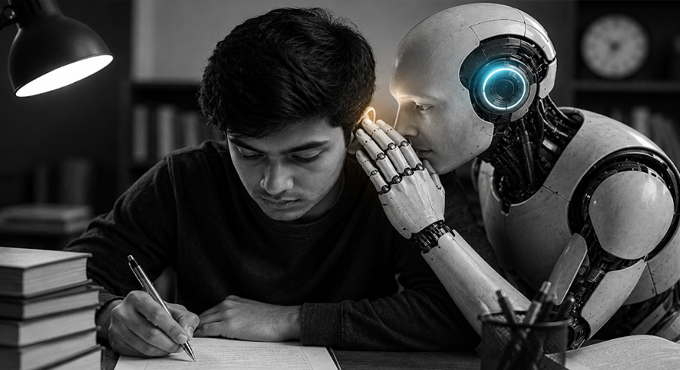
There was a time when cheating in exams meant using micro-slips, copying from a neighbor, or hiding textbooks. Today, times have changed. A single AI chatbot is all it takes to generate anything from a college assignment to a full-length essay in mere minutes. However, allegations are surfacing that this very technology is now sparking major cheating scandals across some of the world’s most prestigious universities. A recent incident at Brown University in the US has triggered a global debate on whether AI is truly acting as a learning aid or if it is directly undermining the traditional examination system.
This is not just a story about a single university; it is a striking reflection of the challenges facing the future of education itself. Students who achieved a staggering 96% in a home-based exam plummeted to just 48% when asked to write the exact same subject inside an examination hall. As the professor points to AI usage as the primary culprit behind this massive performance gap, it has set off an intense global conversation.
The incident, which unfolded at the elite Ivy League institution, raises tough questions about academic standards in the age of Artificial Intelligence (AI). In an economics class, students averaged a brilliant 96% on a take-home midterm exam. However, when the same students walked into the classroom for an in-person, proctored final exam, their average scores crashed to a mere 48%.
Professor Roberto Serrano strongly alleges that this drastic drop is because a significant number of students used AI tools to cheat on their midterms. While he has labeled it the largest cheating scandal in Ivy League history, the development has opened up a much larger, multi-layered debate within the educational sector.
AI Can Get You Marks… But Is It Halting Critical Thinking?
With advanced AI tools like ChatGPT and Gemini, creating well-researched essays, writing complex code, or building detailed project reports has become incredibly easy. Utilizing these tools as a “learning aid” to understand new concepts is one thing, but submitting AI-generated answers as one’s own authentic work is a completely different matter. Navigating the thin line between assistance and absolute dependence is currently the biggest challenge for educational institutions worldwide.
Power Quote: “Is AI enhancing our intelligence, or is it silently shutting down our ability to think?”
Where Does India Stand in This Crisis?
In India, too, the trend of students using AI tools to assist them in their academics is growing significantly. At the same time, a serious discussion has begun among schools, colleges, and educators regarding how to ensure these tools are used responsibly without being misused.
Tech experts and industry leaders warn that while relying entirely on AI might help students secure good marks on paper, it leaves them vulnerable in the real world. When these students face live technical rounds or core problem-solving tasks during job interviews, an inability to demonstrate genuine, independent skills could severely damage their career prospects.
Power Quote: “High marks are no longer definitive proof that real learning has taken place.”
Is This an AI Problem or an Examination Problem?
On the flip side, several educationists firmly argue that completely banning AI in education is a short-sighted and impractical solution. They believe that collaborating with technology and mastering AI tools through skills like prompt engineering will actually be an essential career asset in the near future. Therefore, the real challenge before modern education is not about stopping the use of AI altogether, but rather redesigning evaluation models to accurately test a student’s core analytical thinking, creativity, and unique human effort.
Universities Pivot to New Evaluation Strategies
To tackle this modern challenge, numerous universities in India and around the globe are actively formulating comprehensive AI policies. Educators are brainstorming on how to monitor AI usage in assignments and how to grade students based on their actual self-driven effort rather than just the final output. As a part of this shifting strategy, institutions are now pivoting back to traditional methods, placing a heavier emphasis on in-person pen-and-paper exams and face-to-face oral evaluations (viva-voce).
Conclusion
Although this specific event took place at an American university, the critical questions it raises apply directly to students, parents, and teachers everywhere, including India, where the number of students incorporating AI into their daily learning is rising rapidly.
Embracing technology to expand our knowledge base is undeniably necessary. However, if technology becomes a total substitute for independent thought, it might help secure short-term marks in college, but it will leave students completely unequipped to face the real-world examinations of life and career.
Ultimately, the global education system is left chasing one defining question: Technology can easily fetch you top marks, but can it teach you the critical problem-solving skills required to navigate real life? That is the answer the world is currently trying to figure out.
Related News

Trump’s Name on the Hit List..? High Alert After Israel’s Warning!

Balakrishna’s Blueprint for Mokshagna? Sandeep Reddy Vanga’s Inputs to Refine the Nandamuri Legacy?
Humanoid Robots Take the Scalpel: Is This the Future of Healthcare?

A Key Clue in the Cancer Mystery..! Has an Answer to a Long-Standing Question Finally Been Found?

‘Climate Economy’: How Thailand is Commercializing the Heat..!