
A Climate Warning From 150 Years Ago: Could the Next El Niño Have a Bigger Impact?
- Published By: Tech Team
- July 12, 2026 / 03:30 PM IST


By Surya Prakash Josyula
A few years ago, tomato prices briefly crossed ₹200 per kilogram, leaving families across India shocked. Social media was flooded with memes, restaurants changed their menus, and consumers wondered how prices could rise so dramatically within such a short time.
There was no single reason behind that spike. Local rainfall, transportation issues, supply shortages, storage, and market conditions all played a role. But climate scientists say that, in some cases, the story behind rising food prices begins much farther away than we imagine — in the Pacific Ocean.
That is why scientists around the world are closely watching changes in the Pacific today. They are studying whether rising sea surface temperatures could signal another strong El Niño phase. This is not just an ocean phenomenon. It has the potential to influence agriculture, food production, water availability, electricity demand, and even household expenses in many parts of the world.
Why History Matters
The years between 1876 and 1878 remain one of the darkest chapters in climate history. India, China, Brazil, and several parts of Africa experienced severe drought and widespread food shortages during that period.
According to historians and climate researchers, El Niño was one of the major climate drivers behind that global crisis.
At that time, the world had a much smaller population. There were no satellites, no advanced weather forecasting systems, and no early warning technology. As a result, extreme weather directly affected millions of lives.
Scientists continue to refer to this period not to create fear, but to remind us how even small changes in the climate system can trigger large human consequences.
Why Scientists Are More Concerned This Time
The world today is very different from what it was 150 years ago.
The global population has grown from around 1.4 billion in the 1870s to more than 8 billion today. Water demand has increased, cities have expanded, and agriculture now supports far more people than ever before.
At the same time, the planet itself has changed.
Compared with the pre-industrial era, Earth’s average temperature has already risen by about 1.4°C. That means the climate system is already carrying additional heat. Scientists are therefore studying whether a strong El Niño developing under today’s warmer conditions could produce different impacts than it did in the past.
Climate scientist Mingfang Ting of Columbia University has also emphasized the need to better understand how El Niño interacts with human-driven climate change.
What Exactly Is El Niño?
In simple terms, El Niño is a warming of sea surface temperatures in parts of the Pacific Ocean.
When this happens, atmospheric circulation patterns can change. As a result, some regions may receive unusually heavy rainfall while others may experience below-normal rainfall, heatwaves, or drought conditions.
However, no two El Niño events are exactly the same. Their intensity and impacts vary from one year to another and from one region to another.
Why Should India Care?
At first glance, a climate event in the Pacific Ocean may seem too far away to matter.
But India’s agriculture still depends heavily on the monsoon. If rainfall patterns change, farmers are often the first to feel the impact. Lower agricultural output can affect market supply, which may eventually influence food prices paid by consumers.
At the same time, rainfall is only one part of the picture. Local weather conditions, water availability, government policies, and market dynamics also determine the final outcome.
What Could It Mean for Telugu States?
If monsoon rainfall weakens, water availability in the Krishna and Godavari river systems could come under pressure.
That may create challenges for paddy-growing regions such as Konaseema and the Godavari Delta. Commercial crops like Guntur chilli could also be affected by changing rainfall patterns. Nellore’s aquaculture sector may face challenges if water temperatures and weather conditions become less favourable.
These are not certain outcomes. Their actual impact will depend on local weather conditions, farming practices, and government preparedness.
One Climate Event, Many Lives
A changing climate does not affect everyone in the same way.
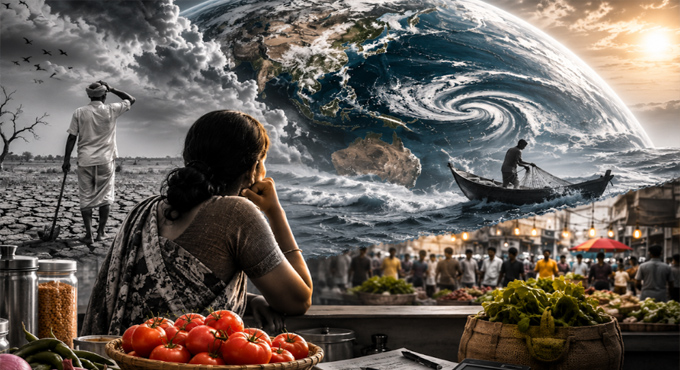
Farmers depend on timely rainfall. Fishermen depend on stable ocean conditions. Families worry about rising food prices, while urban households may also face higher electricity demand during prolonged heat.
Although these challenges appear different, they can sometimes be linked to the same climate event. That is why El Niño is closely monitored not only by climate scientists but also by agricultural experts, economists, and governments.
Should We Be Worried?
The better response is preparedness, not panic.
Unlike 150 years ago, today’s world has satellites, advanced weather forecasting systems, supercomputers, and AI-based climate models. India’s Meteorological Department (IMD) and international weather agencies can detect early warning signs well before major impacts are felt.
If governments, farmers, water managers, and markets respond in time, many of the risks can be reduced.
Conclusion
This story began with tomato prices, but it is really about something much bigger.
When food prices rise, we usually blame the market. When rainfall declines, we blame the weather. But sometimes, both stories begin thousands of kilometres away in the Pacific Ocean.
Climate events often start with small changes over the ocean. Scientists detect those signals first. Their effects may later appear in farms, markets, and eventually in household kitchens.
That is why the world is paying close attention to the Pacific today.
Because this is not just a story about the ocean.
It is a story about food security.
It is a story about farmers.
It is a story about household budgets.
Above all, it is a story about how prepared we are for a changing climate.