
Project Serotonin Launches Tenth-Generation Preventive Health Platform and Precision Health OS in Bengaluru
- Published By: Vishal
- August 11, 2026 / 06:41 PM IST


Project Serotonin officially launched its tenth-generation Preventive Health Platform and proprietary Precision Health OS at the recently concluded “RISE for Healthy Aging, the Longevity India Conference” held at the Indian Institute of Science (IISc) in Bengaluru. Designed specifically for large hospital networks, multispecialty hospitals, clinics, and longevity centers, the modular, ready-to-deploy platform aims to help medical institutions transition from episodic treatments to continuous, personalized preventive care by unifying fragmented health data into actionable insights and measurable patient outcomes.
Bridging Infrastructure Gaps Without Disruption:
Unlike traditional software that forces hospitals to completely overhaul their internal workflows, Project Serotonin’s platform functions as a seamless, complementary prevention layer. It integrates into established clinical pathways to support risk stratification, protocol design, continuous monitoring, patient engagement, and lifestyle behavior change. Crucially, the framework allows clinicians to maintain their existing practices while empowering hospitals to build proactive health strategies without sacrificing core treatment revenues.
The Urgent Need for Proactive Healthcare:
According to World Health Organization (WHO) data, non-communicable diseases account for roughly 75 percent of all deaths globally. Furthermore, in India, non-communicable illnesses frequently manifest three to ten years earlier than in developed nations alongside a dramatic surge in multimorbidity over the past thirty years. A joint assessment by EY and FICCI highlights that appropriate preventive care interventions could successfully lower hospitalizations by 20 to 30 percent. Despite massive advancements in genomics, wearable devices, blood biomarkers, imaging, and artificial intelligence, most healthcare providers continue to analyze these datasets in silos, leaving preventative care fragmented and difficult to scale.
Core Architecture: Precision Health OS and SRTN-pDOS:
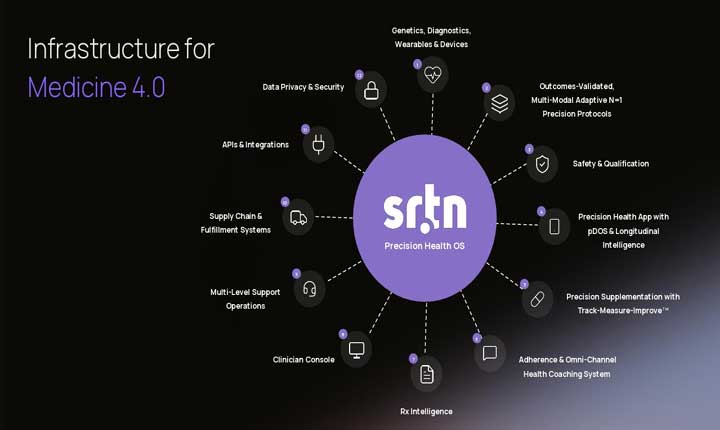
At the heart of the platform sits the proprietary Precision Health OS, an intelligent orchestration engine that evaluates genetic predispositions, biomarker trajectories, lifestyle habits, wearable device data, pharmacogenetic metrics, and clinical histories into a single cohesive profile. Built-in system safety guards manage clinical contraindications, drug interactions, and escalation pathways while maintaining robust data encryption, anonymization, and role-based access controls.
This core intelligence translates directly into the SRTN Precision Daily Operating System (SRTN-pDOS). This individualized care framework converts complex biological metrics into structured, practitioner-guided protocols divided into two main categories: foundational preventive care and targeted therapy-adjunct protocols focusing on specialized areas like gut and cardiovascular health.
Evidence-Based Protocols and Engagement Architecture:
Project Serotonin’s precision protocols draw from an extensive evidence base exceeding 44,000 stratified clinical studies and have been refined via rigorous real-world pilot programs. Spanning nutrition, physical activity, supplementation, sleep optimization, and stress management, the recommendations are delivered through the SRTN App. To combat low adherence rates which the WHO notes can drop as low as 28 percent for regular preventive therapies in developed nations the system incorporates dedicated care concierge teams and health coaches designed to maintain long-term patient engagement and behavioral compliance.
Modular Deployment and Interoperability:
Highlighting the philosophy behind the launch, Dr. Ashwat Visvanathan (PhD), Head of Partnerships and User Outcomes at Project Serotonin, noted that healthcare has heavily prioritized digitization, making the next logical frontier the continuous, intelligent connection of every individual’s health data.
The platform connects twelve previously isolated institutional systems, ranging from diagnostic centers, genomics labs, and wearable trackers to a unified clinician console, an Rx Intelligence tool screened against more than 2,600 medications, patient engagement modules, fulfillment channels, and operational management tools. Hospitals and clinics retain total flexibility, choosing either to deploy the complete end-to-end ecosystem or adopt modular capabilities tailored to their specific operational pace and clinical scope.
Related News

‘Arz Kiya Hai’ by Anuv Jain and Lost Stories Reaches No. 1 on Spotify India and Global Charts
Experts Advocate Prevention, Early Detection, and Community Awareness at World Heart Day Conference

Pullela Gopichand Emphasizes Sports as Essential for Viksit Bharat at PRana 2026
Litemed India Launches ‘Curapod M’, an Innovative Health-Tech Device for Menstrual Pain

Olympian Pranati Nayak to Represent India Solely in Gymnastics at Asian Games 2026