
Pullela Gopichand Emphasizes Sports as Essential for Viksit Bharat at PRana 2026
- Published By: Vishal
- September 21, 2026 / 06:20 PM IST


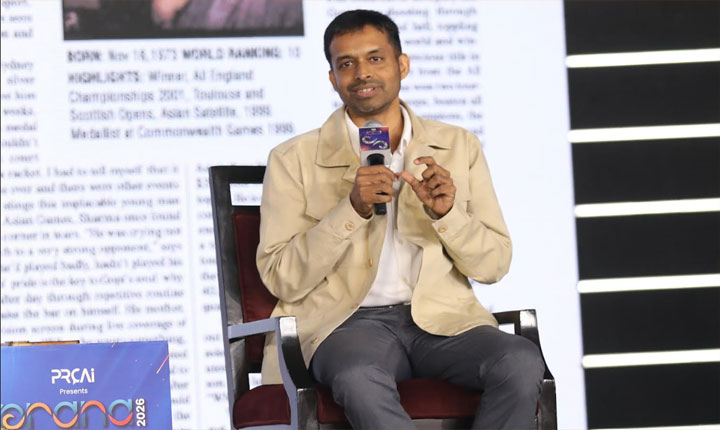
At the third edition of the Brand India Reputation Summit and Story Convention (PRana 2026), Chief National Coach for Indian Badminton and Padma Bhushan awardee Pullela Gopichand asserted that sport is crucial to achieving a Viksit Bharat, emphasizing that education without physical activity remains incomplete. Organised by the Public Relations Consultants Association of India (PRCAI) at The Leela Hotel Ambience in Gurugram, the event convened 250 senior leaders, CXOs, and communications professionals. Gopichand featured as a “pathfinder” speaker in a fireside dialogue titled “The Soft Power That Keeps India on the Bench,” moderated by veteran sports journalist Sharda Ugra. He argued that India’s true sporting reputation depends less on medal tallies and more on ensuring every child has the opportunity to play.
Prioritising Physical Literacy Alongside Academics:
Reflecting on four decades in athletics, Gopichand stressed the urgent need to prioritize physical literacy alongside reading and mathematics. He noted that while academic metrics have advanced over the past thirty years, national physical fitness has declined, leaving older generations fitter than today’s youth. Citing issues such as childhood obesity and flat feet among urban children, he urged a shift toward foundational physical skills such as running, throwing, and movement for every child.
Focusing on Grassroots Participation and Character Building:
Gopichand highlighted that while winning medals is valuable, the primary measure of sporting progress lies at the base of the pyramid. He noted that elite athletic performance does not automatically improve overall public health. Through sports, children learn resilience and how to process failure publicly, preparing them for future setbacks. Recalling a pivotal moment when a thirteen-year-old athlete asked him to teach her basic catching skills, Gopichand explained how his focus expanded beyond elite talent to ensuring that even the least athletic child has a positive experience with sports that encourages lifelong physical activity.
Addressing Equity, Access, and Hyperlocal Infrastructure:
Gopichand pointed out that access, rather than talent alone, often determines whether young athletes can pursue sports. Reflecting on financial hurdles faced by young players and the importance of school support, he remarked that while artificial intelligence might assist with academics, losing interest in physical activity causes lifelong health consequences. Concluding his address, Gopichand advocated for investments in playgrounds and hyperlocal sporting ecosystems, noting that community-funded sports reduce long-term healthcare expenses. He also called for localized research in sports science tailored to Indian demographics, referencing historic physical standards to encourage a renewed national commitment to fitness.
Related News

Litemed India Launches ‘Curapod M’, an Innovative Health-Tech Device for Menstrual Pain
Olympian Pranati Nayak to Represent India Solely in Gymnastics at Asian Games 2026
India Health Forward 2047 Summit Convenes Leaders in Hyderabad to Build Resilient Healthcare Systems
Monsoon Snacking Can Take a Toll on Your Teeth Maintaining Oral Hygiene is Essential: Dr. Sonia Datta
From Prevention to Preservation Everyday Habits That Help Protect Your Heart, Liver and Kidneys