

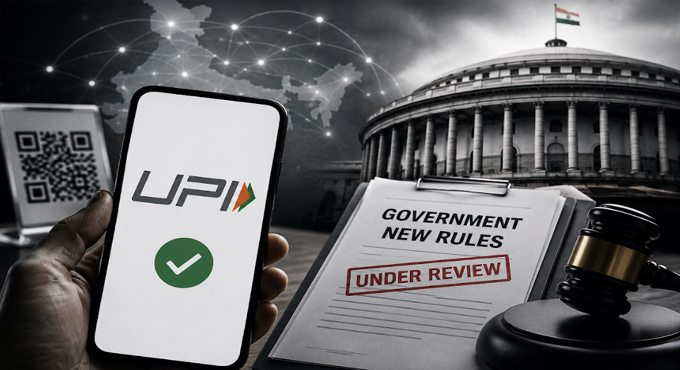
Will UPI Stay Free? Government Reviews MDR for Large Merchants
- Published By: Tech Team
- July 17, 2026 / 08:30 AM IST


— Surya Prakash Josyula
For millions of Indians, paying through PhonePe, Google Pay, or any other UPI app has become part of daily life.
From tea stalls and grocery stores to fuel stations, UPI has made digital payments simple and free. For years, people have believed that using UPI comes with no extra cost.
Now, that could be changing.
The Central Government is reviewing the UPI payment system, raising questions about whether the current zero-fee model can continue in the long run.
The biggest question being asked is simple:
Will UPI payments stop being free?
The discussion has gained attention across the country, with many people wondering whether every UPI transaction could soon attract a charge.
Why Is the Government Reviewing the System?
The issue is not about charging users directly.
The real question is how India’s UPI ecosystem will remain financially sustainable in the future.
Every UPI transaction involves banks, payment service providers, servers, cybersecurity systems, and fraud monitoring infrastructure.
Running these services requires significant investment.
However, since January 2020, the Government has implemented a Zero Merchant Discount Rate (Zero MDR) policy for UPI transactions.
As a result, banks and payment companies receive almost no direct revenue from processing UPI payments, even though they continue to bear the operational costs.
The Government is now examining whether the current model needs changes to ensure the long-term sustainability of the system.
What Is MDR?
Merchant Discount Rate (MDR) is a small service fee paid for processing digital payments.
It is shared among banks and payment service providers that enable the transaction.
To encourage digital payments and promote UPI adoption across India, the Government made MDR zero for UPI transactions in 2020.
That policy helped accelerate the country’s shift toward cashless payments.
The Numbers Behind the Debate
The growth of UPI has been remarkable.
Around 185 billion transactions were recorded during FY25.
That number is estimated to have increased to 240 billion transactions in FY26.
Currently, India processes more than 15 billion UPI transactions every month.
At the same time, Government incentives for digital payments have declined.
Financial support stood at ₹3,500 crore in FY24, but the FY26 Budget Estimate reduced it to ₹427 crore.
Banks and fintech companies have argued for some time that UPI requires a sustainable revenue model.
More recently, a Parliamentary Committee also recommended restoring MDR for large merchants.
What Is the Government Considering?
According to the proposal currently under discussion, MDR may apply only to large merchants with an annual turnover of around ₹1 crore to ₹1.5 crore or more.
The proposed fee is between 5 and 7 basis points, or roughly 0.05% to 0.07%.
This is significantly lower than the 0.3% MDR that existed before 2020.
It is important to note that this remains a proposal.
No final decision has been announced.
Will Consumers Have to Pay?
Based on the proposal currently being discussed, person-to-person UPI transfers will remain free.
UPI payments made to small merchants are also expected to remain outside the MDR framework.
The proposal is focused only on large businesses.
However, the larger question is whether those businesses may eventually pass on the additional cost to customers through slightly higher product prices.
That possibility has become an important point of discussion among industry experts.
Who Benefits and Who Pays?
Banks and payment companies such as PhonePe and Google Pay could benefit because they have been processing billions of transactions without earning direct revenue from MDR.
A stable revenue stream could help them strengthen UPI infrastructure, improve security, and support future growth.
Small merchants are unlikely to be affected, as businesses below the proposed turnover threshold are expected to remain exempt.
Large merchants, however, may have to bear the MDR cost.
If they choose to recover that cost through product pricing, consumers could experience an indirect impact.
Conclusion
For years, UPI has been simple.
Scan.
Pay.
Done.
Now, the discussion has shifted beyond convenience to the economics of maintaining India’s digital payment infrastructure.
Whether the Government introduces MDR, and how that decision ultimately affects businesses and consumers, will become clear in the coming months.
Related News

Biocon Secures Early Global Launch Dates for Pebrilzo Following Genentech Settlement
HDFC AMC Reports 12% Rise in Q2 FY27 Profit Before Tax to ₹9,778 Million, QAAUM Reaches ₹9,691 Billion

UTI Value Fund: Capturing Multi-Cap Opportunities Through a Value-Investing Philosophy

Mahindra Launches XUV 3XO ZNG Starting at ₹9.99 Lakh with Turbocharged CNG Performance
Paramotor Digital and Paras Healthcare Announce Major IPO Developments