

Who Left ₹1 Lakh Crore Behind? RBI Reveals the Shocking Pile of Unclaimed Bank Deposits
- Published By: Tech Team
- August 15, 2026 / 07:10 PM IST


— Surya Prakash Josyula
There could be an old bank passbook somewhere in your house. You may not remember how much money is in the account. You may not even remember who opened it. Years may have passed, but the money could still be sitting in the bank.
Now, imagine this happening across millions of accounts.
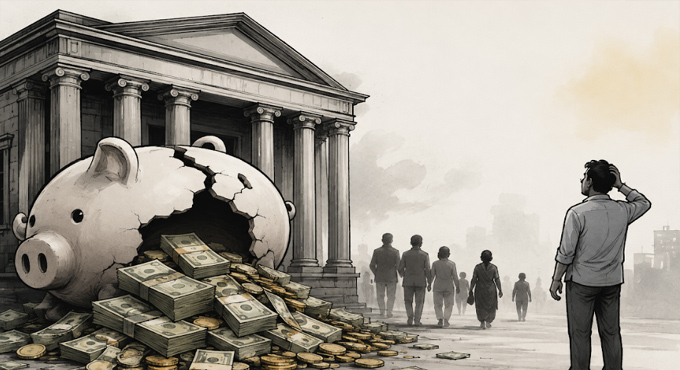
The total amount of such forgotten and unclaimed bank deposits in India has reached ₹98,073 crore, or almost ₹1 lakh crore.
The figure was disclosed by the government in Parliament. As of January 31, 2026, this money had been transferred to the Reserve Bank of India’s Depositor Education and Awareness (DEA) Fund.
But this raises a bigger question: Whose money is it, and why has nobody claimed it?
How does money become ‘unclaimed’?
Not every unclaimed account belongs to someone who simply forgot about their money.
It could be an old savings account opened during a person’s first job. The account may have been left unused after the person moved to another city. Someone may have opened a new account after marriage and forgotten the old one.
It could also be a fixed deposit made many years ago, or an account opened by parents in their children’s name.
Individually, some of these deposits may be small. But when thousands or even millions of such accounts are added together, the amount becomes enormous.
That is how the forgotten savings of individuals have turned into a nearly ₹1 lakh crore pool of unclaimed money.
Some account holders are no longer alive
There is also a more serious reason behind these unclaimed deposits.
Some account holders may have died without their families knowing about their bank accounts or fixed deposits. In some cases, even the nominee may not be aware that the deposit exists.
There are also cases where the legal heirs know about the money but are unable to complete the claim process. They may not have the required documents or may face difficulties proving their legal right to the deposit.
So, the ₹98,073 crore is not simply money that people have forgotten.
It includes money belonging to people who may no longer be alive, families who may not know about the accounts, and heirs who have not been able to complete the required formalities.
When does a bank account become ‘unclaimed’?
The RBI has a clear rule.
If a savings or current account has had no activity for 10 years, it is treated as an unclaimed deposit. Similarly, a term deposit that remains unclaimed for 10 years after its maturity is also classified as an unclaimed deposit.
The bank then transfers the amount to the RBI’s Depositor Education and Awareness Fund.
But there is an important point that many people may not know.
The money does not become the government’s money permanently.
Can the money still be claimed?
Yes.
Even after a deposit is transferred to the DEA Fund, the original depositor or a legally entitled claimant can still recover the money.
The claimant has to approach the concerned bank and complete the required verification and documentation. Depending on the type of deposit and applicable rules, interest may also be payable.
In other words, 10 years of inactivity does not mean that the owner permanently loses the money.
The money remains claimable.
Which banks have the most unclaimed deposits?
Public sector banks account for a large share of the total.
State Bank of India has the highest amount, with ₹20,040 crore in unclaimed deposits. Punjab National Bank follows with ₹7,585 crore, while Canara Bank has ₹6,830 crore.
Bank of Baroda has ₹5,848 crore and Union Bank of India has ₹5,549 crore.
Private banks also have significant amounts. ICICI Bank has ₹2,278 crore, HDFC Bank ₹1,912 crore and Axis Bank ₹1,734 crore in unclaimed deposits.
The numbers show that this is not a problem limited to one or two banks. It is spread across India’s banking system.
How can you check if your family has forgotten money?
This is where the RBI’s UDGAM portal becomes useful.
UDGAM stands for Unclaimed Deposits – Gateway to Access Information. It allows people to search for unclaimed deposits across multiple banks through a single platform.
According to the RBI, the portal currently covers 30 banks, representing around 90% of unclaimed deposits by value.
That means it may be worth checking not only your own name, but also the names of parents or other family members, particularly if they have old bank accounts or fixed deposits.
An old passbook, FD receipt or bank document could potentially lead to money that a family has forgotten about.
UDGAM does not give you the money
There is one important limitation.
UDGAM is a search facility, not a money withdrawal or settlement platform.
If you find an unclaimed deposit through the portal, you still have to approach the concerned bank and complete its claim process. The bank will verify the claimant and the required documents before releasing the money.
The bigger lesson from the nearly ₹1 lakh crore sitting in unclaimed deposits is simple: money can outlive the person who saved it, but it does not have to remain forgotten forever.
Sometimes, the biggest financial asset in a family may not be a new investment or a new bank account.
It may simply be an old one that nobody remembered to check.
Related News

Major Indian Banks Report Strong Q2 FY27 Financial Results with Record Profits and Asset Quality Improvements

KRAFTON Unveils ‘Battlin’, India’s First Unified Esports Tournament Platform for BGMI

Cotecna Expands Global Life Sciences Footprint with Acquisition of Hyderabad-Based Energon Labs

ITC Hotels Signs 104-Key Welcomhotel in Manesar Gurugram to Expand NCR Presence

Weverse Con Festival India Unveils a Landmark Lineup of Global K-Pop and Indian Artists for its Inaugural Edition