
What Makes a Seed VC Say No in 30 Minutes
- Published By: Tech Team
- April 14, 2026 / 11:33 AM IST


Seed VC:Partech’s Alison Imbert on why polished demos and AI-generated decks are the first red flag — not the green light
In an era when any founder can produce a slick prototype in days, the bar for conviction has quietly shifted. The new test is not what you built — it is what you know about the people who need it.
Telugu Times Technology Desk | Source: Tech.eu — What makes a Seed VC say “no” in 30 minutes?
If you walk into a seed pitch with a beautiful demo and not much else, Alison Imbert will likely end the conversation before the half-hour mark. As a Partner at Partech — one of Europe’s leading multi-stage venture firms managing roughly €2.5 to €3 billion in assets — she has seen every variation of the polished-but-hollow pitch. And she has learned to spot it fast.
“The demo is worth nothing. It’s so easy to build,” Imbert says flatly. What she is looking for instead is something far harder to fake: a founder who has done the unglamorous work of sitting across from real customers, listening deeply, and building genuine understanding of a problem worth spending a decade on.
The first question she always asks is simple: how many customers or prospects did you interview in the last two months? The answer — and the quality of detail behind it — tells her almost everything. She does not want polished slides. She wants messy notes. She wants founders who can explain exactly how the pain is articulated, who the buyer is versus the user, and what truly matters in the workflow.
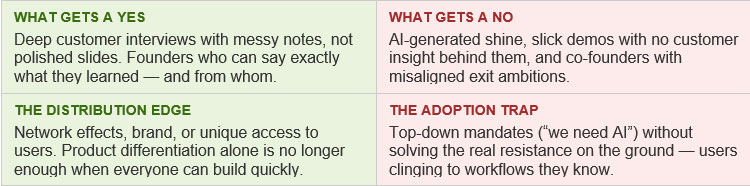
Distribution, she argues, is the new moat. In a market where any team can ship a product in weeks, what endures is the ability to reach and retain users in ways competitors cannot easily replicate. Imbert is particularly focused on the gap between decision-makers who mandate AI adoption from the top and users on the ground who resist changing workflows they have used for years. Founders who understand both layers — and can bridge them — are the ones worth backing.
To stress-test founder credibility, Partech introduces startups to senior technology executives from its network and watches what happens. Are they convincing? Do they hold up under hard questions? Beyond live situations, Imbert runs hypothetical scenarios — a fast-moving competitor, a market shift, a wrong call — to assess how founders think, not just what they have prepared to say.
She is equally focused on the human chemistry of founding teams. She interviews co-founders separately and asks each one: would you take a €20 million exit tomorrow? Misaligned answers, she says, usually end the conversation.
“AI won’t give you deep market insight — only direct conversations with customers will. I want founders who are obsessed with understanding the pain of their customers and willing to spend the next decade working on it.”
— Alison Imbert, Partner, Partech
For technically deep areas — cybersecurity, infrastructure, robotics — Imbert looks for founders who carry genuine authority within their community. Not just credentials, but recognition from other builders who know what good looks like. And across all sectors, she prizes one quality above almost everything else: the ability to say “I was wrong” and mean it. The market is moving too fast for founders who cannot adapt, listen, and course-correct without ego.
For Telugu entrepreneurs building companies anywhere in the world, the takeaway is unambiguous. The AI era has democratised product building. It has not democratised insight. The founders who earn conviction from investors like Imbert are the ones who have put in the time — not in front of a screen, but across a table from the people whose problems they are trying to solve.
By Shiva Duvvuru, CPA. email: [email protected]
Related News

GIRI Opens 39th Showroom and Cultural Hub on MG Road, Puducherry

Citizens Specialty Hospital in Nallagandala Marks World Heart Day with Community Walkathon

JioStar Unveils ‘Har Ghar Mein Jashn’ Festive Playbook to Help Brands Capture Surge in Consumer Spending
Rapido Expands Food Delivery App Ownly to Hyderabad with a Unique Captain Biryani Celebration
Sennheiser Launches MOMENTUM 5 Wireless and MOMENTUM True Wireless 5 in India