
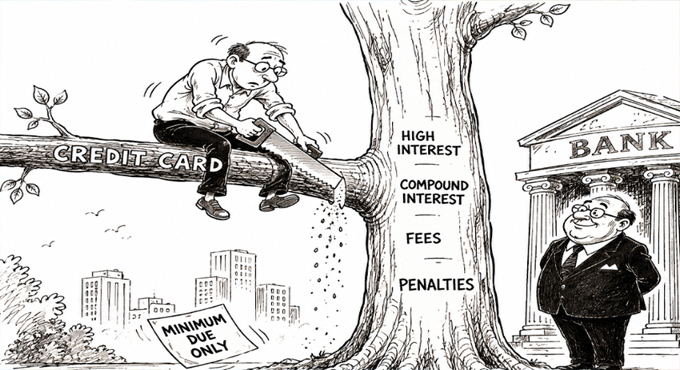
The Credit Card Minimum Due Trap: How a Small Payment Can Turn Costly
- Published By: techteam
- July 24, 2026 / 11:53 AM IST


–Surya Prakash Josyula
“Thank goodness… we survived this month!”
Have you ever felt this way after looking at your credit card bill and paying only the Minimum Due?
Well, there is a small plot twist. You didn’t really clear your bill… you just turned on the bank’s interest meter.
It’s true. That is why there’s a popular saying in the personal finance world: “The Credit Card Trap starts with two innocent words – Minimum Due.”
Most people think Minimum Due means “it’s enough to pay this much.” But its real meaning is: “if you pay this much, we won’t label you a defaulter for this month.” It is not a certificate saying your debt is cleared… it is a notice that your debt continues!
Let’s look at an example:
Suppose you bought a laptop worth ₹1 lakh using your credit card. If you pay the full bill before the due date, most cards offer an interest-free period of 45 to 50 days. But if you put it off for later and pay only the Minimum Due, the story changes completely. There are cards that charge an annual interest rate (APR) of about 36% to 42% on the remaining amount. That translates to roughly 3% or more per month.
If you continue paying only the Minimum Due for a few months, a major portion of the money you pay goes toward interest alone, and your principal balance won’t come down as fast as you expect.
That is why many people get the same doubt:
“I am paying so much money, why isn’t my debt coming down?”
Four Lines in the Statement Most People Ignore
Many people just look at the Minimum Due and make the payment. But in reality, the remaining four lines tell you much more:
Total Amount Due
Payment Due Date
Interest Charged
Annual Percentage Rate (APR)
The Interest Charged line tells you exactly how much of your payment went toward interest. Most people never pay attention to it.
The Secret 90% of People Don’t Know
The moment you pay only the Minimum Due, you lose the “interest-free period” (45–50 days) on your card. This means as long as you have an unpaid balance, every new purchase—from a small packet of milk or vegetables to bigger shopping expenses—will start attracting interest from the very next second you buy it.
Who Do Banks Really Make Money From?
Many people assume that banks make most of their profits from Annual Fees or Late Fees. But that is just a misconception!
The biggest source of revenue for the banking sector is ‘Revolving Credit Interest’. Banks make thousands of crores from customers who do not clear their bills in full and keep rolling their debt forward month after month by paying only the Minimum Due.
It’s Not Just an Interest Problem
Carrying a large balance every month also increases your Credit Utilization. Financial experts generally recommend keeping your credit usage below 30% of your total credit limit to stay financially healthy.
Maintaining a high balance for a long time can negatively impact your credit profile when you apply for home loans, car loans, or other credit in the future.
Is Minimum Due Always Wrong?
No. In situations like an illness, a job change, or a family emergency, it can serve as a temporary relief. But if it becomes a monthly habit, getting out of debt gets much harder.
If paying the full bill isn’t possible, it is wise to check out EMI options or other repayment plans offered by your bank.
The Exit Plan From This Trap!
A credit card is not an enemy. Used correctly, it is a fantastic financial tool that gives you interest-free credit for up to 45 days. Here are 4 clear rules to stay ahead of the game:
Rule 1 (Zero Due Target): Instead of asking “How much should I pay this month?”, ask yourself “How can I close this bill completely (Total Amount Due)?”
Rule 2 (Convert to EMI): If you can’t pay the full bill at once, don’t just settle for the Minimum Due. Immediately convert that amount into an EMI. EMI interest rates (14%–18%) are much lower than credit card interest rates (40%).
Rule 3 (Statement Check): When the statement arrives, don’t just look at the ‘Minimum Due’. Make it a habit to check how much Interest Charged was levied.
Rule 4 (Auto-Debit): If possible, set up auto-debit for the ‘Total Amount Due’. You won’t have to worry about missing the due date.
One Last Thing to Remember…
A credit card bill won’t make you poor overnight. But the habit of pressing the ‘Minimum Due’ button every month will drain your money faster than you can earn it.
Next time your phone buzzes with “Your Credit Card Statement is Ready,” don’t view that small minimum amount as a relief. Recognize it as an alarm warning you about your financial future!
Related News
The Technology Behind Adani’s Rs 3,000-Crore Push Against Power Theft

Our Lives Are a Direct Reflection of Our Standards. Raise Them Without Apology

Keep the Kids Entertained in Dubai This Summer
BUSINESSNEXT Raises USD 40 Million from ServiceNow to Accelerate Autonomous Banking

Hyundai Motor India Foundation and AssisTech Foundation Launch Samarth UnnATi for Assistive Tech Start-Ups