India’s Hidden Banking Revenue: How Minimum Balance Charges Brought in Over ₹7,000 Crore
- Published By: Tech Team
- July 29, 2026 / 12:30 PM IST


By Surya Prakash Josyula
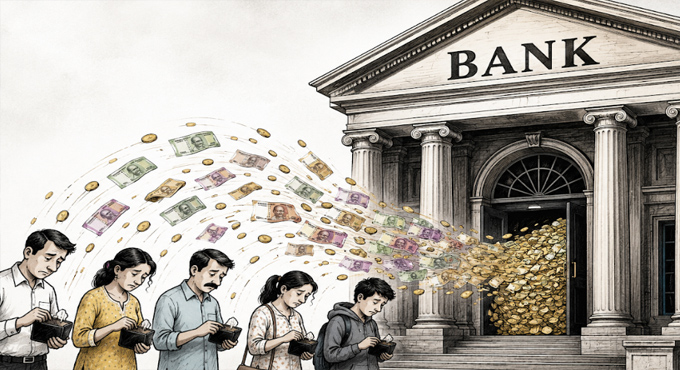
Banks are widely known for generating income through lending, interest spreads, and service fees. Yet one of the industry’s lesser-discussed revenue streams comes from something far more ordinary—the minimum balance requirement attached to millions of savings and current accounts.
According to data tabled by the Government of India in the Rajya Sabha, banks collected more than ₹7,000 crore during FY2025-26 from customers who failed to maintain the prescribed Minimum Average Balance (MAB) in their accounts.
The figures offer an interesting glimpse into how seemingly modest penalties, when applied across millions of customers, translate into a significant source of banking revenue.
A Small Charge, A Massive Revenue Pool
For an individual account holder, a minimum balance penalty may amount to only a few hundred rupees. In isolation, the deduction appears insignificant. At a national level, however, these recurring charges accumulate into thousands of crores.
Of the total collections during FY26, private sector banks accounted for ₹4,948.71 crore, while public sector banks collected ₹2,137.92 crore.
The data also highlights a high degree of concentration. HDFC Bank collected ₹1,798.14 crore, while Axis Bank collected ₹1,081.33 crore. Together, the two institutions accounted for nearly 58 percent of all minimum balance charges collected by India’s 19 private sector banks.
How the Minimum Balance Rule Works
Most banks require customers to maintain a Minimum Average Balance based on the location and category of their branch—metro, urban, semi-urban, or rural. The prescribed balance can range from ₹1,000 to ₹10,000.
When the average monthly balance falls below the required threshold, banks levy a penalty that is automatically debited from the customer’s account.
Because these deductions are relatively small and usually appear among routine banking transactions, many customers remain unaware of them unless they regularly review their account statements.
Diverging Banking Strategies
The data also reflects two distinct approaches within India’s banking sector.
Over the past few years, several public sector banks have either reduced or removed minimum balance penalties as part of broader financial inclusion efforts. Institutions such as SBI have relaxed these requirements for many categories of customers.
Private sector banks, however, continue to treat minimum balance charges as an established component of their fee-based income.
This divergence is reflected in the numbers. Despite having fewer institutions, private banks collected more than twice the amount reported by public sector banks during FY26.
Who Ultimately Pays?
The burden of these charges is rarely distributed evenly.
Customers with large account balances are unlikely to trigger minimum balance penalties. Those most affected are often salaried employees whose balances decline toward the end of the month, students managing limited funds, pensioners, and small business owners dealing with fluctuating cash flows.
For these groups, repeated deductions can gradually erode already limited savings.
The Regulatory Position
Despite periodic public debate, the Reserve Bank of India has maintained that banks are free to determine their own minimum balance requirements and the associated charges.
At the same time, certain account categories—including Basic Savings Bank Deposit Accounts (BSBDA) and Pradhan Mantri Jan Dhan Yojana (PMJDY) accounts—remain exempt from such penalties.
A Growing Policy Debate
The latest parliamentary disclosure is likely to renew discussions around the balance between commercial banking practices and financial inclusion.
While banks view minimum balance charges as a legitimate fee for maintaining accounts, critics argue that the burden falls disproportionately on customers who are already financially constrained.
As India’s banking system continues to expand, the debate is no longer merely about fee income. It increasingly raises a broader question: Should access to basic banking services carry a financial penalty for customers who are least able to maintain minimum balances?
Related News
Major Indian Banks Report Strong Q2 FY27 Financial Results with Record Profits and Asset Quality Improvements

KRAFTON Unveils ‘Battlin’, India’s First Unified Esports Tournament Platform for BGMI

Cotecna Expands Global Life Sciences Footprint with Acquisition of Hyderabad-Based Energon Labs

ITC Hotels Signs 104-Key Welcomhotel in Manesar Gurugram to Expand NCR Presence

Weverse Con Festival India Unveils a Landmark Lineup of Global K-Pop and Indian Artists for its Inaugural Edition