

BluJ Aerospace Unveils Gen #2 Aircraft, Validating India’s First Platform-Based eVTOL Architecture
- Published By: techteam
- May 26, 2026 / 04:30 PM IST


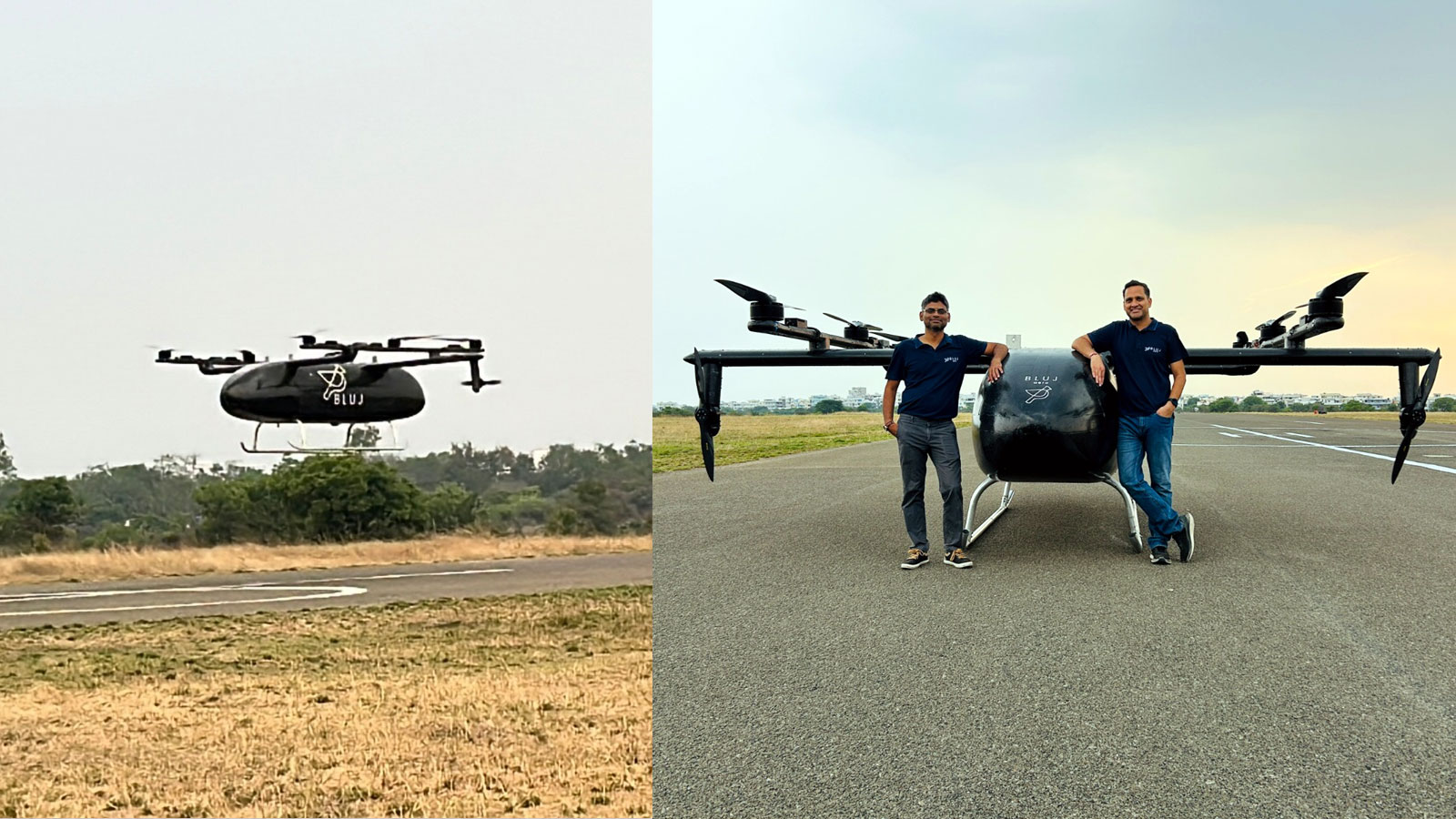
Hyderabad-based deep-tech startup BluJ Aerospace has officially unveiled its Gen #2 prototype, marking a significant milestone in India’s advanced air mobility sector. Developed after 4 years of intensive in-house research and development, Gen #2 is the first aircraft built on VANTIS—the company’s proprietary, platform-based architecture designed to scale efficiently across various vertical take-off and landing (VTOL) variants.
The announcement follows the success of Gen #1, BluJ’s initial technology demonstrator which achieved India’s first public flight demonstration of a 500 kg class eVTOL. The newly unveiled Gen #2 is already undergoing active flight testing, positioning BluJ as a frontrunner in India’s heavy-payload aerial logistics market.
The Power of the VANTIS Platform
Unlike traditional aerospace programs that focus on single-product development, BluJ is leveraging the VANTIS architecture to standardize core subsystems, including the airframe, propulsion, controls, and autonomy systems. This common foundation ensures that future aircraft variants inherit proven technologies, drastically reducing development costs and accelerating time-to-market.
Amar Sri Vatsavaya, Founder and CEO of BluJ Aerospace, highlighted this strategic shift:
“The next major shift in aviation is the move from single product programs to platform-based architectures. Just as the automotive industry builds multiple vehicles on a common platform, Advanced Air Mobility will need adaptable architectures that scale across missions, payloads, and customer use cases. That is the advantage VANTIS gives BluJ.”
Commercial Capabilities and Specifications
Gen #2 is a commercial-grade, fully battery-powered aircraft purpose-built for heavy-payload logistics. It operates with a lift-plus-cruise configuration and features:
Maximum Take-Off Weight: 500 kg
Active Payload Target: Above 200 kg
The aircraft is currently being utilized for early customer pilots, payload testing, and real-world logistics mission evaluations. The scalability of the VANTIS platform allows BluJ to chart a long-term roadmap that extends to a 1-ton payload class for heavy logistics, with regional passenger mobility as the ultimate destination.
Market Traction and the Hydrogen Ecosystem
BluJ Aerospace has built a robust commercial pipeline spanning infrastructure logistics, express cargo, energy, airports, and defense. The company has already completed a successful pilot deployment with a leading Power sector PSU and maintains active defense partnerships with a major Defence PSU and Indian defense primes.
Looking toward future long-range variants, BluJ is aggressively developing hydrogen-electric propulsion systems. The company has already built a ground version of the system, featuring an in-house Type IV composite hydrogen tank. Flight-ready hydrogen-electric variants are targeted for 2027 to 2028. To support this vision, BluJ is collaborating with Bharat Petroleum Corporation Limited (BPCL) and Cochin International Airport Limited (CIAL) to establish the necessary hydrogen ecosystem.
Investor Confidence
The company’s platform-centric engineering approach has garnered strong support from its investment partners. Sateesh Andra, Managing Director of Endiya Partners, noted that BluJ is proving that Indian deep-tech can build globally relevant aerospace intellectual property from the ground up. Similarly, Naganand Doraswamy, Managing Partner of Ideaspring Capital, emphasized that categories like aerospace are won by teams building platforms rather than single products, predicting VANTIS will shape India’s presence in global aerospace over the next decade.
Operating from a 40,000-square-foot facility in Hyderabad with a team of over 50 engineers, BluJ Aerospace holds an issued design patent on its eVTOL architecture and has multiple utility patents pending across its airframe, propulsion, and powertrain systems.
Related News
Driving the Future – Maruti Suzuki Unveils Advanced Manufacturing Lab to Champion India’s Skill Mission

HDFC Securities Launches New Hybrid and Remote Work Framework to Boost Employee Flexibility

The Warrior with No Feet :Stolen art, and the long road home

String Metaverse Reports Record FY26 Revenue of ₹1,069 Crore

Vizag Shifts Towards Protein-Rich Diets Through Everyday Staples