

The Warrior with No Feet :Stolen art, and the long road home
- Published By: shivaduvvuru
- May 26, 2026 / 03:24 PM IST


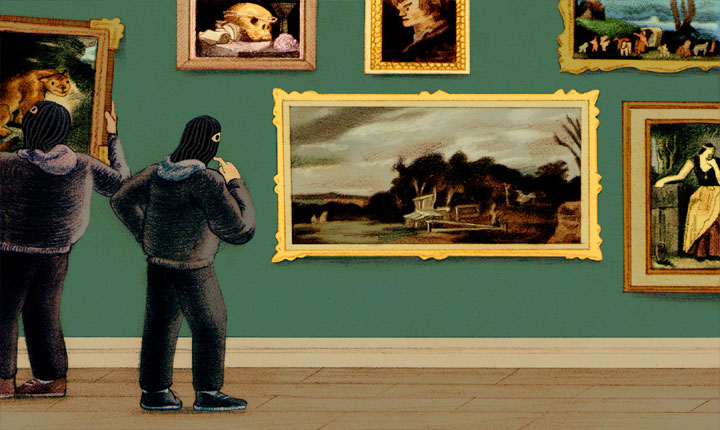
art crime: When thieves climbed a borrowed furniture lift to the Louvre’s Apollo Gallery on a Sunday morning in October 2025, smashed open display cases with angle grinders, and disappeared on scooters with around $102 million in Napoleonic jewels, the world reacted with a familiar mix of disbelief and fascination. Seven minutes inside the most visited museum on the planet. Seven months later, several suspects are in custody but the jewels have not been found. The Louvre heist is unusual only in its theatricality. Art crime, in less cinematic forms, happens every day.
A trade hiding in plain sight:
Interpol ranks art and cultural property crime among the highest-grossing illicit trades in the world, behind drugs, arms, and human trafficking. UNESCO has put the value of the illicit cultural property market at roughly $10 billion a year. The FBI’s own estimates land at $4 to $6 billion annually. Precise figures are impossible because most theft is never reported and most stolen objects are never registered in any database. Interpol’s Stolen Works of Art file holds close to 57,000 entries, and the privately run Art Loss Register tracks around 700,000 — but global estimates suggest tens of thousands of new objects vanish from collections, churches, archaeological sites, and private homes every year.
The FBI’s Art Crime Team, founded in 2004, has recovered more than 20,000 pieces with a market value of roughly $900 million in two decades of work. That sounds impressive until you set it against the scale of what is missing. Recovery rates for stolen art have been estimated in the single digits for years. The Isabella Stewart Gardner Museum in Boston is still waiting, thirty-six years on, for the thirteen works snatched in March 1990 a Vermeer, three Rembrandts, a Manet, several Degas drawings. The empty frames still hang in the gallery where the paintings once were.
Two different problems wearing the same name:
What we call “stolen art” actually covers two very different phenomena. One is the museum heist or the grab-and-run from a private collection — the kind of crime that produces front-page photographs of empty walls. The other is heritage looting: the slow, organized stripping of archaeological sites and houses of worship in countries weakened by war, poverty, or weak governance, with the proceeds funneled through brokers and dealers into the legitimate market. The first kind generates headlines. The second produces most of the objects.
Heritage looting is the harder problem because the chain is longer and the laundering is more sophisticated. An idol prised from a temple lintel in one country crosses a border on the back of an oxcart, is sold for cash to a regional broker, moves to a transshipment hub like Bangkok or Geneva, acquires a polite paper trail somewhere along the way, and eventually surfaces in a London gallery catalog or a New York auction house with a provenance that reads “Swiss private collection, acquired in the 1960s.” By the time the piece reaches its final buyer, the original theft is three or four owners and several decades in the past, and the price has multiplied by something like a hundred.
The Duryodhana:
The case that best illustrates how all of this works and that has reshaped the law around stolen antiquities for more than a decade concerns a ten-foot-tall, half-ton sandstone warrior carved in Cambodia in the early tenth century. The figure depicts Duryodhana, the antagonist of the Mahabharata, captured by the sculptor in mid-leap, knees bent, ready to fight his cousin Bhima. It once stood in a tableau of wrestlers at Prasat Chen, a temple inside the ancient city of Koh Ker, about seventy miles northeast of Angkor. In 1972, during the chaos that preceded the Khmer Rouge’s seizure of power, looters hacked the statue off its pedestal and trucked it out of Cambodia. The feet were left behind, still sticking out of the ochre soil eventually the forensic clue that would tie the statue irrefutably to its origin.
The Duryodhana surfaced in London at the dealer Spink & Son, was sold to a Belgian collector in 1975, and quietly entered the international market. In 2010 his widow consigned it to Sotheby’s in New York, which valued it at $2 to $3 million and put it on the cover of an Asia Week sale catalog. Cambodia objected. Sotheby’s pulled the piece from auction but refused to surrender it, and in 2012 the U.S. Attorney for the Southern District of New York filed a civil forfeiture action under the National Stolen Property Act. After a two-year fight, Sotheby’s agreed in December 2013 to return the statue. At the repatriation ceremony in Manhattan in 2014, U.S. Attorney Preet Bharara called the Duryodhana “a priceless piece of Cambodia’s cultural history” that had been stolen four decades earlier.
The Duryodhana was the first domino. Its companion Bhima, held at the Norton Simon Museum in Pasadena, came home the same year. The Metropolitan Museum of Art returned two kneeling attendants from the same temple complex. By 2024 several more figures from the Prasat Chen tableau had been recovered. Cambodian authorities are still looking for the rest.
What investigators didn’t fully understand at the time was how systematic the trade had been. New reporting in Bloomberg Businessweek by Matthew Campbell, adapted from his book The Man Who Stole the Gods, has filled in the picture. A Phnom Penh-based American lawyer named Bradley Gordon, hired as a Department of Justice consultant in 2012, spent years interviewing former Khmer Rouge fighters and villagers along the trafficking corridor toward the Thai border. He eventually found the looter who had supplied much of the merchandise: a man named Toek Tik, a former child soldier who built the largest looting operation in Cambodia after the war and sold to a single dominant buyer in Bangkok he knew only as “Sia Ford.” That buyer was Douglas Latchford, a British dealer based in Thailand who had spent fifty years placing Khmer masterpieces in major museums and private collections. The investigation that began with one statue eventually exposed what may be the largest single-source antiquities trafficking operation in modern history.
The argument for sending things back:
Restitution has become the defining art-world story of the past decade, and not just for Cambodia. The Netherlands has announced the return of more than a hundred Benin Bronzes to Nigeria. Greek campaigns for the Parthenon Marbles continue, with the British Museum signaling cautious openness to some kind of arrangement. Major institutions the Met, the Smithsonian, the Pitt Rivers — have begun to publish provenance research and quietly return objects whose acquisition histories will not survive scrutiny.
Resistance to repatriation usually rests on a version of the same argument: that universal museums preserve objects for everyone, that source countries lack the resources to protect what they recover, that opening the door invites a flood. Each of these claims looks weaker than it did a generation ago. Cambodia built a wing of the National Museum in Phnom Penh specifically for the Koh Ker reunifications. Nigeria is building the Edo Museum of West African Art around the returning Bronzes. The flood, when it comes, turns out to be manageable.
What’s actually at stake:
The looted object is never just an object. The Duryodhana stood for a thousand years next to its kin in a temple courtyard, part of a sculptural conversation that a sculptor in the tenth century designed it to have. Removed, it became a beautiful but mute commodity, valued at a few million dollars and displayed alone in a New York saleroom. Returned, it is once again part of something. The argument for taking stolen art seriously — for funding the small police units that investigate it, for the slow, unglamorous due diligence that auction houses are finally being forced to do, for the international cooperation that makes repatriation possible is that the stakes are not really financial. They are about whether a place gets to keep the things that made it that place.
That is also the argument, in the end, against the Sotheby’s defense, and against the long line of dealers and curators who told themselves the provenance was fine because it was easier than asking. The statue’s feet were still in the ground.
Sources & Credits
Related News

Stars Unite in Mumbai for The Earthshot Prize 2026 Awards Night Prime Video Named Exclusive Streaming Partner

HCCB-Backed Archer Ganesh Mani Ratnam Thirumuru Wins Gold and Bronze at 20th Asian Games

Ultraviolette Expands Retail Footprint with New UV Space Station in Anantapur

Amazon Expands Ultra-Fast Delivery Service ‘Amazon Now’ to Over 120 Cities Across India

GREW Solar Announces Channel Partnership with Energy Cubez in Kerala