
The Sunset and the Nature of Reality
- Published By: shivaduvvuru
- August 5, 2026 / 01:41 PM IST


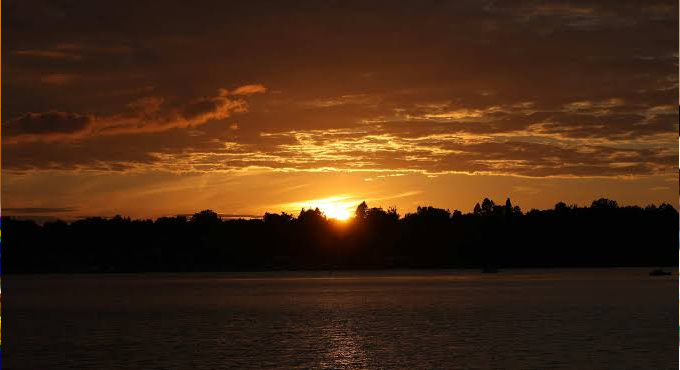
Every evening, the Sun sinks toward the horizon.
The sky changes color. The light fades. For a moment, the Sun seems to rest at the edge of the Earth. Then it disappears.
We call this a sunset.
The colors are real. The fading light is real. Our experience is real.
But the Sun is not sinking.
The Earth is turning.
The sunset offers a simple lesson: what we experience may be real without being reality exactly as it is.
The World We Experience
We do not encounter the universe directly. We encounter it through our senses.
Our eyes detect only a narrow part of the electromagnetic spectrum. Our ears hear only a limited range of sound. Other creatures perceive parts of the world hidden from us.
Each creature inhabits the same world through a different window.
Our brains turn limited signals into colors, sounds, shapes, and meanings. What we experience is reality interpreted through the instruments available to us—not necessarily reality in its entirety.
Appearance and Reality
A sunset is not an illusion. Something is happening. Light passes through the atmosphere. Our eyes receive it. Our minds experience its colors.
But the appearance—the Sun moving downward—is not the deeper physical explanation.
The experience is genuine. The interpretation is incomplete.
This offers a way to understand the Advaita Vedānta interpretation of the Upanishadic idea of Māyā.
Māyā is often translated as “illusion.” The word can mislead. It may suggest that the world does not exist or that life is only a dream.
A more careful understanding is that the world we experience is shaped by perception. It is not false. But it may not reveal reality in its deepest form.
We see the sunset. We do not feel the Earth turning beneath us.
Both belong to the same event—one as experience, the other as explanation.
The Reality Beneath Change
The Upanishads distinguish between the changing world we experience and an ultimate reality called Brahman, or the Absolute.
Everything we perceive changes. Bodies age. Civilizations disappear. Thoughts pass from moment to moment.
The Absolute is described as the unchanging reality beneath these appearances—the foundation from which everything arises, within which everything exists, and into which everything dissolves.
The distinction is not between a real world and an unreal one. It is between reality as we experience it and reality in its deepest nature.
Waves rise and vanish.
The water remains.
The Upanishads ask us to look beyond the waves and consider the water.
Schrödinger’s Question
This way of thinking fascinated Erwin Schrödinger, one of the founders of quantum physics.
Quantum physics had revealed a microscopic world that defied ordinary intuition. An electron could not always be pictured as a tiny grain of matter occupying one definite place.
Schrödinger also studied consciousness and the Upanishads. He faced a profound question:
If the world we experience depends upon perception, why do we not each experience a separate world?
I look at a flower. You look at the same flower.
Our private experiences may differ. The color may appear slightly different to each of us. Yet we agree that a flower is there.
The same is true of mountains, rivers, planets, and stars. Billions of minds appear to share one coherent world.
What accounts for that unity?
Many Windows, One Light
Schrödinger found a possible philosophical answer in the Upanishads.
Our minds appear separate. My thoughts are not yours. Your experiences are not mine.
Yet the Upanishads suggest that this separation may exist only at the surface. Beneath it may lie a deeper unity.
Imagine sunlight entering a house through many windows.
One window is large, another small. One is clear, another colored. The light in each room appears different.
But its source is one.
In the same way, human beings may be separate expressions of one underlying consciousness. The minds are many. Their deepest foundation may be one.
This idea helped Schrödinger understand why we experience a shared world. If consciousness is fundamentally one, billions of isolated minds are not creating billions of separate realities. The many observers may arise from one deeper ground of awareness.
It was a philosophical answer, not an experimental discovery.
Physics and Philosophy
Quantum physics does not prove universal consciousness. It does not prove Brahman.
It gives us an extraordinarily successful mathematical account of experimental results. But physicists still debate what those results reveal about the ultimate nature of reality.
Schrödinger did not claim that physics had proved the Upanishads. He found in them a way to approach questions that physics had opened but could not finally answer.
Physics investigates nature through measurement, mathematics, and experiment. The Upanishads approach existence through philosophical inquiry and reflection on consciousness.
They may stand before the same mystery. But they reach it by different paths.
The Window
We are not mistaken when we say that the Sun sets. We describe the world as it appears from where we stand.
Perhaps much of human experience is like the sunset: genuine, yet not the final description of reality.
The Upanishads suggest that beneath apparent separateness lies a deeper unity.
Every sunset therefore carries a quiet invitation.
Experience what we see.
But do not assume that seeing is the whole of knowing.
The Sun appears to descend.
The Earth turns.
The experience is real.
And reality remains deeper than it appears.
Wonder.
Acknowledgment: This article was inspired in part by Shri Vemuri Venkateswara Rao’s Telugu essay “గుళిక వేదాంతం”, published in Eemaata in September 2023.