
The Mystery Parcel Business: Why Millions Are Paying for a Surprise
- Published By: Tech Team
- August 3, 2026 / 10:15 AM IST


— Surya Prakash Josyula
Do you remember a popular game from village fairs during childhood? A large board would display pictures of gods or movie stars, and for a small fee you could pick one. If luck was on your side, there might be a ₹10 note hidden behind it. If not, you walked away empty-handed. Yet the money was never the biggest attraction. The real excitement came from not knowing what was hidden behind the picture. That same feeling of curiosity has now returned in Europe, but in a completely different form.
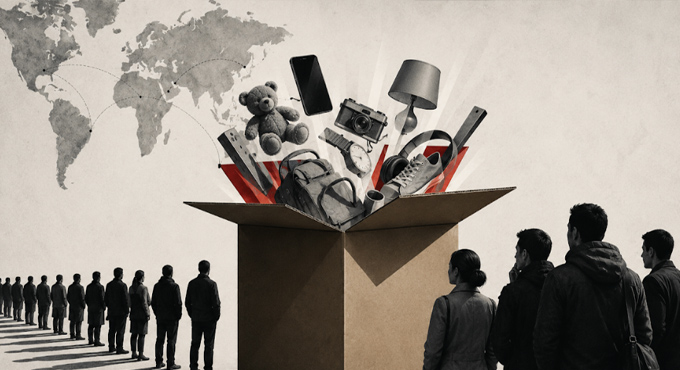
Across several European countries, people are paying money to buy sealed parcels without knowing what is inside. These are not specially packed gift boxes. They are returned parcels from Amazon and other online retailers. Customers simply choose a package based on its size or weight, pay for it, and open it on the spot. The experience has become a new form of retail entertainment, attracting thousands of curious shoppers.
Mystery parcel stores have become particularly popular in Amsterdam, where visitors spend time picking through stacks of unopened packages before making their choice. The excitement begins the moment the box is opened. Some customers have discovered smartphones worth hundreds of euros, while others have found tool kits, kitchen accessories, clothing, mattresses, baby products or household items. In many cases, the value of the item is secondary. What customers are really paying for is the thrill of discovering the unknown.
The business is built on one of the biggest side effects of modern e-commerce: product returns. Every year, millions of online purchases are sent back because customers order the wrong size, change their minds or cannot receive the delivery. Not every returned product goes back onto store shelves. Some parcels have damaged packaging, incorrect shipping labels or become too expensive to process. These packages are often sold in bulk to liquidation companies at a fraction of their original value. Mystery parcel retailers purchase those lots and resell the unopened boxes without knowing their contents.
The growing popularity of these stores has also raised an obvious question: is this shopping or gambling? Store owners argue that the comparison is unfair because every customer receives a product. Unlike gambling, where people may walk away with nothing, mystery parcel buyers always leave with an item. What remains uncertain is its value. That uncertainty is exactly what makes the experience attractive.
Consumer psychologists say the success of mystery parcels has less to do with the products themselves and more to do with human behaviour. People naturally enjoy surprises. The excitement of opening a gift, waiting for a lottery result or avoiding movie spoilers all comes from the brain’s anticipation of an unknown outcome. Mystery parcels tap into the same psychological response, turning curiosity into a product that consumers are willing to pay for.
The trend also reflects a broader transformation in the retail industry. Shopping is no longer just about purchasing goods. Increasingly, it is about creating memorable experiences that cannot be replicated online. Just as cafés are designed for Instagram photos and restaurants for social media content, mystery parcel stores are built around the unboxing experience. Many customers even buy the parcels primarily to film their reactions and share them on platforms like TikTok and Instagram.
Beyond entertainment, the business also has a sustainability angle. Instead of allowing returned goods to remain in warehouses or become waste, mystery parcel retailers give many of these products a second life. In doing so, they create a new revenue stream from items that might otherwise have little commercial value, while also reducing unnecessary waste generated by the e-commerce industry.
The concept raises an interesting question for markets like India. If mystery parcel stores selling returned Amazon or Flipkart packages were to open in cities such as Hyderabad, Vijayawada or Visakhapatnam, would consumers embrace the idea? Given India’s growing e-commerce market and the popularity of surprise-based content on social media, the model could find a ready audience.
Perhaps that explains why the concept feels so familiar. Every generation creates its own version of excitement. One generation paid a rupee to pick a picture at a village fair. Today’s generation pays to open a mystery parcel. The game has changed, the prizes have changed and the prices have certainly changed. But the curiosity that drives people to ask, “What’s inside?” remains exactly the same. In Europe, that simple human instinct has now grown into a multi-million-dollar business.