

Restaurants Are Banning Tips.. Why? Here’s the Real Reason!
- Published By: Tech Team
- August 26, 2026 / 10:34 AM IST


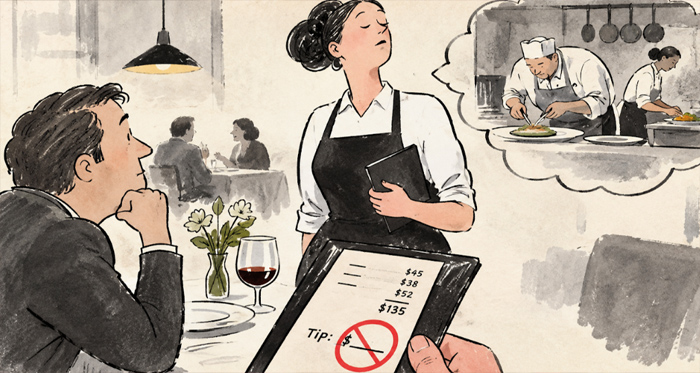
You may soon stop seeing tip jars and tip screens at some restaurants. You may want to give a tip out of kindness, but the restaurant may simply tell you, “No tips, please.” Don’t worry, this is not happening in India yet. This is a growing trend in the US. And if it works there, there is a good chance some Indian restaurants may try it too.
But why are American restaurants suddenly taking tips so seriously? Why are some restaurant owners asking customers not to tip their staff? That is where the interesting story begins.
A new trend is growing in the US. Some restaurants are removing tips and instead paying their staff higher salaries. Their message is simple: “Our employees should not have to depend on tips from customers. We will pay them properly.”
But why make such a big change?
Think about a normal restaurant. The person you see most is the server. But behind that person, there is a whole team working in the kitchen. They prepare the food, get the plates ready and work for hours, often without being seen by customers. But when a customer leaves a tip, most of that money usually goes to the front-of-house staff.
Rachel Miller, owner of Nightshade Noodle Bar in Massachusetts, did not like this system. She felt it was unfair that two people working the same number of hours could take home very different amounts simply because one received more tips.
She also noticed another problem. Tips can sometimes be affected by gender, race or even a person’s appearance. Miller said she did not want a customer’s personal choice to decide how much money her employees earned.
So she removed tips and increased staff wages.
But here comes the interesting part.
The tip disappeared, but the money did not.
Restaurants still have to pay their workers. So when they stop taking tips, they often increase menu prices to cover the higher salaries.
For example, a meal that once cost $80 may now cost $100. But after paying that $100, the customer does not have to add another $20 as a tip.
Here comes the mind game
This is where things get interesting.
When customers see a $100 bill, they may think, “Wow, that’s expensive!”
But if they see an $80 bill and then add a 20% tip at the end, it may not feel as expensive.
In other words, people often judge the cost by the number they first see on the menu, rather than thinking about the final amount after the tip.
That is one reason why some restaurants tried the no-tip system and later went back to tipping.
For example, Talulla, a restaurant in Massachusetts, removed tips and increased menu prices by 23% to pay staff better. But the system did not work for long. The restaurant eventually brought tips back.
But employees see it differently
For workers, the story can be very different.
A server who depends on tips may make $200 on one day and only $80 on another. It depends on the customers, how busy the restaurant is and how much people decide to tip.
And when someone leaves a small tip, the server may even wonder, “Was my service bad? Did I do something wrong?”
With a no-tip system, the calculation is much simpler.
“I work this many hours, and I earn this much.” That’s it.
One restaurant worker who previously earned about $10 an hour plus tips started earning $21 an hour after the restaurant removed tips. She liked the change because she finally knew how much money she would make.
There is another reason behind the change: tip fatigue.
In the US, customers are increasingly being asked for tips everywhere. Coffee shops, food deliveries, restaurants and even some small services now show a tip option on the payment screen.
So people are starting to ask:
“Why do I have to tip for everything?”
That frustration is pushing some restaurants to say:
“The full price is already on the menu. You don’t have to pay anything extra.”
Still, tips are unlikely to disappear completely anytime soon. Good servers can sometimes make much more money through tips, and restaurants that remove tips may find it harder to attract and keep experienced staff.
So this is not simply a story about whether customers should tip or not.
The bigger question is:
Should a restaurant worker’s income depend on the customer’s mood and generosity? Or should the restaurant owner guarantee a fair wage?
Some American restaurants are choosing the second option.
For customers, the new system sounds very simple.
The bill comes. You pay it. You leave. No tip calculation.
But remember one small twist:
When a restaurant stops asking for tips, the cost of that tip may already be included in the menu price.
—Surya Prakash Josyula
Related News
Wife Files a Case? What Should You Do – and What Should You Avoid?

Ice Batteries: Storing Cold Instead of Electricity? Here’s How It Works
Do You Need to Pay ₹1 Crore to Go to America? Trump’s New H-1B Shock

Shocking: Are Governments Using Criminals to Carry Out Killings?
Flying Abroad from India? This Airport Routine Is About to Disappear