

India Takes on Deepfakes With an AI-Powered Counterattack
- Published By: Tech Team
- August 4, 2026 / 11:15 AM IST


— Surya Prakash Josyula
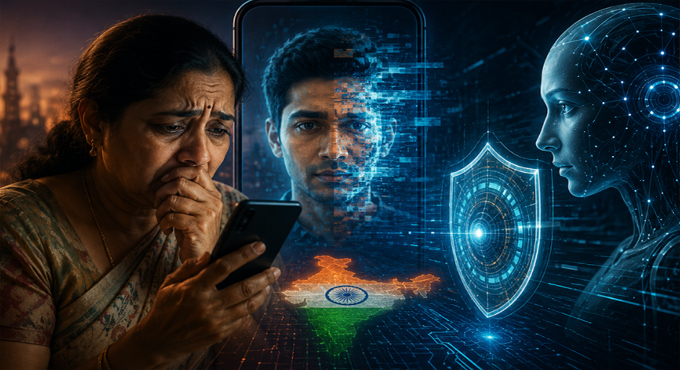
Imagine receiving a phone call from your son asking for help. His voice sounds exactly the same, and he tells you he is in serious trouble and urgently needs ₹2 lakh. Without a second thought, you transfer the money. A few hours later, you discover the painful truth—the call never came from your son. It came from an AI system that had perfectly cloned his voice.
This is no longer science fiction. Voice deepfake scams are becoming increasingly common across the world, and India is no exception. At the same time, another threat is growing rapidly. A fake video using your face could appear on social media overnight, making it look as if you said or did something that never actually happened. In the age of artificial intelligence, criminals are no longer interested only in stealing passwords or bank details—they are trying to steal identities.
Cybersecurity experts warn that the photos, videos, and voice clips people casually upload to social media can become valuable training material for deepfake creators. As AI tools become more powerful and accessible, distinguishing between what is real and what is fake is becoming increasingly difficult. We grew up believing that seeing is believing, but today even a convincing video or a familiar voice may no longer be enough to establish the truth. In many ways, trust itself has become the biggest casualty of the AI era.
To deal with this challenge, India has decided to take an unusual approach—fight AI with AI. Just as the saying goes that “only a diamond can cut another diamond,” the government wants to use artificial intelligence itself to detect and stop AI-powered fraud. As part of this strategy, it has approved 13 Responsible AI projects that focus on identifying deepfake videos, cloned voices, and manipulated digital content before they can cause widespread harm.
The government has also introduced one of its most significant regulatory changes. Until now, social media companies had up to 36 hours to remove illegal AI-generated content after receiving a valid government or court order. During that period, fake videos could spread rapidly, damaging reputations, careers, and even families. Under the amended IT Rules, that window has now been reduced to just three hours. The objective is to prevent harmful synthetic content from remaining online long enough to go viral.
Several of the newly approved AI projects focus specifically on deepfake detection. IIT Kharagpur is developing a real-time voice deepfake detection system capable of identifying AI-generated voices during live conversations. IIT Jodhpur and IIT Madras are jointly building Saakshya, a framework designed to detect manipulation in both audio and video files. Another project, AI Vishleshak, aims to identify digital forgeries across different forms of media. Together, these technologies represent India’s attempt to turn AI from a weapon used by criminals into a tool that protects citizens.
The new rules also place greater responsibility on social media platforms. Companies will be expected to identify AI-generated content, apply appropriate labels where necessary, preserve metadata that can help investigators trace manipulated files, and deploy automated systems to reduce the spread of illegal synthetic media. In other words, tackling deepfakes is no longer just the government’s responsibility; technology platforms will also be expected to play a much more active role.
The urgency of these measures has been reinforced by the Supreme Court, which recently expressed concern over the growing number of digital arrest scams and AI-powered frauds. The Central Government is now considering dedicated legislation that would classify deepfakes and digital arrest scams as separate criminal offences. The proposed law may also allow authorities to freeze the assets of offenders involved in such crimes.
While technology continues to evolve, experts say public awareness remains the strongest first line of defence. People should never transfer money solely based on an emotional phone call, even if the voice sounds familiar. Viral videos should always be verified through trusted sources before being believed or shared. If someone’s photos or videos are misused, they should immediately report the content to the relevant platform and file a complaint through India’s National Cyber Crime Portal.
The battle against deepfakes is no longer just about technology. It is about protecting identity, reputation, and public trust in a world where artificial intelligence can imitate almost anyone. As AI grows smarter, the tools designed to stop it must become smarter too. That is exactly the path India has chosen by launching an AI-powered counterattack against deepfake crimes.