
“I’m Human”: The New Digital ID That Wants to Separate People From AI Bots
- Published By: Tech Team
- August 22, 2026 / 09:17 AM IST


— Surya Prakash Josyula
It is night in a city. A long queue stretches along the street. The line has been growing since morning, but it is still not getting shorter. Hundreds of people are waiting for their turn.
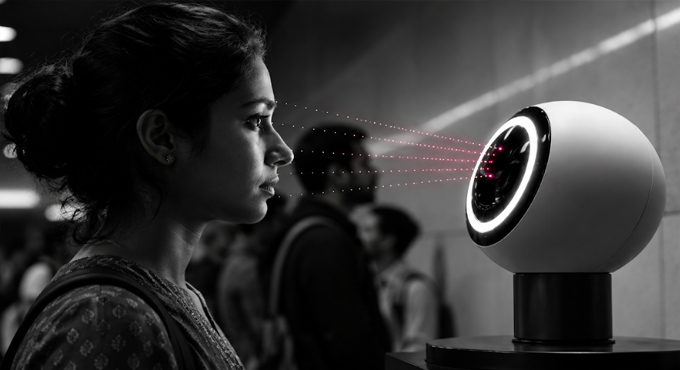
At the end of the queue is a silver, round-shaped machine. It looks futuristic — almost like a giant robotic eye. One by one, people walk up to it, stand in front of the machine and let it scan their eyes.
A few seconds later, it is done. They simply walk away.
So, what exactly is happening?
The machine is checking one thing: “Are you really human?”
This is happening in Japan. A similar system has also recently started attracting attention in India. And the obvious question is: We are already human. Why do we need a machine to prove it?
Well, the internet is changing. We were born human and have lived as humans all our lives. But in the age of AI, a machine may now have to say, “Yes, this person is human,” before the digital world fully trusts us.
That machine is called Orb.
What exactly is Orb?
In simple terms, Orb is a system designed to verify that a person is a real human. The idea has become important because AI bots are becoming much better at behaving like people.
They can create accounts, post comments, send messages, browse websites and perform certain online tasks. So platforms are facing a new problem: Who is actually behind an account — a human or an AI?
That is where Orb comes in.
A person stands in front of the Orb and gets their eyes scanned. After verification, they can receive a World ID, a digital identity designed to prove that they are a real, unique human.
Think of it as another form of digital identity. We already have Aadhaar, PAN, passports and driving licences.
Now, in the AI era, there is another one:
“Bro, I’m not a robot.”
Why do people need it?
The internet is becoming a very different place. Earlier, a fake account usually meant that one person had created an account using a false identity.
Today, AI can create thousands of accounts much faster. Bots can post comments, send messages, browse websites and interact with online services.
Some AI agents can even perform tasks on behalf of humans.
That creates a basic problem for digital platforms: Is this user actually human?
This is where the idea of Proof of Humanity comes in. The concept is simple: verify the human once, and use that verification wherever it is needed.
In the future, some digital services could ask users to prove that they are human before giving them access.
What can an ordinary user gain from it?
The first possible benefit is fewer fake accounts.
If a platform can verify that an account belongs to a real person, it becomes harder for automated systems to create thousands of fake accounts.
The second benefit is more trust online.
For example, is the person behind a dating profile actually real? Is an account in an online community operated by a human? Is the person you are interacting with actually a person — and not an AI system?
Human verification could become useful in such situations.
World says its World ID system is already being used for human verification across some platforms, including Zoom, Tinder, Shopify and DocuSign.
So, in the future, “Real Human” itself could become a digital feature.
Does everyone need Orb verification?
No.
It is not mandatory. If you do not get verified through Orb, your Aadhaar will not be cancelled. Your bank account will not be blocked. Your passport will not be cancelled.
Nobody is going to knock on your door and ask, “Where is your Human ID?”
For now, it is an optional digital identity. If you find it useful, you can choose to get it. If you don’t need it, you can simply skip it.
You are still human.
At least for now, you don’t need a machine to tell you that.
Related News
Did You Apply for a Ghost Job? Be Careful.. That Job May Not Even Exist!
Trump vs Disney: The Strange Battle Over ABC That Could Change American Media
Gandhi’s 688 Pages Sold for ₹16.20 Crore! What Was Written in Them?
The Country Is Ours… But You Need a Permit to Enter These States! The Surprising History of ILP
Before Buying a House, Check This One Number… Or Your Crores Could Get Stuck!