
If that rock had not hit Earth that day… the human race would not even exist!
- Published By: Tech Team
- July 24, 2026 / 03:03 PM IST


— Surya Prakash Josyula
66 million years ago…
On that day, too, life on Earth was going on as usual.
Giant dinosaurs roamed the forests. They drank water at the riverbanks. Flying reptiles spread their wings across the sky. For millions of years, they were the undisputed rulers of this planet. But they didn’t know that in just a few minutes, the final chapter of their species’ history was about to begin.
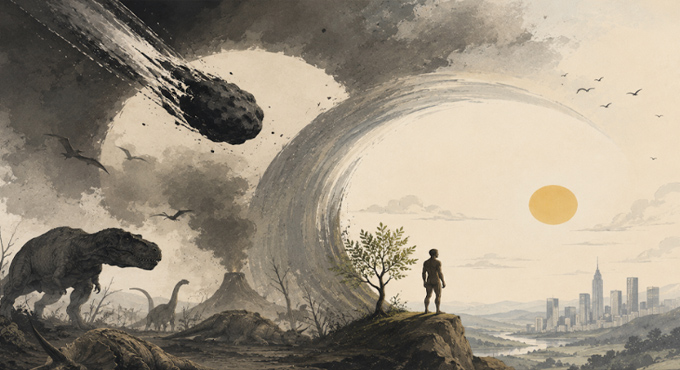
Suddenly… a fireball appeared in the sky. Growing bigger and brighter by the second, it hurtled toward Earth. Moments later, that glowing ball of fire crashed into the planet.
It was no ordinary collision. An asteroid roughly 10 kilometers wide, traveling at thousands of kilometers per hour, struck what is now the Yucatán Peninsula in Mexico. Scientists estimate that the energy released in that single moment was equivalent to billions of atomic bombs exploding at once.
The Earth shook violently. Rocks, dust, and molten debris were blasted hundreds of kilometers into the atmosphere. As those burning fragments rained back down, forests around the world caught fire. Towering tsunamis thousands of feet high surged across the oceans. Massive earthquakes and volcanic eruptions threw the planet into complete chaos. But the disaster didn’t stop there.
Dust, ash, and microscopic particles hurled into the atmosphere blocked out sunlight for months—perhaps even years. The Earth cooled rapidly. Plants could no longer perform photosynthesis and died out. Plant-eating dinosaurs starved to death, and soon after, the meat-eating dinosaurs that preyed on them disappeared as well.
The world wasn’t destroyed in a single day. But a catastrophe that started on a single day wiped out the empire of the dinosaurs within a few thousand years—ending a reign that had lasted for millions of years.
You probably think you already know this story, right? But that’s where the real twist lies. On that day, it wasn’t just the extinction of the dinosaurs that happened. That day also opened the door for the birth of humankind.
If that asteroid had missed Earth 66 million years ago, dinosaurs would still be alive today. Mammals would never have gotten the chance to dominate the planet. The course of evolution would have taken an entirely different path. Today, you wouldn’t be reading this story, and I wouldn’t be writing it. The human race simply wouldn’t exist.
And now, scientists have added another sensational twist to this tale.
It turns out the object that wiped out the dinosaurs was no ordinary asteroid. According to a recent study published in the journal Science Advances, it was an extremely rare meteorite known as Carbonaceous Ornans (CO). Carbonaceous chondrite meteorites that land on Earth are already very rare; among them, the CO type is even rarer. Scientists say the rock that hit Earth was truly a one-in-a-million projectile. Until now, we only knew that a massive asteroid was responsible for the dinosaurs’ destruction, but now we know the exact family it belonged to.
To uncover this, researchers collected 66-million-year-old rock samples from Denmark, Spain, and Italy. They analyzed the nickel isotopes within them and compared them with various meteorites found on Earth. That forensic investigation pointed to a single conclusion: the species-ending killer of the dinosaurs was an exceptionally rare CO-type meteorite. And that is the most fascinating part of this story.
The end of the dinosaurs didn’t happen because of a single factor. An extremely rare rock. Striking at an exceptionally dangerous location. Massive amounts of dust and debris blasted into the atmosphere. Sunlight blocked from reaching the Earth. The complete collapse of the food chain. All these events lined up one after another. That is why creatures that ruled the planet for millions of years could not recover.
On that fateful day, those dinosaurs might have believed they were the eternal rulers of their world. But a single rock from the sky erased their history forever. Today, we live under that very same sky. That is why scientists are digging into the past and searching for the rock that killed the dinosaurs. Because if another rock like that comes hurtling toward Earth tomorrow, it could write the final chapter for the humans ruling the planet today.