

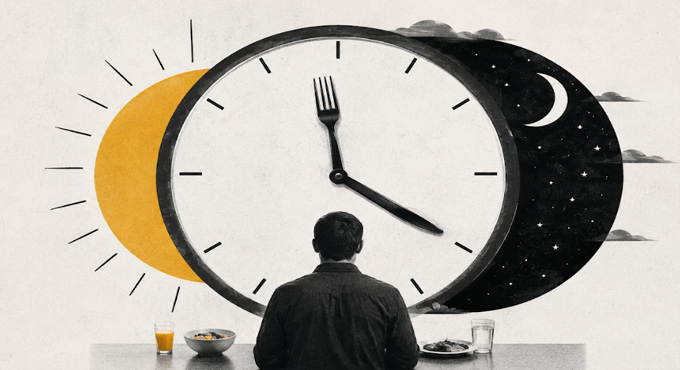
Does Breakfast Timing Have a Link to How Long You Live?
- Published By: Tech Team
- August 21, 2026 / 04:32 AM IST


— Surya Prakash Josyula
“I’ll eat when I’m hungry. Why do I need to have breakfast so early? Let me finish my work first. I can eat at 10 or 11. What happens if I skip an early breakfast? I can just have my first meal later. Even our grandparents probably ate whenever they had time.”
These are thoughts many of us have every day.
We usually don’t worry much if breakfast gets delayed. Dinner can also get pushed late when work keeps us busy. It feels like a small part of our daily routine.
But what if the time we eat is also connected to our health and how long we live?
A large study of 31,044 adults in the US has raised exactly this question. Researchers looked at when people had their first and last calories of the day and compared those timings with their health and mortality records.
The results were interesting.
Compared with people who had their first meal between 7 and 8 am, those who started eating between 8 and 10 am had a 10 percent higher risk of death from any cause.
For people whose first meal was between 10 am and noon, the risk was 19 percent higher. For those who did not eat until after noon, it was 29 percent higher.
The pattern was even stronger for cardiovascular deaths.
People who had their first food after noon had a 46 percent higher risk of cardiovascular death compared with those who ate between 7 and 8 am.
The researchers also estimated life expectancy. At age 50, people in the later-eating group had an estimated life expectancy about 2.46 years shorter on average.
But there was another part of the study.
Researchers also looked at when people had their last meal of the day.
Here, the relationship was not simply “the later, the worse.”
Compared with people who finished eating between 7 and 8 pm, those who had their last meal before 7 pm had a 13 percent higher risk of death from any cause. Those who ate after midnight had a 27 percent higher risk.
The lowest modeled risk was around 8 pm.
That does not mean everyone should suddenly make 8 pm their fixed dinner time.
There are several reasons to be careful with these findings.
For example, people who eat very early may be older, eat less frequently, or already have health problems. Their health condition may have influenced their eating schedule.
In other words, the health problem may have changed the eating pattern, rather than the eating pattern causing the health problem.
This is known as reverse causation.
So the study does not prove that eating breakfast late will shorten your life. It found an association between meal timing and mortality.
But there may be a biological reason behind the connection.
Our bodies have an internal clock, often called the circadian rhythm. It helps regulate sleep, hormones, digestion and metabolism. The timing of food may also act as a signal for this body clock.
Eating very late, especially at night, may disturb these rhythms and affect the way the body handles glucose and fats.
Still, the study has important limitations.
The participants’ food intake was mainly recorded through a single 24-hour dietary recall. One day of eating does not necessarily represent someone’s usual eating pattern over many years.
Sleep schedules, shift work, individual body clocks and other factors may also have influenced the results.
That is why the researchers do not suggest making extreme changes to eating schedules based on this study alone.
But the findings do raise an interesting question.
For years, we have mostly asked:
“What should we eat?”
Perhaps there is another question worth asking:
“When should we eat?”
Delaying breakfast every day or having dinner very late may seem like harmless habits.
But our bodies may not see them as just clock times.
They may also be signals being sent to the body’s internal clock — and that is something worth paying attention to.
Related News
Gandhi’s 688 Pages Sold for ₹16.20 Crore! What Was Written in Them?

The Country Is Ours… But You Need a Permit to Enter These States! The Surprising History of ILP
Before Buying a House, Check This One Number… Or Your Crores Could Get Stuck!
YouTube Is Offering Millions to Keep Creators Away From Netflix. Why Is It So Worried?

Are Rituals and Traditions a “Symbolic Language”? Decode Them, and Do We Find Science?