
Are Rituals and Traditions a “Symbolic Language”? Decode Them, and Do We Find Science?
- Published By: Tech Team
- August 20, 2026 / 11:09 AM IST


— Surya Prakash Josyula
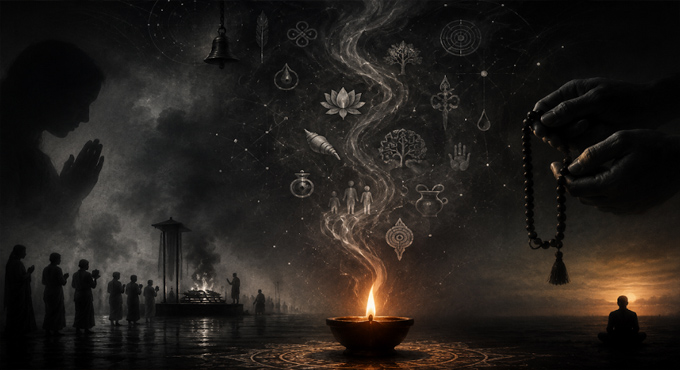
We speak a language every day without realizing it. But this language has no words. It uses symbols.
Lighting a lamp is a symbol. Saying goodbye is a symbol. Keeping an old object is a symbol. But who are we really speaking to through these symbols? To other people? To society? Or to our own minds?
If we decode this “symbolic language,” can we see the psychology—and perhaps the science—behind our rituals and traditions?
Think about a birthday. We cut a cake, blow out candles and celebrate another year of life. Now think about death. We place a lamp near a photograph, perform the last rites, immerse ashes in a river, or sometimes plant a tree in someone’s memory.
These actions look completely different. But they may have something important in common: they help us mark a change.
So are these rituals simply traditions passed down from one generation to another? Or are they a kind of symbolic language that helps the human mind accept something that is difficult to put into words?
Why do we perform actions that cannot change reality?
Cutting a birthday cake does not change our age. Lighting a lamp cannot bring back someone who has died. Tearing up a letter cannot change the past. Immersing ashes in a river cannot instantly remove grief.
And yet, human beings have been performing symbolic actions like these for thousands of years. Why?
Because the real purpose of a ritual may not be to change the outside world. It may be to change how we experience the inside world.
Grief is invisible. Anxiety is invisible. The feeling of losing someone is invisible. When a relationship ends, there is no physical object that represents the emptiness we feel.
When life suddenly changes, the mind may understand what happened intellectually, but emotionally, it can take much longer to catch up. This is where rituals become interesting.
They give an external form to an internal experience.
When the mind changes, the body wants to mark it
Human beings often use physical actions to mark important psychological transitions. That is why weddings have rings, graduations have certificates and ceremonies, and funerals have farewell rituals.
The object itself may have little power. What matters is the meaning we give to it.
A wedding ring is only a piece of metal. But after a marriage, it becomes a symbol of a relationship. A photograph is only paper or a digital image. But when the person in that photograph is no longer alive, the image can become something much more powerful—a connection to memory.
The object has not changed. Our relationship with the object has changed.
And our minds respond to that meaning. The human brain does not understand the world through words alone. Symbols, objects, places and physical actions can also carry emotional meaning.
That is why performing a certain action can sometimes make a transition feel more real. It can communicate something as simple as: “This happened. Now something has changed.”
Rituals may give us something we lose during uncertainty: control
There is another important psychological reason rituals can matter: control.
When something painful happens, we often feel that life is no longer in our hands. We cannot reverse a death. We cannot change the past. We cannot control what another person decides. We cannot always predict what happens next.
That loss of control can create anxiety.
Research on rituals suggests that structured, repeated actions can sometimes reduce anxiety and increase a person’s sense of control, especially in uncertain situations.
The ritual does not necessarily change the situation. Instead, it can give the person something they can do.
You cannot change what happened. But you can light the lamp, say goodbye, write the letter, or take part in the ceremony.
The action does not erase the loss. But it can help the mind respond to it.
Why do we need to give our feelings a form?
Psychology often deals with an interesting problem: some experiences are difficult to explain simply by thinking about them. Sometimes we need to express them.
A person may write down a fear. Someone may draw what they are feeling. Someone may write a letter to a person they have lost—even when they never intend to send it.
Why write a letter that has nowhere to go?
Because the letter may not need a physical destination. It may give an emotional experience a destination.
The words can bring something that has been circling inside the mind into a form that can be seen, read and acknowledged.
Some therapeutic approaches also use structured ways of putting difficult experiences into words, paying attention to bodily sensations, breathing, movement, or other guided exercises.
That does not mean every ritual or symbolic action is therapy. Nor does one technique work for everyone.
But the larger psychological idea is important: what is difficult to process internally can sometimes become easier to face when we give it a form.
Sometimes an object becomes more than an object
This is why people often struggle to throw away the belongings of someone who has died.
A watch may be just a watch to someone else. But to a grieving family member, it may be the last watch that person wore. An old shirt may have almost no practical value. Yet someone may keep it for years.
A phone may be outdated. But deleting everything from it can feel almost impossible.
From the outside, these objects are ordinary. From the inside, they carry a relationship.
We are not always protecting the object. Sometimes, we are protecting what the object represents.
This is one reason symbolic objects can become powerful during grief. They provide something physical that can hold a memory that is otherwise invisible.
This is much older than modern psychology
The interesting part is that humans did not invent rituals after psychology became a science. Rituals are much older.
Across human societies, people have created ceremonies around birth, death, marriage, harvests, seasons, war, migration and major life changes.
The details are different. The meanings are different. The beliefs are different. But the pattern appears again and again:
When something important changes, humans create a way to mark that change.
Why?
Because saying “it happened” is not always enough for the human mind.
A ritual creates a boundary: before this, after this; one stage is over, another has begun.
In that sense, rituals can act almost like punctuation in the story of a human life.
But does every tradition have a scientific explanation?
No. This distinction matters.
We should not assume that every ancient tradition was secretly based on modern science. And we should not assume that every ritual is meaningless simply because science cannot prove its traditional explanation.
Those are two different questions.
One question is: Does this ritual produce a supernatural effect? That requires one kind of evidence.
Another question is: Does performing this ritual affect the person’s emotions, sense of control, memory or connection with others?
That is a psychological question.
Science can study the second question without automatically accepting the first.
And that is where rituals become especially interesting.
The ritual does not even have to be religious
A ritual can be deeply personal.
Someone may have a small routine before an important event. Someone may keep a particular object because it represents a loved one. Someone may write down painful thoughts and then destroy the paper.
Someone may return to a particular place every year to remember a person.
These actions do not need to belong to a religion or a formal tradition. They can simply have personal meaning.
The important part is not necessarily the action itself. It is the meaning attached to the action.
That may be why two people can perform the same ritual and experience it very differently.
For one person, it may be an empty tradition. For another, it may carry deep emotional meaning.
Perhaps rituals are the mind’s way of saying, “This matters”
We often think of rituals as something our grandparents did and we simply continue. But perhaps there is another way to look at them.
Human beings have always needed ways to deal with things that cannot be easily controlled or explained: loss, change, uncertainty, love, separation and death.
Words are not always enough. So we create actions.
We light something. We hold something. We give something away. We gather together. We say goodbye. We remember.
The action itself may be small. But the meaning behind it can be enormous.
Perhaps that is the real symbolic language of rituals—a language without words, in which the brain, the body and society communicate with one another.
And maybe the most surprising part is this:
When we perform a ritual, we may think we are speaking to the world. But sometimes, we may actually be speaking to ourselves.
Related News
What Happens If Your Gold Pledged With a Bank Is Stolen? Who Pays the Compensation? Court Clarifies
India wants NRI money to flow more easily. What SEBI’s new KYC proposal means
Big Surprise From ‘Varanasi’.. What Is Rajamouli Planning To Show?
Niu Lai: China’s ‘Worst’ Animation Turns Viral and Storms the Box Office
SHOCKING: Human Brain Inside a Computer! Is This the Next Big Thing After AI?