

China Invading the World with Robots? Growing Global Tension!
- Published By: Tech Team
- July 31, 2026 / 12:40 PM IST


— Surya Prakash Josyula
If we asked what brand of mobile phone people had in their hands a few years ago, most would show Chinese brands like Xiaomi, Vivo, Oppo, or Realme. Similarly, if we look around our homes today at TVs, smartwatches, earbuds, or CCTV cameras, Chinese electronic products dominate.
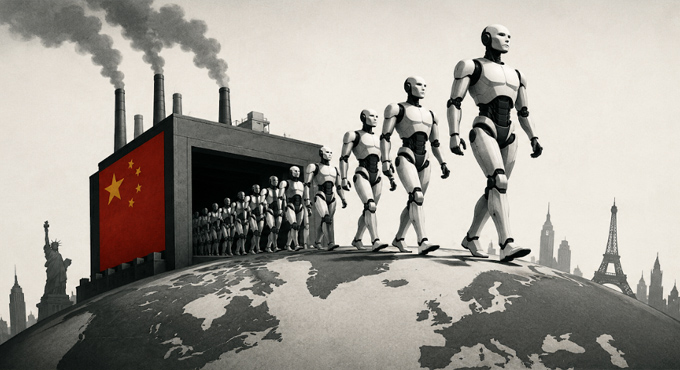
That did not happen by accident. Good quality, lower prices than competitors, and massive manufacturing scale—with these three strengths, China took control of one industry after another. Now, it is targeting another sector using the exact same formula. However, what it is selling this time is not mobile phones… it is human-like humanoid robots.
If this continues, in a few years, will we see robots stamped with “Made in China” in factories, warehouses, hotels, hospitals, shopping malls, and even offices across the world? Today, not just the US, but Europe, Japan, South Korea, and many other countries around the world are worried about this very question.
A Great Strategy
China has done this before. First in solar panels, then in lithium-ion batteries, and after that in electric cars. The world feels China is now implementing that same strategy in robotics.
Why is the US Tense?
Recently, the US imposed restrictions on imports of new Chinese humanoid robots. Officially, they cited national security as the reason, but the real fear is just one thing: Will China take the entire global market into its hands once again?
This Fear is Not Just Imaginary
In 2024, 54 percent of the industrial robots installed worldwide were set up in China alone. In a single year, China deployed nearly 295,000 industrial robots in its factories. Currently, more than 2 million robots are operating there.
Even more surprising is that a decade ago, foreign companies dominated the Chinese market. Today, 57 percent of the industrial robots sold there belong to domestic Chinese companies. When it comes to human-like humanoid robots, China’s aggressive push is even faster.
According to Barclays estimates, up to 85 percent of the humanoid robots currently in use globally belong to Chinese companies.
According to Interact Analysis, up to 90 percent of the humanoid robots shipped worldwide in 2025 came from Chinese firms.
While Chinese companies like AgiBot, Unitree, and UBTech are sending thousands of robots into the market, American companies like Tesla and Figure AI are limited to just a few hundred units.
Why Can They Sell So Cheaply?
It is not that China is making the world’s smartest robots… it is able to manufacture them at the cheapest cost globally. That is the real twist in this story. The reason is that the entire supply chain needed for robot manufacturing—batteries, motors, sensors, cameras, power electronics, and precision parts—is located right inside China. It is using the same massive manufacturing ecosystem built for smartphones, drones, and electric vehicles for robotics today. That is why it can produce robots at a scale and at low prices that companies in other countries cannot compete with.
The Real Reason the Whole World is Afraid
China is now moving forward rapidly in research as well. There are already more than 140 humanoid robot manufacturing companies in the country. According to a recent report released by LexisNexis, out of the top 10 humanoid robot startups globally with the strongest patent portfolios, six are Chinese companies. In fact, the top five positions were secured by Chinese firms.
There Are Both Pros and Cons
If robots become available at cheap prices, industrial productivity will increase. Automation will become possible for small companies too. Robots can be used instead of humans in dangerous jobs.
At the same time, it could put pressure on low-skilled jobs in sectors like manufacturing, warehousing, logistics, and retail. There is also a concern that if the whole world becomes dependent on Chinese robots, the influence of a single country will rise across all areas.
The Real Challenge is Here
However, the competition is not over yet. The US is strong in artificial intelligence. Japan, South Korea, and Europe are also investing heavily. But with three weapons—massive production, low prices, and rapid manufacturing capability—China is once again challenging the global market.
Still No Conclusion
Looking at all this… the question haunting everyone is: Will we see human-like robots stamped with “Made in China” everywhere in the world tomorrow? Now, not just America, but the entire world is searching for an answer to this question.