

2,000 Years Ago, the Bhagavad Gita Explained How the Human Mind Works
- Published By: Tech Team
- August 24, 2026 / 12:10 PM IST


It is past 11 at night. Everyone at home is asleep. But he cannot sleep. He is waiting for a phone call the next morning. That one call could decide whether he gets the job or not.
He puts his phone aside. Two minutes later, he picks it up again. There is no notification. Still, he checks it once more. “What if I don’t get selected?”
That is where the mind begins its real game.
The interview is over. There is nothing more he can do. But his mind refuses to leave the interview room. He keeps thinking about his answers. “Maybe I should have answered that question differently.” He remembers the interviewer’s face and wonders what they really thought about him.
The mind keeps replaying one hour again and again.
This does not happen only with job interviews. A student goes through the same thing after an exam while waiting for the result. Someone waiting for a reply from a person they love goes through it too. So does a businessman waiting to see whether the money he invested will bring returns.
This is one of the strange things about being human. We can experience tomorrow’s pain before tomorrow even arrives.
The failure has not happened yet, but we are already hurt by it. The rejection has not happened yet, but we are already feeling rejected. The result is not out yet, but our mind has already given its verdict.
And here is what makes this even more interesting. The Bhagavad Gita described this journey of the human mind nearly 2,000 years ago.
It All Begins With a Thought
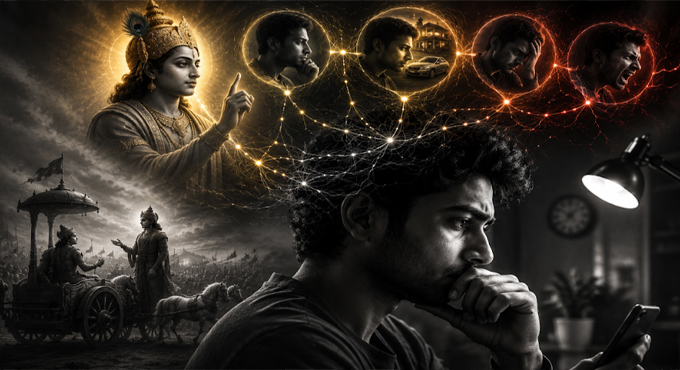
Krishna explains that it can all begin when we keep thinking about something. We think about it once, then again, and then again. Slowly, that thought becomes important to us. We develop an attachment to it, and that attachment creates desire.
When that desire is not fulfilled, frustration and anger can follow. When anger takes over, clear thinking becomes difficult, and our ability to make wise decisions can also suffer.
The second chapter of the Bhagavad Gita, especially verses 62 and 63, describes this chain of events. It sounds simple, but look at our everyday lives and the idea suddenly feels very familiar.
Take Social Media
You see someone else’s life online. A beautiful house, a new car, a foreign holiday or a successful career. You like what you see. Then you see it again. And again.
Slowly, you start comparing their life with yours. Then comes one simple question: “They have it. Why don’t I?”
From that moment, the life you already have can start looking smaller.
The real problem is not the car. It is not the house. It is not even that person.
The problem begins when your mind refuses to move away from what you don’t have.
Desire Should Drive Us, Not Control Us
Without desire, life would not move forward. We want a good job. We want our children to do well. We want our own house. We want our business to grow. We want the people we love to stay with us.
These are normal human desires. The Gita is not telling us to destroy every desire. It is telling us something more subtle: Do not give your desires complete control over your peace of mind.
There is a big difference between working hard for a promotion and thinking, “If I don’t get promoted, I am worthless.”
There is a difference between studying hard for good marks and thinking, “If I get low marks, my life is over.”
There is also a difference between wanting someone’s love and thinking, “They rejected me, so there must be something wrong with me.”
A result is an event. Turning that result into a judgment about your own worth is the real danger.
Our Problem Is Not the Result. It Is Our Attachment to It
The idea of Nishkama Karma is often explained simply as “work without expecting the result.” But the idea is deeper than that.
We can control our effort to some extent. We cannot completely control what comes out of that effort.
A student can study hard, but cannot control the question paper. An employee can work sincerely, but cannot control every decision made by the company. A farmer can take care of his crop, but cannot control the weather.
Still, we spend much of our mental energy worrying about the result.
The work is over, but the mind keeps working.
That is where attachment to the result becomes a problem.
This Is Where Modern Psychology Meets the Gita
Modern psychology also points toward a similar idea. Focusing too much on the final result can increase stress. Focusing on the process — what you need to do right now — can improve concentration and performance.
Think about a cricketer. His goal may be to win the match. But when the ball comes toward him, can he play well if his mind is stuck on the scoreboard?
At that moment, he has only one job: play the ball in front of him.
Life can sometimes be approached in the same way. Instead of asking a hundred times, “What will happen tomorrow?” it may be more useful to ask, “What do I need to do today?”
The Last Warning in This Mind Map
A thought appears. We keep feeding it. It becomes a desire. The desire starts controlling us. When it is not fulfilled, we may see it as an insult, a failure or an injustice.
Then come anger, frustration and disappointment.
So the thing that finally breaks us may not be the anger we see on the surface.
The real journey began much earlier — with a thought.
That is why the Gita’s insight still feels relevant today. We spend so much time worrying about things that are not in our control. We suffer for results that have not even arrived. And sometimes, we experience tomorrow’s pain while completely losing today’s peace.
Perhaps the practical meaning of Nishkama Karma is simple: Do your work. Do it sincerely. Give it your best. But don’t suffer for the result before it arrives.
We do not know what tomorrow will bring. But one thing is certain.
We should not lose today’s peace because of tomorrow’s uncertainty.
There will always be things in life that are beyond our control. But how much power we give those things over our mind — that, at least to some extent, is still in our hands.
— Surya Prakash Josyula
Related News

This Is Gen Z’s Biggest Problem With Love… Why Are They Failing at the First Date?
Reddit Built the Internet’s Human Voice. Is Its Best Era Over?

Did You Apply for a Ghost Job? Be Careful.. That Job May Not Even Exist!

Trump vs Disney: The Strange Battle Over ABC That Could Change American Media
“I’m Human”: The New Digital ID That Wants to Separate People From AI Bots