
The X-Ray..From Marya Sklodowska to Marie Curie
- Published By: shivaduvvuru
- July 3, 2026 / 03:55 PM IST


Before the world knew her as Marie Curie, she was born Marya Sklodowska in Warsaw, Poland. She arrived in Paris with almost nothing, lived in an unheated attic room, and often skipped meals to afford her studies. She graduated first in her class in physics at the Sorbonne and it was there that “Marya” became “Marie.”
Becoming Madame Curie:
In 1895, she married a fellow scientist, Pierre Curie, and the two became one of history’s great research partnerships. Together they investigated the strange rays given off by uranium work so original that Marie had to invent a word for what she’d found: radioactivity. It was the discovery that opened the door to modern nuclear physics and medical radiology.
Then, in 1906, Pierre was killed instantly by a horse-drawn cart on a Paris street. Marie was left a widow with two young daughters and an unfinished body of work. She didn’t stop. She took over Pierre’s post at the Sorbonne becoming its first female professor and kept pushing the science forward alone.
How the X-Ray Was First Invented:
The X-ray itself predates Marie Curie’s own work. It was discovered by chance in 1895 by German physicist Wilhelm Röntgen, who noticed a mysterious form of radiation could pass through solid objects and expose photographic plates revealing the bones inside a living hand. He called it the “X-ray” because “X” stood for the unknown. The discovery won Röntgen the first-ever Nobel Prize in Physics in 1901, and hospitals quickly installed the new machines but only as large, fixed equipment bolted to hospital walls, far from anyone who couldn’t travel to a city.
The X-Ray Ambulances of World War I:
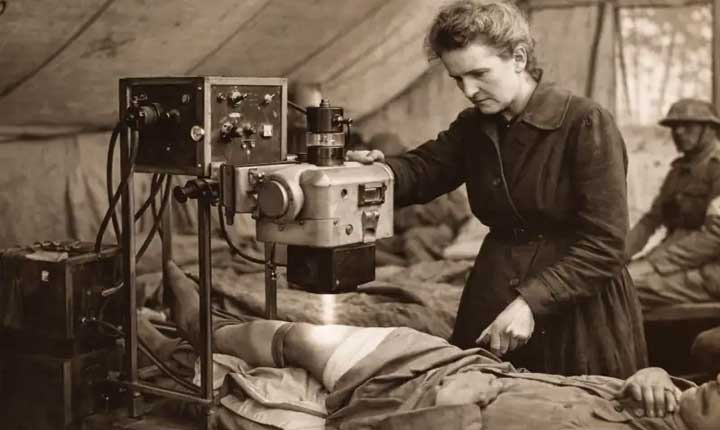
When war broke out in 1914, Marie didn’t retreat into her laboratory. She saw the gap Röntgen’s invention had left: X-ray machines existed, but they were bulky and stuck in city hospitals, useless to soldiers bleeding out miles away. So she designed something new mobile X-ray units, powered by a car’s own engine, that could drive straight to the battlefield. She and her teenage daughter, Irène, built these units nicknamed “petites Curies” and drove them to the front lines so battlefield surgeons could locate bullets andshrapnel in wounded soldiers before operating. She personally trained roughly 150 women to operate the equipment. Historians estimate the units helped treat over a million soldiers.
A Record of Recognition:
By the end of her career, she’d earned fifteen gold medals, nineteen honorary degrees, and two Nobel Prizes in two different sciences physics in 1903 and chemistry in 1911 a feat still unmatched by any other woman.
In Her Own Words:
Curie left behind a philosophy as durable as the science itself: “Life is not easy for any of us. But what of that? We must have perseverance and above all confidence in ourselves.” “Nothing in life is to be feared. It is only to be understood.”
The Price of the Discovery:
The same rays that made her famous were, invisibly, killing her. In an era before anyone understood radiation’s dangers, she carried test tubes of radioactive material in her pockets and stored them in her desk drawer, later remarking on the way they glowed in the dark. There was no protective glass, no dosimeter, no warning label only the material itself, unknowingly borrowed against her own body.
She died of leukemia in 1934, at 66. Her lab notebooks are still radioactive today, kept in lead-lined boxes, and anyone who wants to read them has to sign a waiver.
Marie Curie paid for her discoveries with her own body, and never once asked whether it was worth it. She simply kept working, in an unheated attic, in a widow’s grief, on a battlefield, in a laboratory that was slowly killing her because the question in front of her mattered more than the cost of answering it. That, more than any medal or prize, is her real legacy: proof of what becomes possible when someone refuses to be told what she isn’t allowed to know.
Related News
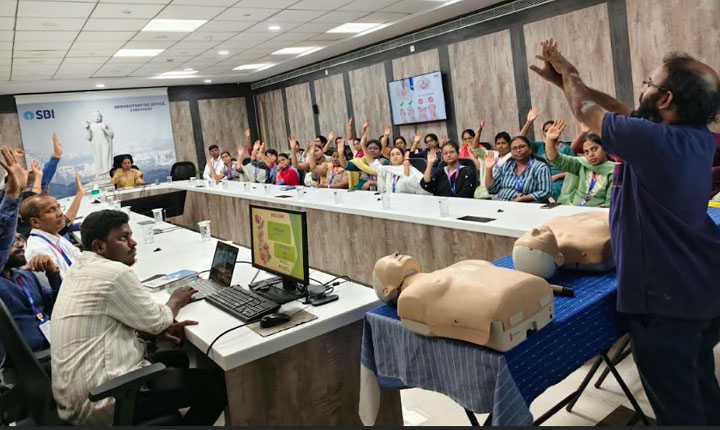
Citizens Specialty Hospitals Launches “Don’t Miss a Beat. Be an Informed Citizen” Campaign for World Heart Day

‘Arz Kiya Hai’ by Anuv Jain and Lost Stories Reaches No. 1 on Spotify India and Global Charts
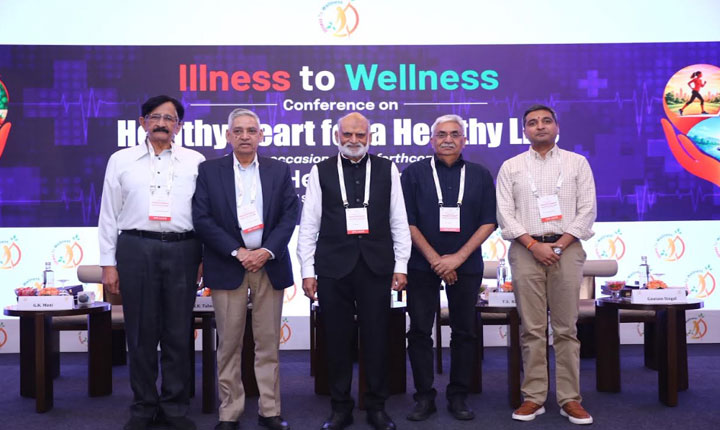
Experts Advocate Prevention, Early Detection, and Community Awareness at World Heart Day Conference
Pullela Gopichand Emphasizes Sports as Essential for Viksit Bharat at PRana 2026
Litemed India Launches ‘Curapod M’, an Innovative Health-Tech Device for Menstrual Pain