

The $5 Stanford Test: Why Everything We Know About Starting a Business Is Wrong
- Published By: shivaduvvuru
- May 21, 2026 / 12:39 PM IST


Every struggling entrepreneur tells themselves the exact same lie: “If we just had more funding, a better product, or a bigger team, we’d finally make it.”
We treat capital like the ultimate gatekeeper to success. But a legendary experiment conducted at Stanford University shattered this excuse forever. It proved that in the high-stakes game of wealth creation, raw capital is a vanity metric. The real currency?
Asymmetric leverage.
If we are waiting for a big bank loan, a venture capitalist, or a perfect market to validate our dream, this story will completely dismantle how we view value.
The Setup: Two Envelopes, One Clock
Professor Tina Seelig walked into her Stanford lecture hall with a stack of sealed envelopes. She divided the class into competitive teams, handing each group an envelope containing an insultingly small amount of seed money:
a single five-dollar bill.
The rules of the challenge were simple but brutal:
• Teams could spend as much time as they wanted planning.
• The moment they tore open the envelope, a strict
• two-hour countdown began.
• Our goal? Generate maximum revenue.
• At the end of the week, each team would get exactly three minutes to present our results to the entire class.
Most of us given this challenge immediately start sweating over the inventory math. What can we buy for $5 that we can quickly flip for $10?
That exact line of thinking is why 90% of businesses fail before they ever launch.
The Trap: The Illusion of the Hard Hustle
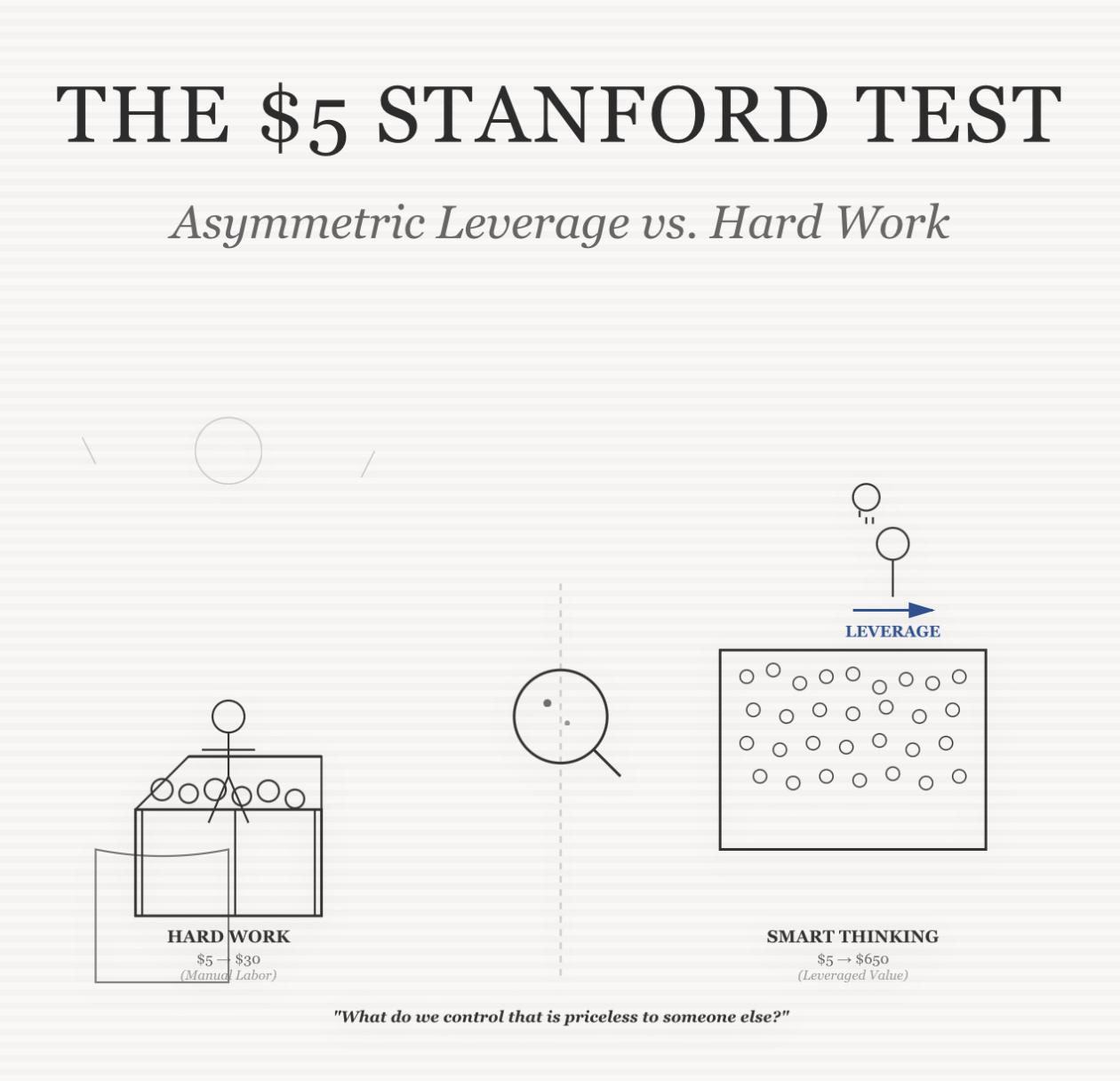
Team A fell straight into the resource trap. They looked at the five dollars and saw a limitation. They decided that the only way to win was to out-work everyone else.
They ran to the store, spent their $5 on lemons, sugar, and ice, and set up a classic lemonade stand on the Stanford campus. They stood in the blistering sun, pitched passersby, and aggressively hustled for a grueling 120 minutes.
By the time the clock struck zero, they had turned $5 into $30.
On paper, this is a 500% return on capital. In a traditional business textbook, this looks like a victory. In reality, it was a trap. They didn’t build a scalable business; they merely bought themselves a low-wage, back-breaking job. They limited their revenue to the physical number of lemons they could squeeze by hand in two hours.
The Pivot: Sizing Up the Real Monopoly Board
Meanwhile, Team B didn’t even bother to open their envelope.
They realized a fundamental law of elite entrepreneurship: Our greatest asset is almost never the physical product we are holding.
Instead of rushing out to buy materials, they sat in a quiet room and asked a radically deeper question: “What do we control right now that someone with deep pockets is desperately starving for?”
They looked past the $5 bill. They looked past the two-hour clock. Then, they looked at the very end of the experiment: the 3-minute presentation slot.
To a tired student, those three minutes were just a homework requirement. But Team B looked at the room. The auditorium would be packed to the brim with hundreds of the sharpest, most ambitious future tech founders, engineers, and data scientists on the planet the absolute top 1% of Silicon Valley talent.
To a corporate recruiter fighting the brutal tech talent wars, that room wasn’t a classroom. It was an untapped goldmine.
The Payoff: The 13,000% No-Capital Flip
Team B bypassed the consumer market entirely. They didn’t sell to individuals; they went straight to B2B enterprise companies.
They picked up the phone, called major recruiting firms, and delivered a lethal pitch:
“We control three minutes of undivided attention from the most elite graduating talent at Stanford. We will give you that time to run a high-impact recruitment ad directly to them. The price tag is $650.”
The corporation didn’t just say yes; they saw it as a massive bargain compared to traditional recruiting costs.
While Team A was squeezing lemons in the dirt for pocket change, Team B closed a massive B2B deal over the phone without spending a single dime of their $5 seed capital. They unlocked a staggering 13,000% return simply by identifying and monetizing the hidden value already sitting in the room.
The Million-Dollar Takeaway
The Stanford test exposes the massive divide between amateur business owners and elite entrepreneurs:
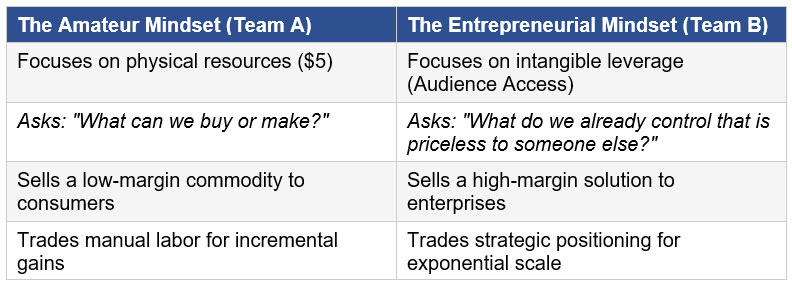
If we want to scale our business, we should stop complaining about our lack of capital. Let us audit our entire ecosystem. We should look at our network, our unique data, our specialized insights, or our proximity to a specific audience.
The odds are high that we are already sitting on a unique niche or untapped opportunity of our own, waiting to be unlocked. Let us stop selling lemonade. Start selling leverage.
Related News

Stars Unite in Mumbai for The Earthshot Prize 2026 Awards Night Prime Video Named Exclusive Streaming Partner

HCCB-Backed Archer Ganesh Mani Ratnam Thirumuru Wins Gold and Bronze at 20th Asian Games

Ultraviolette Expands Retail Footprint with New UV Space Station in Anantapur

Amazon Expands Ultra-Fast Delivery Service ‘Amazon Now’ to Over 120 Cities Across India

GREW Solar Announces Channel Partnership with Energy Cubez in Kerala