

EV Transition to Save ₹1 Lakh Crore in Crude Imports by 2030 as Adoption Soars, Says SBI Report
- Published By: Phanindra
- July 8, 2026 / 10:10 AM IST


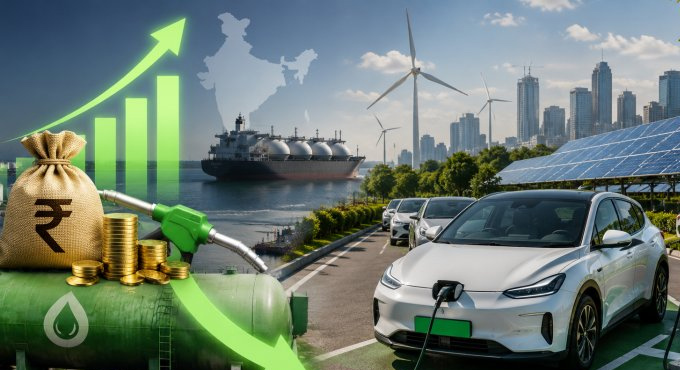
In a significant economic forecast, the country’s largest public sector lender, State Bank of India (SBI), highlighted that the accelerating adoption of Electric Vehicles (EVs) is poised to deliver a massive fiscal boost to the Indian economy. According to SBI’s latest research report, EVs are projected to capture a commanding 20% share of the total automotive market by 2030—meaning one out of every five vehicles on Indian roads will be electric.
The report estimates that between 2027 and 2030, an additional 35 lakh (3.5 million) conventional petrol vehicles will be replaced by electric alternatives. This massive structural shift is expected to save the nation approximately ₹1 lakh crore in foreign exchange outflows by significantly lowering crude oil import bills.
Geopolitical Triggers and Skyrocketing Registrations
The transition toward clean mobility has gathered unprecedented momentum over the last few quarters. SBI noted that India’s EV market share has already climbed to 8% in 2026. A primary driver behind this sudden retail pivot was the outbreak of intense geopolitical tensions in West Asia in February 2026, which triggered widespread consumer anxiety regarding volatile fuel prices and long-term oil security. This shift in consumer sentiment is clearly visible in vehicle registration statistics:
Monthly Averages: Average monthly EV registrations, which stood at 1.3 lakh units in 2025, skyrocketed to 2.3 lakh units between March and June 2026.
Annual Forecast: Driven by this aggressive buying momentum, total EV registrations in India are comfortably on track to cross the 25 lakh (2.5 million) milestone by the end of this calendar year.
The Charging Infrastructure Bottleneck
Despite the booming demand, the SBI report explicitly warns that the lack of robust charging infrastructure remains the single biggest roadblock to widespread EV expansion. India currently counts 29,151 operational public charging stations, but a mere 30% of these installations are equipped with high-capacity fast chargers.
Geographically, the charging footprint remains highly concentrated. Karnataka and Maharashtra together command a dominant 35% share of the entire national charging network. However, states like Tamil Nadu, Telangana, Andhra Pradesh, and Goan territories are rapidly emerging as pioneers in aggressively deploying dedicated fast-charging infrastructure. Concurrently, regional governments are scaling up targets, with the Delhi administration setting a firm mandate to set up 32,000 new charging points over the next four years.
Policy Recommendations for Sustainable Growth
To sustain this green transition over the next decade, SBI’s economic research wing recommended that the central government implement structured policy frameworks:
Establishing a definitive, long-term regulatory road map spanning 10 to 15 years to provide investment clarity for automakers.
Introducing specialized domestic manufacturing incentives specifically for advanced battery cells.
Setting up an EV Credit Guarantee Fund to ease vehicle financing and lower credit risks for buyers.
Providing subsidized land allotments and targeted real estate concessions for setting up public charging stations.
Mandating aggressive government procurement policies to replace aging public transport and administrative fleets with electric alternatives.
Related News

BenQ Unveils “MOBIUZ Game Art Museum” Experience at Tokyo Game Show 2026

Dreame Technology Launches Flagship X60 Ultra Complete Robot Vacuum in India

Turtle Wax Marks 80 Years of Global Leadership as CEO Laurie King Visits India to Accelerate Expansion Plans

Hyundai Motor India Opens Bookings for the New Intelligent Utility Vehicle, Hyundai BAYON

Telangana AI Summit 2026 Drives State’s Vision to Become a Global Artificial Intelligence Hub