
Why Hyderabad’s Tank Bund Is Getting New Statues – And What They Say About Telangana
- Published By: Tech Team
- August 26, 2026 / 04:00 PM IST


When we think of Hyderabad, places like Hussainsagar and Tank Bund immediately come to mind. The lake, the Buddha statue and the line of statues along Tank Bund have all become part of the city’s identity.
But have you noticed one change? The story told by these statues is slowly changing.
Earlier, the statues were mainly about Telugu pride, Telugu culture and Telugu history. Now, statues representing social justice, equality and the history of weaker and backward communities are also becoming part of the same landscape.
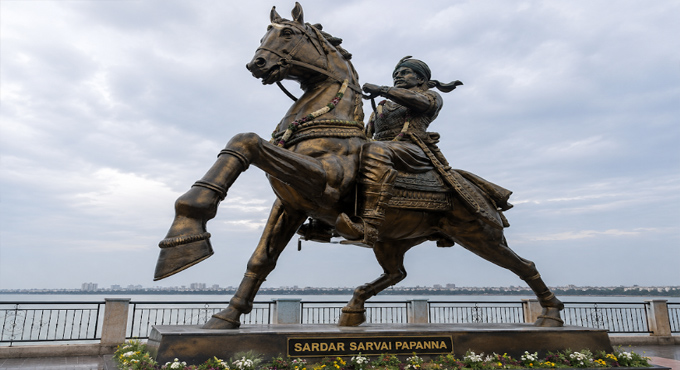
The latest addition is the statue of Sarvai Papanna on Tank Bund. The huge bronze statue shows Papanna riding a horse with a spear in his hand. It has now become another major attraction near Hussainsagar.
The statue weighs around 3.5 tonnes and was made using brass. It took about one-and-a-half months to complete. The sculptors used an old photograph of Papanna and modern machines to create the huge statue.
But the interesting question is not how big the statue is. The real question is: Why is Papanna being given a place here?
Sarvai Papanna is seen by many BC communities in Telangana as a brave leader and an important figure in their social history. He is remembered as someone who challenged the rich and powerful and stood with ordinary people.
Historian Richard Eaton has compared Papanna with Robin Hood of England. The reason is simple. Papanna is remembered for taking wealth from rich and powerful people and sharing it with weaker sections of society.
And that tells us something about the bigger change happening around Hussainsagar.
If we go back a few decades, this area looked very different. Until 1989, there were no major statues around Hussainsagar. Then the government led by then Chief Minister N.T. Rama Rao decided to place 33 statues of famous personalities along Tank Bund.
The idea was to showcase Telugu language, culture and history. Those 33 statues soon became an important part of Hyderabad’s identity. For many people, Tank Bund became closely associated with these statues.
During the separate Telangana movement, some of these statues were damaged. But the story of Tank Bund’s statues did not end there.
As time passed, new names and new stories began finding a place here.
Today, we have the huge statue of B.R. Ambedkar. Statues of social reformers Jyotiba Phule and Savitribai Phule have also been added. Now Sarvai Papanna has joined them.
So, the focus is slowly changing.
Earlier, the statues mainly answered the question, “Who are the great people of Telugu history?”
The new statues are also asking another question: “Who are the people who changed our society?”
That is why the 43 statues around Hussainsagar are more than just statues. They reflect how society itself is changing and how people are choosing to remember their history.
These statues have also become tourist attractions.
Tourist buses now stop near the Ambedkar statue. Families and children get down, walk around and take photographs. Many people try to take selfies with the entire statue in the frame. But sometimes the statue is so huge that only half of it fits into the phone!
Some visitors also take boats on Hussainsagar to see the Buddha statue.
So these statues are no longer just about history. They have also become part of Hyderabad’s tourism experience.
The Telangana government under Chief Minister Revanth Reddy has also given importance to statues and public memorials. The Telangana Thalli statue was installed at the Secretariat. An NTR statue was unveiled at Ameerpet. Statues of Jyotiba Phule and Savitribai Phule were installed near the Khairatabad flyover. Nearby, we can also see statues of Ambedkar, former Prime Minister Indira Gandhi and former Prime Minister P.V. Narasimha Rao.
When we look at all of this together, an interesting picture emerges.
The 33 statues that once stood on Tank Bund mainly represented Telugu pride.
The new statues are bringing in a wider idea — social justice, equality and the stories of people who fought for ordinary and weaker sections of society.
So, when you look at the 43 statues around Hussainsagar, you are not just looking at statues of famous people.
You are also seeing how Telangana is choosing to remember its past, who it wants to honour and whose stories it wants the next generation to know.
Cities change with time. And the changing statues around Hussainsagar are telling us a small but interesting story about how Hyderabad and Telangana are changing too.
—Suryaprakash Josyula
Related News

PAN Fraud: How to Detect Bank Accounts and Transactions You Never Made
Wife Files a Case? What Should You Do – and What Should You Avoid?

Ice Batteries: Storing Cold Instead of Electricity? Here’s How It Works

Restaurants Are Banning Tips.. Why? Here’s the Real Reason!

Do You Need to Pay ₹1 Crore to Go to America? Trump’s New H-1B Shock