When One Species Became the Fate of Millions
- Published By: shivaduvvuru
- August 6, 2026 / 12:38 PM IST


A reflection on the accelerating loss of Earth’s living world
For almost four billion years, life has been experimenting on Earth.
A cell learned to capture sunlight. Fish filled the seas. Plants covered the continents. Insects learned to fly. Forests rose. Dinosaurs came and vanished. Mammals inherited their world.
And very late in this immense story, we arrived.
For nearly all of Earth’s history, we were absent. Yet in a geological instant, one species acquired the power to alter the fate of countless others.
One in Eight
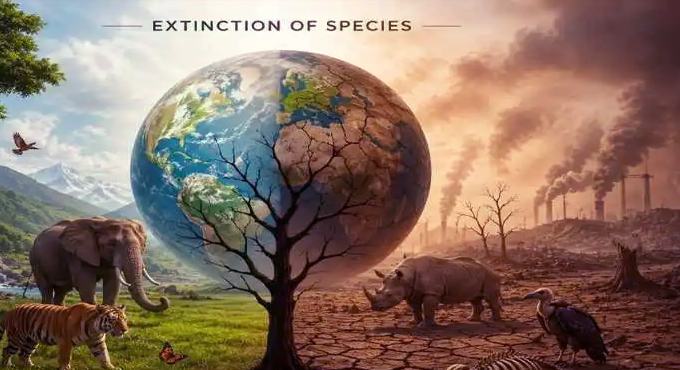
Scientists estimate that Earth is home to roughly 8 million species of animals and plants. About one million – roughly one in eight – are now threatened with extinction. Many could disappear within decades unless the forces driving their decline are reduced. [1]
This does not mean a million species will suddenly vanish by a particular year. Extinction has no calendar. Some may disappear soon. Others may survive much longer. The IPBES assessment says many are threatened with extinction within decades, not that all one million will be extinct by a fixed date.
But the direction is unmistakable. The present rate of extinction is already tens to hundreds of times greater than the average over the past ten million years. [1]
And extinction is only the final act.
The abundance of native species in most major terrestrial habitats has fallen by at least 20 percent. More than 85 percent of the world’s wetlands have disappeared. About half of the living coral cover that existed in the 1870s is gone. Three quarters of Earth’s land has been significantly altered by us. [1]
More than three quarters of the world’s food-crop types depend, at least partly, on animal pollination. IPBES estimates that $235 billion to $577 billion in annual global crop output is at risk from pollinator loss. [1]
The Paradox of Progress
And here lies a remarkable contradiction.
These same centuries gave us modern medicine, electricity, flight, computers and journeys into space. They created scientific knowledge and prosperity unimaginable to our ancestors.
We should be proud of that achievement. But we should also be ashamed of its destruction.
In only a few generations, the most intelligent species we know has profoundly altered the land, oceans and living world – and may leave its descendants a planet far poorer than the one it inherited.
The World We Have Made
Perhaps the most astonishing change is not simply what has vanished, but the scale of our presence.
Forests became farms. Wetlands became cities. Wild habitats gave way to roads, mines and settlements.
It happened field by field, road by road and city by city.
Each change seemed small against the immensity of Earth.
Together they transformed a planet.
The Final Coincidence
There is something extraordinary about our moment in history.
The same human mind that transformed ecosystems now understands the damage – and yet is failing to change course.
We can measure the disappearance of a forest, reconstruct the history of a coral reef and estimate the probability that another species will vanish.
We are no longer merely witnesses to Earth’s changing future. Increasingly, we are choosing it.
Perhaps that is the strangest coincidence of all.
After four billion years of life, one species has acquired the power to influence the fate of perhaps a million others.
And that same species may be leaving its descendants a poorer, more fragile and diminished Earth.
Scientific References
[1] IPBES (2019). Summary for Policymakers of the Global Assessment Report on Biodiversity and Ecosystem Services. S. Díaz, J. Settele, E. S. Brondízio et al. IPBES Secretariat, Bonn, Germany. DOI: 10.5281/zenodo.3553579. The assessment was prepared by about 150 experts, supported by approximately 350 contributing authors, and assessed more than 15,000 scientific publications.
[2] IPBES (2019). Global Assessment Report on Biodiversity and Ecosystem Services. E. S. Brondízio, J. Settele, S. Díaz & H. T. Ngo (eds.). IPBES Secretariat, Bonn, Germany. DOI: 10.5281/zenodo.3831673.