
When Air Conditioners Aren’t Enough: Japan’s Rise of the ‘Human Refrigerator’
- Published By: Tech Team
- August 5, 2026 / 11:30 AM IST


By Surya Prakash Josyula
“If we had been two minutes later, he wouldn’t have survived.”
The shout pierced through the stifling air as a man stumbled helplessly nearby. His shirt was completely drenched in sweat, and though his eyes were wide open, his gaze remained vacant, lost in a daze. Sensing the urgency, the crowd around him quickly moved in, supporting his weight and guiding him toward a massive, sleek stainless-steel enclosure standing just feet away.
The heavy door was pulled open, and he was helped inside. As the thick metallic door swung shut, the onlookers anxiously tracked the ticking clock—one minute, two minutes, three minutes. While no one on the outside could see what was taking place inside, the door suddenly opened again shortly after. The same man who could barely stand moments earlier stepped out entirely on his own strength. The sweat was gone from his face, his heavy gasping had calmed, and his body temperature had stabilized back to safety.
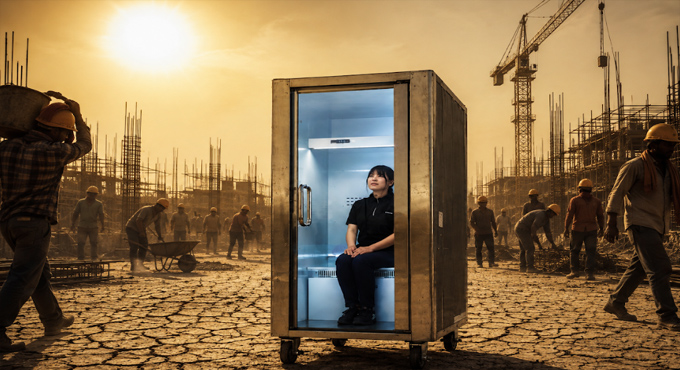
This is neither a cryo-chamber designed to freeze human beings for the future, nor an advanced medical bay from a science fiction spacecraft. It is a real, functioning appliance deployed in Japan today—a refrigerator built explicitly for humans, known as the ‘Do Hiemon Box.’
As global temperatures continue to climb, technology is evolving in unexpected directions. An appliance that was originally invented to keep food from spoiling has now been adapted to save human lives from extreme climate conditions.
Designed as a specialized cooling booth, the Do Hiemon Box resembles a oversized commercial refrigerator from the outside. However, instead of storing perishables, it accommodates individuals suffering from severe heat exhaustion. Once the door closes, the internal temperature rapidly drops to around 15 degrees Celsius, while targeted jets of 5-degree cold air focus directly on the user’s head, neck, and shoulders to swiftly mitigate the risk of heatstroke.
Engineers did not build this device to replace conventional air conditioning or serve as a leisure lounge. Instead, it was developed as an emergency intervention tool for high-risk environments—such as construction sites, steel plants, golf courses, and disaster relief centers—where workers face prolonged exposure to punishing sun.
Manufactured by Trusco Nakayama, each unit carries a price tag of approximately 1.5 million yen (around $10,000 USD). Since launching in early 2026, the company has already distributed around 200 units, including deploying several to evacuation shelters following the recent earthquake in Kumamoto.
With summer temperatures in Japan routinely surpassing 35 degrees Celsius, heatstroke risks have reached unprecedented levels. Strict workplace safety regulations introduced by local authorities have fueled a surge in demand, attracting international inquiries from countries like the United States and Germany.
Yet, the most startling aspect of this narrative is not the invention itself, but the reality that humanity now requires refrigerated boxes to survive the outdoors. We have transitioned from simply drinking water on a hot day to stepping into industrial cooling chambers to avoid physiological failure. While this scenario is currently unfolding in Japan, regions like India—which already endure extreme summers reaching 45 to 50 degrees Celsius—may soon face a similar reality.
Ultimately, history shows that refrigerators were created to preserve food. Today, they are being repurposed to sustain human life—a clear indication that while technology is adapting, the planet itself is fundamentally changing.