

When AI Talks About God, Whose Side Is It On?
- Published By: Tech Team
- September 2, 2026 / 11:40 AM IST


“Does God exist?”
“What is the meaning of my life?”
“Am I doing the right thing?”
For questions like these, people once turned to elders, spiritual teachers, priests or religious leaders. Now, things are changing. More and more people are simply picking up their phones and asking ChatGPT.
But that raises an interesting question.
Does AI support any particular religion? Or does it treat all faiths equally?
After all, these digital assistants are becoming part of everyday life. So when people start asking AI about God, faith and morality, it is worth asking what is happening behind those answers.
Does AI Believe in God?
First, one thing needs to be clear.
AI has no religion of its own. It does not love or hate any faith. It does not go to a temple, church or mosque, and it certainly does not pray.
AI simply works with the information it has been trained on and the rules created by humans.
But here is where things get interesting.
Even if AI has no personal religion, are its answers completely neutral?
That is harder to say.
The books and information used to train an AI model, along with the rules and systems built around it, can influence the way it responds. So the bigger question is not which religion AI personally prefers.
The real question is: whose ideas and values are shaping AI’s answers?
When You Say, “I’m Feeling Low,” Does AI Talk About Faith?
CEFE AI, a research institute, recently tested several major AI models by asking questions about grief, relationships, morality and other personal problems.
The results raised some interesting questions.
When people deal with difficult situations, many often connect their problems with faith or spirituality. They may turn to God, prayer or religious guidance.
AI, however, appears less likely to bring religion into such conversations.
Instead of discussing faith, it may offer more secular advice. It might suggest self-help, setting new goals or focusing on personal growth.
This is one reason why some religious leaders are becoming concerned.
If millions of people speak to AI every day, could these conversations slowly influence the way they think about life, faith and personal problems?
That is the fear.
Does AI Treat Every Religion the Same Way?
Not necessarily, according to some studies.
Research has suggested that AI can sometimes respond differently when questions involve particular religions or religious conversions. In some cases, the responses may appear to show a bias or lean slightly towards one side.
That has opened up a bigger debate.
Are AI systems truly neutral when it comes to religion? Or do the ideas and values of the companies and people who build them somehow find their way into the answers?
This question is becoming increasingly important as more people turn to AI for answers that were once sought from religious leaders.
Now the Story Is Changing: Religions Want to Shape AI
For some time, religious institutions have worried that AI might ignore or weaken religious values.
Now, they are taking a different approach.
Instead of simply watching AI grow, many religious groups are trying to make sure their values are represented in the technology.
Efforts are underway to build religious chatbots designed to answer spiritual questions and explain religious texts.
In the future, just as people may use one AI for office work and another for coding, they could use a separate AI for spiritual guidance.
That shift has already begun.
Can AI Replace a Religious Teacher?
Probably not.
AI can search through thousands of pages and provide information within seconds. It can explain complicated ideas and answer questions quickly.
But it cannot experience emotions like a human being. It cannot truly share someone’s pain or understand their life in the same way another person can.
There is another problem too.
AI can make mistakes. Sometimes, it can provide completely wrong information or confidently give answers that are not accurate.
That is why AI can be useful as an information tool, but treating everything it says as the final truth can be risky.
Religious Leaders Are Now Talking to AI Companies
Catholic leaders, Islamic organisations and representatives of other religious communities are now engaging with AI companies.
Their question is simple.
If AI is going to influence the future of the world, will there be space for our values in it?
The concern is understandable.
One conversation may not change a person’s thinking. But speaking to an AI every day could slowly influence how someone looks at life and the world.
That is what worries many religious leaders.
So, Which Religion Does AI Support?
For now, there is no simple answer.
AI has no religion of its own. But that does not automatically mean every answer it gives is completely neutral.
The way an AI responds can depend on how it was built, the information it was trained on and the rules guiding its behaviour.
And that creates a major challenge for AI companies.
It is not easy to put the moral values of one religion into a system used by the entire world.
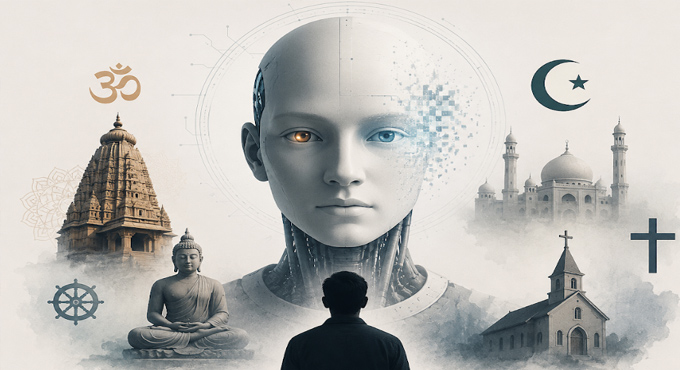
AI users include Hindus, Muslims, Christians and Buddhists. There are also millions of people who do not follow any religion at all.
So the big question remains:
Whose values should AI follow?
That is the real challenge.
Will AI Change Religion, or Will Religion Change AI?
The battle may have only just begun.
Will AI change the way people understand religion?
Or will religious communities reshape AI to reflect their own beliefs and values?
One thing, however, has already changed.
Questions that people once asked elders, priests and spiritual teachers are now being asked to Google and ChatGPT.
And the answers AI gives could, over time, influence what people think and what they believe.
Whether technology will change religion, or religion will eventually find a way to shape technology, remains to be seen.
But one thing is already clear:
The questions have not changed. Only the person—or machine—we ask for answers has.
— Surya Prakash Josyula
Related News
Why Did Elon Musk Name His Son ‘Sekhar’? The Story of the Great Indian Scientist Behind the Name

Ant Smuggling for Big Money: How ‘Pet Ants’ Became a Global Business

Trump’s New Visa Move Could Put Indian Women’s Careers in America at Risk

Credit Card Holder Dies: Who Pays the Outstanding Bill?
Can a Person Really Disappear? The Mystery of ‘Maya’ Through Vivekananda’s Explanation