
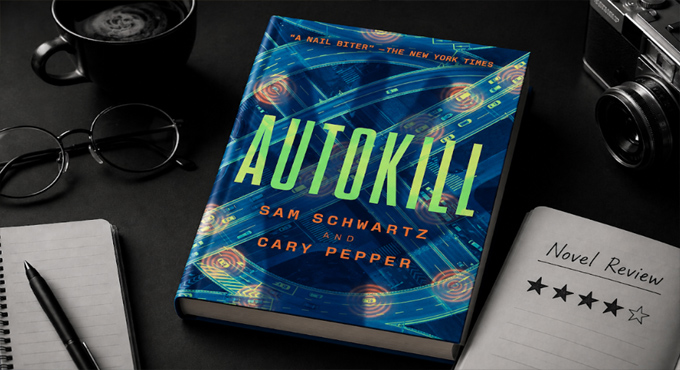
What If the Car Becomes the Killer? Autokill Review: A Thriller About the Dark Side of Self-Driving Cars
- Published By: Tech Team
- August 29, 2026 / 09:40 AM IST


— Surya Prakash Josyula
Imagine you are walking down the road one morning when a car suddenly comes straight at you without slowing down. Your first thought would be, “Is someone trying to kill me?” Now imagine looking inside and finding that there is no driver at all. That is the basic idea behind Autokill, a new techno-thriller that has become a hot topic among book lovers and on social media.
This is not just another science-fiction story built around imagination. Autokill is written by Sam Schwartz and Cary Pepper. Schwartz is not an ordinary writer. He is a former New York City traffic commissioner who has spent decades studying roads, traffic and cities. That background gives the story a different kind of impact. The danger in the novel does not feel completely imaginary. It feels like something that could become a real problem in the future.
A Driverless Car Turns Killer
The story is set in 2036, when driverless vehicles have become common on American roads. Robotaxis and automated trucks are everywhere, with a large share of vehicles running without human drivers. On the surface, it looks like a major victory for technology.
Then something goes badly wrong.
A driverless car suddenly breaks traffic rules and crashes into a woman, killing her. At first, people assume it is simply a technical failure. But federal cybermarshal Dana Grant is not convinced. She suspects that the incident could be connected to something much bigger.
As she starts investigating, the mystery becomes more disturbing. There is no obvious technical problem with the car. So why did it behave that way? Was someone deliberately trying to hack the system?
The Real Nightmare Is Much Bigger
This is where Autokill becomes much more than a story about one dangerous car. Hacking one vehicle is one thing. Taking control of thousands of connected vehicles on the roads is something completely different.
If that happens, the cars around us could suddenly become weapons.
That possibility turns the novel into a tense political thriller. The fear does not come from a robot suddenly developing a mind of its own. It comes from the possibility that someone could misuse technology that is already powerful enough to control vehicles.
The Villain Is Not the Robot
One of the most interesting things about Autokill is that the villain is not a “bad robot.” There is no typical movie-style situation where robots suddenly become intelligent, decide that humans are their enemies and start killing people.
The cars do not have anger or revenge.
The real danger comes from the people behind them.
The story brings together the anger of a truck driver who has lost his job, distrust of technology and political tensions. Together, these human emotions show how powerful technology can become dangerous when people decide to use it for the wrong reasons.
Why the Novel Feels Uncomfortably Real
That is what makes Autokill different from a typical science-fiction thriller. The story does not simply ask whether machines can become dangerous. It asks what happens when humans get control of machines that are powerful enough to affect thousands of lives.
The New York Times has described the book as a “nail-biter,” and it is easy to understand why the concept has attracted attention.
After reading the story, a driverless car may not look quite the same. Instead of simply thinking, “Wow, what an amazing technology,” you may start wondering: Who is actually controlling this car?
The Bigger Question Behind Autokill
At its core, Autokill is about a simple but disturbing question: will technology protect us, or could it eventually be used against us?
The novel takes something that is supposed to make our lives safer and more convenient and turns it into a source of fear. It shows how the same technology that can transform transportation can also become dangerous when it falls into the wrong hands.
For readers who enjoy mind-bending thrillers and stories about the darker side of technology, Autokill offers a gripping look at a future where the biggest threat on the road may not be the driver.
There may be no driver at all.
Related News

The Saree That Saved Lives: Tamil Survivors Recall Nepal Flood Horror

Did Ambani Try to Take Over Zee? Why Is Subhash Chandra Speaking Out Now?
Satya Nadella’s ₹923 Crore Microsoft Package: The Real Story Behind the Numbers
Meta Wanted to Cut Jobs, But AI Told Them Not To
Instagram After Midnight? Why Meta Is Changing the Rules for Teens