

The Pine Cone: Where Mathematics, Nature, and Spirituality Converge
- Published By: shivaduvvuru
- July 15, 2026 / 03:25 PM IST


What appears to be an ordinary pine cone is, in reality, one of nature’s most extraordinary designs. From Fibonacci spirals and the Golden Ratio to the pineal gland, Lord Shiva, and the Sri Yantra, this humble creation has inspired mathematicians, scientists, architects, philosophers, and spiritual traditions for millennia.
Nature’s Silent Geometry:
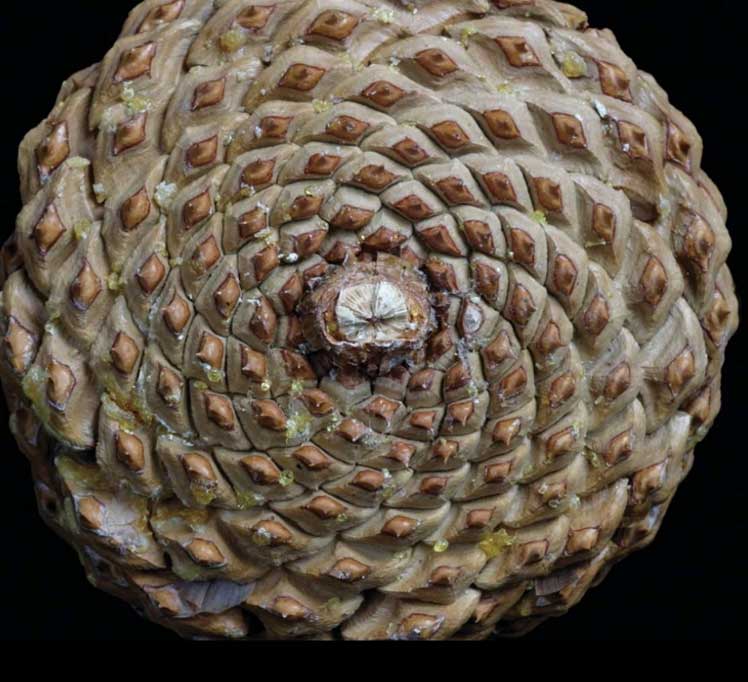
Turn a pine cone over and examine its base. The elegant spiral pattern formed by its overlapping scales is far more than a beautiful natural design it is a remarkable expression of mathematical order. For centuries, botanists, mathematicians, philosophers, and spiritual seekers have found in the pine cone a symbol of harmony between nature’s laws and humanity’s search for deeper meaning.
The Fibonacci Spiral:
The scales of a pine cone are arranged in opposing spirals that almost always correspond to consecutive Fibonacci numbers, such as 8 and 13. This pattern emerges naturally because each scale grows at approximately the Golden Angle (137.5°), producing the most efficient arrangement for growth and seed distribution.
The Golden Ratio:
Underlying this arrangement is the Golden Ratio (Φ ≈ 1.618), one of mathematics’ most celebrated proportions. From pine cones and sunflowers to galaxies, nature repeatedly employs this geometry to maximize efficiency while creating extraordinary beauty.
Science and Spirituality:
The pineal gland derives its name from its resemblance to a pine cone and has long been associated symbolically with the ‘Third Eye.’ In Indian philosophy, Lord Shiva’s conical crown of matted hair, Kundalini, and the Sri Yantra all reflect enduring traditions that connect geometry with higher consciousness. These associations belong to the rich realm of symbolism and spiritual philosophy, complementing rather than replacing the scientific understanding of the pine cone.
A Universal Symbol:
In Sanskrit, the pine tree is often referred to as Sarala. Whether appreciated through mathematics, botany, architecture, or spirituality, the pine cone reminds us that nature’s simplest creations often reveal its deepest principles. It is a quiet masterpiece—one that continues to inspire scientists, artists, architects, and seekers across cultures.