
The Mystery of the 300 Verses: Ganapati Muni’s Pen or Ramana Maharshi’s Silence?
- Published By: techteam
- August 7, 2026 / 03:15 PM IST


—By Surya Prakash Josyula
Some events in history are difficult to explain. You cannot fully believe them, yet you cannot simply dismiss them either. That is because the people behind these stories were far from ordinary.
One such event is the completion of the Uma Sahasram.
The story begins with a simple but fascinating question. If one person’s mind suddenly stops creating, can another person’s silent presence make it flow again? In India’s spiritual history, this is one of the most remarkable stories connected to that question.
Kavyakantha Ganapati Muni was one of the greatest Sanskrit scholars and poets of his time. People who knew him often said that he never searched for words. Instead, words seemed to come to him naturally.
He decided to compose Uma Sahasram, a collection of one thousand verses in praise of Goddess Uma. For Ganapati Muni, it was much more than a literary work. It was the highest expression of his devotion, his spiritual practice, and his extraordinary poetic gift.
He even promised that the work would be completed and offered on a particular day.
Everything went smoothly in the beginning. The verses flowed effortlessly, and he completed the first 700 verses without difficulty. Then, unexpectedly, the flow stopped.
Days passed. The promised date was getting closer, but the remaining 300 verses simply would not come. No matter how hard he tried, he could not compose even one more verse.
For an ordinary writer, this might be called writer’s block. But for a poet who had spent his entire life immersed in Sanskrit literature, it was something far more unusual.
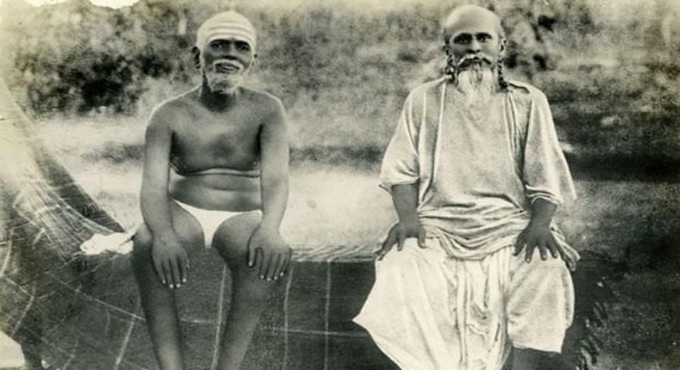
During this difficult period, Ganapati Muni sat in the presence of Bhagavan Ramana Maharshi at Arunachala. Ramana Maharshi did not give a discourse. He did not chant a mantra or offer any advice. He simply remained silent.
It is at this point that the story moves from history into mystery.
After some time, Ganapati Muni suddenly entered a state of inspiration and began dictating verses continuously. The words flowed without hesitation, without pauses, and without any visible effort.
According to traditional accounts, the dictation moved so rapidly that several scribes had to write at the same time to keep up with him.
When the final verse was completed, Ramana Maharshi quietly asked a single question:
“Has everything been written down?”
Ganapati Muni simply replied:
“Yes.”
But the story did not end there.
Later, Ganapati Muni is said to have remarked that those final 300 verses did not come from his ordinary intellect. He believed they had flowed through Bhagavan’s grace, a view recorded in publications associated with Sri Ramanasramam.
This is where the story takes on two different meanings.
For devotees, it is a powerful example of the Guru’s grace—a moment when a higher consciousness expressed itself through a disciple.
For historians and scholars, it is an extraordinary spiritual experience preserved in early accounts and biographies.
Whether one accepts it as a miracle or as a deeply transformative spiritual experience depends entirely on one’s perspective.
However, one fact remains undisputed. A work that had stopped at 700 verses was completed as a 1,000-verse masterpiece within a remarkably short time.
That masterpiece is known today as Uma Sahasram.
This is why many devotees consider the episode one of the defining moments in the spiritual relationship between Ramana Maharshi and Ganapati Muni. They believe the transformation happened not through spoken words, but through silence itself.
History remembers many teachers who inspired through speeches and many saints who were believed to perform miracles. Yet very few are remembered for changing another person’s creative flow without uttering a single word.
Perhaps that is why this story continues to inspire curiosity even today.
Did Ganapati Muni write those final 300 verses? Or did something greater flow through him?
History does not offer a final answer. Each reader must find one through their own understanding—and perhaps, through their own faith.
Related News
Moon Factory Before Humans? Elon Musk’s Bold Vision Explained

The Visa Story: Read Between the Lines of Mass Layoffs and AI Deals

Why Did Disney Finally Turn to TikTok? The Real Story Behind This Surprise Deal

No US Citizenship Even If a Baby Is Born in America? Is Trump Trying to Change the Rules?

Has the Pressure on Varun Tej Really Reduced? The Numbers Tell a Different Story