
Moon Factory Before Humans? Elon Musk’s Bold Vision Explained
- Published By: Tech Team
- August 7, 2026 / 11:30 AM IST


—Surya Prakash Josyula
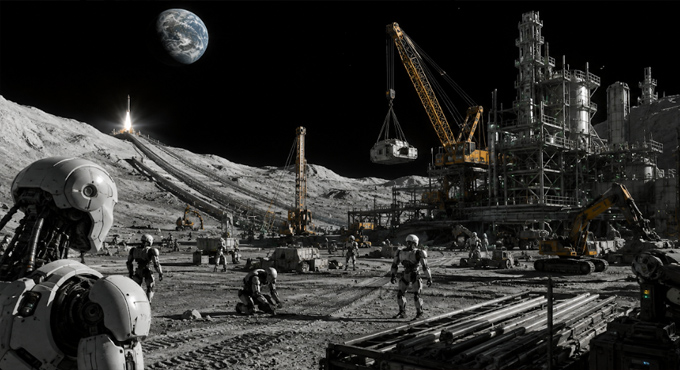
The Sun rises slowly over the Moon.
Against the pitch-black sky, Earth hangs in the distance like a glowing blue marble.
Giant cranes move across the silent lunar landscape. Sparks fly as towering steel structures rise from the gray surface. Nearby, hundreds of humanoid robots work without stopping. No one gives them orders. No one speaks. Yet the entire construction site operates with perfect precision, like a single intelligent machine.
Moments later, a metal cargo container races along a massive electromagnetic track and shoots into space—without a rocket.
There isn’t a single human watching.
Because humans haven’t even arrived on the Moon yet.
It sounds like the final scene of a Christopher Nolan or Denis Villeneuve science-fiction film. But this is remarkably close to the future Elon Musk is imagining. His vision is to send robots first, build factories on the Moon, and only then send human settlers.
For decades, landing on the Moon was humanity’s biggest dream. Now, SpaceX wants to take the next step—not just visiting the Moon, but building an industrial base there. That raises some fascinating questions. Why build factories on the Moon? What would they produce? And why send robots before astronauts?
During SpaceX’s first public earnings call, Elon Musk shared this ambitious vision. He believes that before humans can live and work on the Moon, they will need roads, power systems, industrial facilities, and other basic infrastructure. Instead of asking astronauts to build all of that, autonomous robots could do the job first.
These robots would construct factories, install power systems, maintain equipment, and even process lunar resources. By handling dangerous and repetitive work, they could greatly reduce the risks faced by future human crews.
Another idea Musk discussed is a mass accelerator—a giant electromagnetic launch system that could send cargo from the Moon into space without traditional rockets. Powered mainly by solar energy, such a system could dramatically reduce the cost of transporting materials beyond the Moon. Robots, Musk says, would also build and maintain this enormous infrastructure.
Musk admitted that the idea “sounds totally crazy today.” But he believes it will eventually become reality. If industries are established on the Moon, he argues, humanity’s economy could one day become hundreds or even a thousand times larger than it is today.
SpaceX has not yet revealed whether Tesla’s Optimus humanoid robots would be used for these missions or whether an entirely new generation of lunar robots would be developed. The company also has not announced a timeline or estimated cost for the project.
For now, the Moon factory remains a vision rather than a construction project.
Still, history has a way of turning impossible ideas into everyday reality. Once, simply landing a human on the Moon seemed impossible. Today, the conversation has moved far beyond footprints. Elon Musk is talking about factories, robots, and a future where the Moon is not just a destination for exploration—but the first industrial outpost beyond Earth.