

The AI Boom Is Giving China’s Communist Party a Problem It Can’t Ignore
- Published By: Tech Team
- August 12, 2026 / 06:15 PM IST


— Surya Prakash Josyula
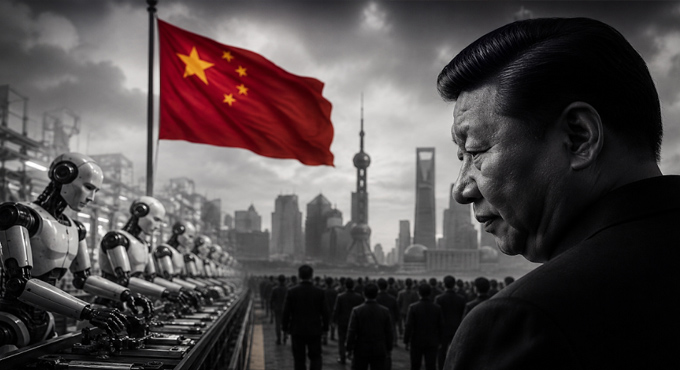
China’s government is facing a strange situation with AI. On one side, it has to compete with its rival, the United States. It wants to stay ahead in the global AI race, increase productivity in industries and use technology to deal with the country’s shrinking workforce. That is why Beijing is giving strong support to AI.
But at the same time, the rapid growth of AI could create a new problem for the Communist Party itself. The biggest concern is what could happen if AI starts taking away large numbers of jobs from ordinary workers. This is becoming one of the biggest dilemmas facing China. So, what exactly is happening? And what is the real problem behind China’s AI push?
China has been strongly supporting AI companies for some time. It is rapidly expanding infrastructure, from advanced chips to data centres. Now it is also moving quickly to bring humanoid robots into real workplaces. China wants more than 10,000 commercial humanoid robots to be working across more than 100 industries by the end of 2026.
Chinese AI models are also getting closer to American models. China is moving fast with cheaper open-weight AI models. Instead of keeping AI inside research labs, the government wants to take it directly into factories, businesses and other industries.
From the outside, this looks like a major strength for China.
But for the Communist Party, the same success could eventually create a new problem.
What happens if AI becomes too successful?
What if AI develops much faster than expected?
What if companies can run their businesses with hundreds of AI systems and robots instead of thousands of workers?
What if trucks no longer need two drivers?
What if a few humanoid robots can do the work that once required hundreds of warehouse workers?
And what if AI and robots reduce the need for workers across many industries?
Then the real problem will not be AI itself.
The real problem will be the people who lose their jobs because of AI.
This is where China faces a very different challenge compared with many other countries.
China is not just another capitalist economy. It is a Communist state that has long placed workers, social stability and public welfare at the centre of its political system.
So, if AI leads to a major fall in employment, it will not simply be another number in an unemployment report.
It could become a political problem for the government.
China needs AI. But what will it do with the workers it replaces?
This is where China’s problem becomes particularly interesting.
China’s working-age population is expected to fall by around 25% by 2050. That means the country will have fewer workers in the future.
So China needs automation.
It needs robots.
It needs AI.
So far, the logic is simple.
But AI can do something more than just make workers more productive.
In some industries, it can reduce the need for workers altogether.
That is the real paradox.
China is bringing in technology to solve one problem — a shrinking workforce.
But the same technology could create another problem — too many people competing for too few jobs.
Is the impact already beginning to appear?
There is still no evidence that AI has suddenly wiped out millions of jobs across China or the world. But changes are already visible in some sectors.
Take driverless taxis, for example.
The rapid expansion of autonomous taxis in Wuhan has put pressure on the earnings of human taxi drivers, according to reports. When technical problems affected some autonomous taxi services in 2026, demand for traditional taxis increased again.
For a moment, the situation almost turned into a strange reminder of the old world.
When the technology works, the need for human workers falls. When the technology fails, humans become necessary again.
That may not sound like a major issue today.
But what happens when the technology becomes much better and much more reliable?
That is the question China will eventually have to answer.
What if workers start becoming angry?
This is where the political side of the story begins.
Imagine a factory introducing automation and 100 workers losing their jobs.
Some may find new jobs.
Some may move into the gig economy.
Others may not find work at all.
If this happens in one factory, it may not create a major crisis.
But what if the same thing happens in thousands of factories?
What if AI and robotics reduce the demand for workers across manufacturing, transport, warehouses, entertainment and other industries?
Then this would no longer be just an individual unemployment problem.
It could become a question about the future of an entire section of society.
And that is where economic dissatisfaction could potentially turn into a political issue.
This is why the subject is particularly sensitive for the Chinese government.
Social stability is one of the most important priorities of China’s political system. The government has a strong interest in preventing public dissatisfaction from growing into a larger social problem.
So Beijing cannot look at AI-driven job losses as just an economic issue.
It is also a stability issue.
China knows the problem is coming
This is why China is now paying closer attention to the employment impact of AI.
Its 2026–2030 employment blueprint includes the need to track how AI is creating jobs and how it may destroy or reduce existing jobs.
That does not mean Beijing has found a solution.
It means the government can already see the problem coming.
And this is not a normal unemployment problem.
China needs AI to deal with a shrinking workforce and to compete with the United States.
But if AI becomes extremely powerful, it could also reduce the need for the very workers the Communist Party has historically claimed to represent.
That is the real dilemma.
China wants AI to make its economy stronger.
It wants robots to fill the gap left by a shrinking workforce.
It wants to win the global AI race.
But if that race moves too fast, the government may eventually have to answer a much harder question:
If the machines can do the work, what happens to the people who can no longer find work?
And for Communist China, that question could become much bigger than an economic problem.
It could become a problem at the very core of the political system.