Is the Secret of Human Speech Hidden in a Bird’s Song?
- Published By: Tech Team
- August 8, 2026 / 10:00 AM IST


—Surya Prakash Josyula
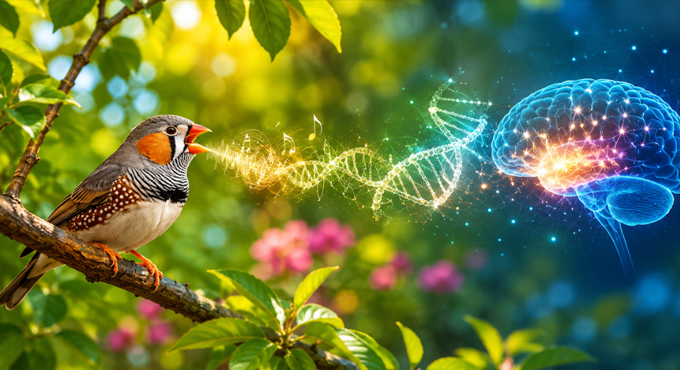
Could a bird’s song hold a small clue to how human speech began?
The answer may not be heard in the song itself. It could be written deep inside the bird’s DNA. And scientists are now trying to understand what that hidden code can tell us.
Imagine a bird sitting on a tree and singing.
To us, it may sound like nothing more than a pleasant chirping sound. But behind that song is a fascinating scientific mystery.
A human learns to speak.
A bird learns to sing.
They may seem completely different. One has a human brain. The other has the brain of a tiny bird.
But scientists are asking an interesting question:
Are both using a similar process — listening, remembering, learning and repeating sounds?
And if they are, how does that process work?
To find answers, researchers at Rockefeller University have completely mapped the genome of the zebra finch, a small songbird.
The researchers discovered 2,710 genes that had not been identified before. They also added nearly 90 million DNA base pairs that were missing from earlier versions of the bird’s genome.
For the first time, even the bird’s smallest chromosomes have been mapped in detail.
So, what does this have to do with humans?
This is the most interesting part of the research.
A zebra finch does not simply make sounds. It listens to other birds, remembers their sounds, learns them and practices until it develops its own song.
Humans also learn language in a similar way.
A child listens to adults speaking. The child remembers those sounds and then tries to repeat them.
In both cases, processes such as listening, remembering, learning and copying sounds are involved.
That is why scientists can now study the bird’s DNA in much greater detail.
They can ask:
Which genes are involved in learning sounds? How do those genes work in the brain?
Finding answers could eventually help scientists understand more about how the human brain learns language and speech.
It could also open new research into some human conditions involving speech and language. But this does not mean that a new medicine or treatment has been discovered today.
The research has mainly provided scientists with a much more complete genetic map that can be used for future studies.
Can we now understand what the bird is saying?
Not yet.
This research has not decoded the meaning of the bird’s song into human language.
Scientists cannot yet say, “This particular sound means this.”
But they now have a much better way to study another important question:
How does a bird learn its song in the first place?
And that may be the real importance of this discovery.
We do not always have to study humans directly to understand something about ourselves.
Sometimes, a tiny bird can provide an important clue.
By completely reading the DNA of a songbird, scientists may get new evidence about how the brain learns, how speech develops and perhaps even how the ability to communicate through speech evolved in the first place.
The bird may not be telling us the meaning of its song yet.
But somewhere inside its DNA, there could be a clue to a much bigger mystery:
How did we learn to speak?