
India’s New Digital Debt Trap: Are You Already Caught in It?
- Published By: techteam
- August 8, 2026 / 09:00 AM IST


— Surya Prakash Josyula
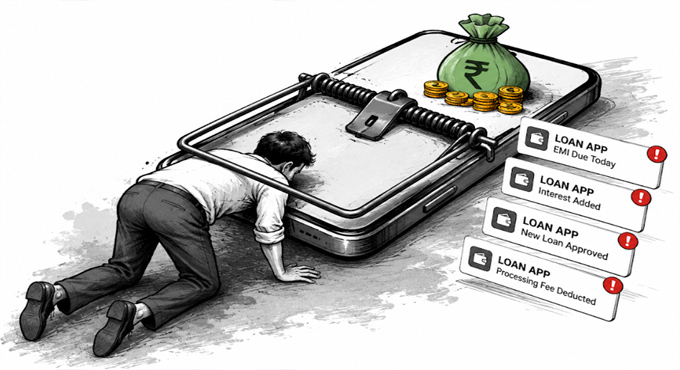
Once, people borrowed money to buy something they needed. A house, a vehicle, an education or perhaps to deal with an emergency. Today, something more troubling is happening. People are increasingly taking one loan to repay another.
Think of a middle-class employee on the first day of the month. The salary arrives, and for a moment there is relief. Then the deductions begin. One EMI goes out. Another loan app sends a reminder. A third payment is due.
By the time the first ten days are over, much of the salary may already be gone. But the month is still young. Rent, groceries, school fees, travel and other household expenses cannot wait.
That is when another loan app enters the picture.
A few clicks later, the money is in the bank account. The immediate problem appears to be solved. But in reality, a new problem has just begun.
The moment a person takes a new loan to repay an old one, borrowing stops being a financial solution and becomes a cycle.
That cycle is now becoming one of the more worrying side effects of India’s digital lending boom.
Borrowing Has Never Been This Easy
Taking a loan is not new. What has changed is how quickly and easily people can access credit.
Earlier, borrowing from a bank meant paperwork, documentation, credit checks and waiting for approval. Today, a smartphone can bring the same basic promise of money within minutes.
That convenience has clear benefits. Someone facing an emergency does not have to wait for days to access a small amount of money.
But there is another side to this convenience.
When borrowing becomes almost as easy as ordering something online, the decision to borrow can happen before the borrower has fully considered the consequences.
This is particularly important when the loans are small, short-term and expensive.
India’s Household Debt Is Rising
The broader numbers show why this deserves attention. India’s household debt-to-GDP ratio rose from around 38% before the pandemic to about 48% by December 2025.
The concern is not simply that households are borrowing more. It is also about why they are borrowing.
A significant share of non-housing credit is being used for consumption rather than for buying productive assets. In other words, some families are increasingly using borrowed money to manage everyday life rather than to build wealth.
Digital lenders have moved quickly into this gap.
India’s digital lending market has grown about 2.5 times in three years and is now estimated at around $23 billion a year. During the last financial year, fintech platforms sanctioned more than 130 million small loans, with an average loan size of roughly ₹16,000.
₹16,000 may look modest on paper. For a household living on a tight monthly budget, however, it can be the difference between getting through the month and falling behind on a payment.
The Interest Rate Is Only Part of the Story
A loan app may advertise an annual interest rate of 36%. But that number does not always tell the borrower what the loan will actually cost.
Processing fees, penalties and other charges can add substantially to the final repayment burden. A Moneylife Foundation study of distressed borrowers found cases where the effective annual cost of digital borrowing reached 365% or more.
But even high interest rates are not the most dangerous part of the story.
The real problem begins when one loan is used to pay another.
A borrower takes a second loan to clear the first EMI. When the second payment becomes due, another app is used. The individual loans may appear small, but together they can create a debt burden that becomes almost impossible to escape.
Some cases examined by Moneylife involved borrowers carrying 15 to 30 active loans at the same time.
At that point, a person is no longer simply borrowing for an emergency.
A large part of the person’s future income has already been committed to the past.
When ₹100 of Income Needs ₹200 for Debt
The scale of the problem becomes clearer in individual cases.
Moneylife Foundation examined 13 distressed borrower cases. In 11 of them, monthly debt payments were higher than the borrower’s income. The median debt-service ratio was around 200% of income.
Think about what that means.
A family earns ₹100, but its monthly debt obligations require ₹200.
The missing ₹100 does not magically appear.
In many cases, it comes from another loan.
This is why the digital debt problem cannot be viewed simply as a story about irresponsible borrowers or aggressive lending apps. Behind it are bigger economic pressures — stagnant incomes, rising living costs, uncertain employment and inadequate household savings.
The loan app may be the doorway. The financial pressure already exists on the other side.
India Doesn’t Just Need More Credit
The answer is not to stop digital lending altogether. Small loans can be extremely useful when people face genuine emergencies.
The bigger question is how to prevent useful credit from turning into chronic debt.
There is a strong case for limits on the number of digital loans a person can hold, tighter controls on the total cost of borrowing and real-time reporting of digital loans to credit bureaus.
People who are already deeply trapped in debt also need a practical legal route to get a fresh start.
But regulation alone will not solve the deeper problem.
India also needs to make saving as easy as borrowing.
Digital payments have made moving money almost effortless. Digital lending has made accessing credit remarkably fast. The next challenge should be making small, regular savings just as simple.
If borrowing can happen in three clicks, why shouldn’t saving ₹20 or ₹500 happen just as easily?
That shift would change the role of fintech itself. Instead of simply helping people bring tomorrow’s money into today, technology could help them move a small part of today’s income into tomorrow.
Because the financial strength of a household cannot be judged only by how much credit it can access.
The more important question is what remains after the EMIs are paid.
How much money is still there for the family?
And how much of the next month’s salary has already been spent?
That is the real warning behind India’s digital lending boom.
The danger is not that Indians can borrow money more easily than ever. The danger is that they may slowly reach a point where their future income already belongs to their past debts.
Related News
Your Instagram Video Could Be Removed in Just 2 Hours!

Farmers Vs Lay’s Chips Case Reaches Supreme Court… What Exactly Happened?

Is the Secret of Human Speech Hidden in a Bird’s Song?

FSSAI Penalises Fortune Oil Maker After Vitamin Levels Fall Below Standards

The Mystery of the 300 Verses: Ganapati Muni’s Pen or Ramana Maharshi’s Silence?