

Hundreds of Years-Old Human Remains Are Being Sold Online! What Are Buyers Doing With Them?
- Published By: Tech Team
- August 12, 2026 / 11:15 AM IST


— Surya Prakash Josyula
A human body that belonged to someone who died hundreds of years ago. Dried hands, shrunken feet and a head with hair still attached. In some cases, even an entire mummy.
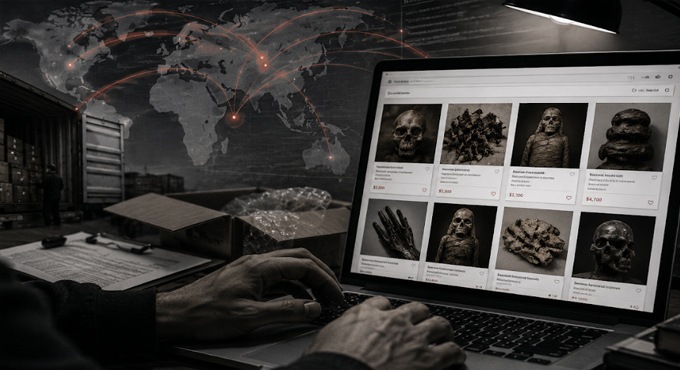
Once, such remains were mainly studied as part of archaeology and history. But now, mummified human remains are being sold online through social media, e-commerce platforms, personal websites and auction houses. A secretive market for human remains is slowly growing.
So, who is buying these centuries-old remains? Why are they buying them? And what are they actually doing with them?
What Do People Do With Them?
Many buyers purchase these remains as rare historical objects. Some keep them in private collections, while others display them at home. Some are also sold again through online auctions.
Researchers examined 128 online posts and found mummified hands and feet among the most common items. But the more disturbing finding was that 51.6% of the listings involved heads, skulls, or human heads with hair and soft tissue.
In other words, a body that once belonged to a living person is now becoming a collector’s item. But scientists say there could be a serious danger hidden behind this unusual trade.
Can They Still Be Dangerous After Hundreds of Years?
This is where the story becomes worrying. During the mummification process, different chemicals were used to slow down the decay of the body. In some cases, heavy metals such as arsenic, mercury and lead were also used.
At the same time, some microorganisms may survive in dried human remains for centuries. This includes fungal spores that can remain dormant for long periods. When the remains are moved or disturbed, these spores could become airborne.
That means the person handling the remains may not be the only one at risk. People in the same room could also be exposed to them.
Is This the Real “Mummy’s Curse”?
Stories about people dying after disturbing ancient mummy tombs have existed for centuries. The death of Lord Carnarvon after the opening of Tutankhamun’s tomb added even more fuel to the famous “Mummy’s Curse” story.
But scientists are more interested in a possible natural explanation than a supernatural one. One concern is infection from fungal spores such as Aspergillus.
When the tomb of King Casimir IV was opened in Kraków, Poland, 10 of the 12 conservation scientists involved later died. The research says exposure to Aspergillus spores may have played a role.
So, even if there is no supernatural curse, a mummy can still be dangerous.
And What About Courier Workers?
This is where the story becomes even more worrying. Mummified human remains are also being transported through postal and courier services.
The people packing the remains may know what is inside. The buyer certainly knows. But what about the people in between?
Warehouse workers, delivery drivers, transport hub workers and customs officials may have no idea that a package contains human remains. They could handle such packages without the protective equipment needed for potentially hazardous material.
Researchers also found photographs of badly deteriorated mummified remains displayed without glass protection inside ordinary homes. Something that may require careful preservation in a museum could be sitting on someone’s shelf at home.
So, Who Is Really Cursed?
Is there really a curse attached to mummies? There is no scientific evidence for a supernatural curse. But buying and selling centuries-old human remains without proper safety measures can create real risks.
The danger may not come from some mysterious power of the mummy. It may come from turning a human body into a collector’s item and ignoring what could still be hidden inside it.
Researchers have described this as “The Real Mummy’s Curse.”
The real curse may not be something supernatural. It may simply be what happens when human history is turned into a commodity and its risks are ignored.
If there is a curse, it may not come from the mummy.
It may come from our own carelessness.