
From ISRO Resignations to $1.1B Unicorn: How Two Telugu Engineers Built India’s SpaceX
- Published By: Tech Team
- July 23, 2026 / 08:25 AM IST


— Surya Prakash Josyula
“Get a government job, and your life is set…”
This is a statement echoing across Telugu households for generations. Millions of young men and women work tirelessly for years just to secure that one job. And if that job happens to be in a prestigious organization like ISRO, it is celebrated as the ultimate success in life. But two Telugu youths thought differently. They walked away from those very jobs. With a single decision, they set aside a secure future, a steady monthly salary, and societal respect.
Back then, many looked at them, laughed, and dismissed their choice as “foolishness and youthful reckless thinking.” They were lectured. But exactly eight years later, the situation turned upside down. Indian Prime Minister Narendra Modi personally phoned to warmly congratulate both of them. Because the success they achieved was of that stature. What did they achieve? And who are they?
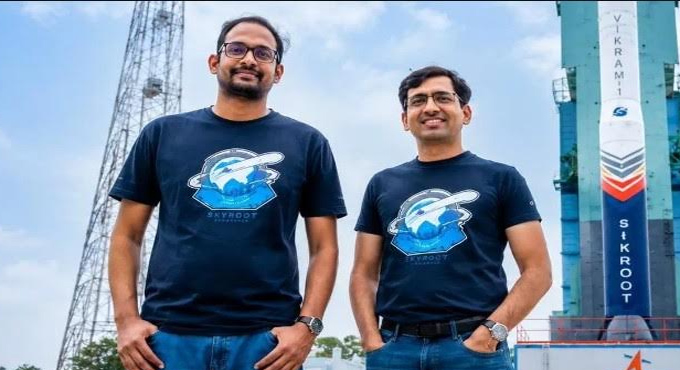
Those two trailblazers are Pawan Kumar Chandana and Naga Bharath Daka. Their achievement: entering the private space sector and placing India alongside global giants like the United States and China. Space itself is beyond the imagination of common people, so achieving success at this scale is no small feat. That is why the whole world is looking at these young men today. However, this success did not come overnight or from a single thought. Behind it lay immense hard work, countless sleepless nights, and above all, meticulous planning.
When the Dream Became Bigger Than Fear…
During their days working at ISRO, Pawan and Bharath said one single question haunted them every day: “India has an exceptional organization like ISRO… but why don’t we have a world-class private space company in our country?” It sounds like a simple question, but its answer was as vast as the universe.
Because at that time, India had no clear regulations for private rocket manufacturing. It was uncertain whether investors would trust them enough to invest a single rupee. And if an experiment failed, they would end up on the street, forced to restart life from zero. As you can see… the real villain in this story was ‘fear’. But they did not surrender to that fear. With sheer determination, they founded ‘Skyroot Aerospace’ based out of Hyderabad.
Starting as a startup with a small office and a few employees, it has grown today into India’s first space-tech unicorn, valued at ₹9,000 crores ($1.1 Billion).
Once Employees… Now with Their Own Rocket!
There is another remarkable highlight to share here. A few years ago, Pawan and Bharath watched rocket launches at the Sriharikota launch center as ISRO employees. This time, they returned to the very same Sriharikota with ‘Vikram-1’, a rocket built by their own company. And they succeeded.
As the rocket engines fired on the launch pad and smoke engulfed the area, Vikram-1 soared into the sky for 16 minutes—answering seven years of hard work. The moment the rocket successfully entered Earth’s orbit, a new record was scripted in India’s private space exploration history.
A few facts in this achievement astonished the world. Elon Musk’s ‘SpaceX’, which dominates the space sector today, succeeded on its 4th attempt to send its first rocket into orbit. Skyroot, on the other hand, achieved 100% success on its very first attempt.
Now comes another surprising fact: 95% of the team members who worked day and night for this mission had no prior rocket launch experience. Their average age was just 28 years. Don’t brush this off lightly—we all see every day how most people at that age spend their lives enjoying themselves.
What Is Their Concept?
Until now, if a small satellite needed to be sent into space, one had to wait for months or years until space became available on a large rocket. Skyroot is changing this very approach. They introduced a concept that makes ‘launching a satellite as easy as booking a cab’.
“You don’t wait for months for a train or bus to travel somewhere; you simply book an Ola or Uber cab. What we are doing in the space sector is precisely that kind of service,” clarified CEO Pawan Kumar. Skyroot is making plans to manufacture one rocket per month at their Hyderabad plant, allowing clients to directly book a launch as soon as their satellite is ready in the future. That is what you call vision.
Humility That Remembers Its Roots
Despite achieving such monumental success, Pawan and Bharath did not forget their roots. Inside the Vikram-1 rocket, they sent miniature statues of India’s space pioneers—Dr. Vikram Sarabhai, Dr. A.P.J. Abdul Kalam, and Nobel laureate Sir C.V. Raman—to pay homage. They recalled, “If we are standing at this height today… it is because we are standing on the shoulders of those great scientists who came before us.”
Conclusion
History has a peculiar habit.
What appears to be a crazy idea today… it writes down as history tomorrow.
The story of Pawan Kumar Chandana and Naga Bharath Daka is just like that.
They are the space powers… the Telugu boys who soared into space!