
From Battlefield to Business: How a War-Born Legend Turned into a Massive Bilateral Deal for India
- Published By: Tech Team
- July 8, 2026 / 01:27 PM IST


By Surya Prakash Josyula
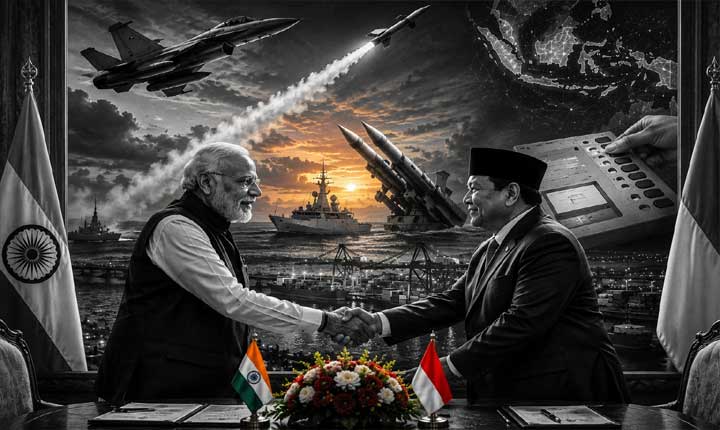
The heavy wooden door closed slowly, casting an immediate silence over the room. Outside, camera flashes continued to blink, the Guard of Honour had just concluded, and the global media waited with bated breath. But inside that room, away from the lenses, there were no words only three files resting on the table. The first file read ASTRA in bold letters; the second read BRAHMOS; and the third, EVM.
As each file opened and signatures were inked, they appeared to be three entirely different agreements. Yet, an invisible thread connected them all a thread that was woven on the battlefield just a year ago.
Suddenly, an Indian missile tore through the sky like a streak of fire, neutralizing its target within seconds. The echo of that explosion did not stop at the borders; it resonated deeply within the strategic calculations of nations thousands of miles away. It is precisely why a foreign nation has not just asked India for missiles today, but has also sought its election-management technology and a partnership in securing critical maritime routes. How did a nation that once looked to the world to purchase weapons reach a stage where global powers knock on its door, seeking its technology, missiles, and partnership? To find the answer, one must trace the story back not to the meeting behind closed doors in Jakarta but to the inception of Operation Sindoor.
Operation Sindoor was the definitive moment that turned global attention toward Indian defense technology. It demonstrated more than just missile capabilities; it served as a clear signal of how rapidly India’s defense sector was evolving. Indonesia took note of this very signal. Consequently, during the bilateral meeting in Jakarta, one of the primary discussions centered on the Astra air-to-air missiles. Impressed by India’s operational success during Operation Sindoor, Indonesia decided to import these advanced systems.
Yet, that was not even the biggest development of the summit. Indonesia did not merely look for new weaponry; it also chose to significantly expand its existing BrahMos missile inventory, with India setting the stage to supply additional missile batteries. For a single nation to show such immense trust in two distinct Indian missile systems during a single meeting speaks volumes about India’s growing strategic credibility.
However, the third file on the table was yet to be unraveled, bearing three letters: EVM. Buying missiles is a transaction of defense, but a nation choosing to adopt another country’s election management system belongs to an entirely different realm of trust. Recognizing India’s unparalleled expertise in handling massive democratic exercises, India will support the development of Indonesia-specific Electronic Voting Machines. This marks a paradigm shift where India is no longer just exporting security tech, but also its robust democratic infrastructure.
The narrative extended even further as a map was unfurled across the table, highlighting the Strait of Malacca one of the world’s most critical maritime trade routes. Directly facing it sat Sabang Port, located just over a hundred miles from India’s ambitious Great Nicobar port project. In a major geopolitical move, the two nations decided to jointly develop Sabang Port, an initiative that firmly strengthens India’s strategic footprint in the Indian Ocean.
The discussions culminated in the highly competitive sector of critical minerals. India agreed to invest in the manufacturing of steel, nickel, and rare earth permanent magnets within Indonesia. Crucial for everything from electric vehicles to advanced defense systems, this partnership is bound to secure the supply chains for both nations.
As the meeting concluded, the three files were closed, and the heavy wooden doors reopened to the waiting media. Prime Minister Narendra Modi and Indonesian President Prabowo Subianto walked out with warm smiles, offering the world a glimpse of a standard handshake. But what emerged from that room was much more than a set of bilateral agreements; it was a brand-new definition of India’s global standing.
A nation that once imported weapons from the world is now being approached by global peers for its indigenous missiles. A nation that once studied global models to strengthen its own democracy is now sharing its electoral technology with the world. A nation whose maritime security was once influenced by external powers now commands a seat at the table determining the future of global sea lanes. What the world witnessed in Jakarta was the unfolding of India’s new legacy a phenomenal transition from the battlefield to global business.