Digital Crime Wave: Investigation Reveals Social Media Gateways Driving Traffic to AI Abuse Tools
- Published By: Tech Team
- July 16, 2026 / 12:33 PM IST


— Surya Prakash Josyula
What is the most precious photograph in your life?
Is it your wedding picture? Your child’s birthday photo? Or perhaps the last photo you took with your mother?
To you, they are memories. But to AI, they are products.
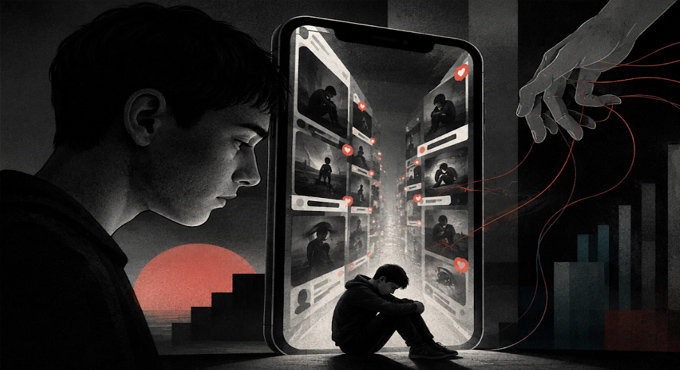
A recent report warns that a photo you lovingly posted on social media can be taken by someone without your permission, converted into a fake obscene image, and used to generate revenue. This exploitation has evolved into a global digital market worth hundreds of crores of rupees.
One photo, one click. Money for the perpetrator, lifelong mental agony for the victim. This is the dark reality of the AI ‘Nudify’ market that is currently alarming the world.
Starting at Just ₹100: A ₹300-Crore Industry
Researchers reveal that certain websites charge as little as one dollar (approximately ₹80 to ₹100) to convert a standard photograph into a fake obscene image using AI. Due to these low prices, the demand for such services is rising rapidly.
Another investigation exposes the massive scale of the business behind this technology. Leading Nudify platforms collectively generate an estimated annual revenue of up to 36 million dollars (well over ₹300 crores). This means a highly profitable digital industry has formed entirely around the unauthorized misuse of human photographs.
Where Are the Customers of This Market Coming From?
According to a report released by the Institute for Strategic Dialogue (ISD), these Nudify websites recorded over 5.7 million visits from social media platforms in just a four-month period between December 2025 and March 2026.
The most concerning finding in the report is that YouTube alone directed 1.82 million visits to these websites. The study identified that users reached these platforms through video reviews of these tools and the links provided beneath them. Similarly, X (formerly Twitter) accounted for over 1.3 million visits.
The ISD noted that while these major social media platforms do not generate these images directly, they have served as pathways for users to discover and access these tools. The report criticized YouTube, stating that despite having policies that prohibit such content, enforcement is not consistently effective across all cases.
How Do Personal Photos Enter This Market?
Many people assume that a phone must be hacked for such incidents to occur. However, security experts point out a different reality. In most cases, it is the photos publicly visible on social media that are vulnerable to misuse.
When the pictures we share on platforms like Facebook, Instagram, X, and LinkedIn are set to public view, downloading or collecting them becomes very easy. Cyber security experts warn that perpetrators can then alter these images without authorization using AI tools to create fake explicit content.
Beyond Obscene Content: A Tool for Exploitation
The motives behind using these tools are even more alarming, according to the ISD report. The study states that this technology is being misused for targeted harassment, such as seeking revenge against current or former partners, blackmailing individuals, damaging employment opportunities, and destroying personal reputations.
Therefore, this is no longer just a problem of explicit online content. It has become a severe digital crime that inflicts a heavy toll on personal lives, mental health, and social standing.
How to Protect Your Photos
Adjust Account Settings: Keep your Facebook, Instagram, and other social media accounts private instead of public.
Protect Children’s Privacy: Think twice before posting pictures of children in public forums.
Restrict App Access: Avoid granting photo gallery access to untrusted or unknown AI photo editing applications.
Be Mindful of Sharing: Do not share photographs containing personal details openly with everyone.
Conclusion
The most tragic element of this situation is not the AI technology itself, but the reality that personal memories are being turned into a commercial commodity for strangers.
Consequently, the next time you post a photograph on social media, do not just ask, “How many likes will this photo get?” Take a moment to also consider, “What if this photo falls into the wrong hands?”